
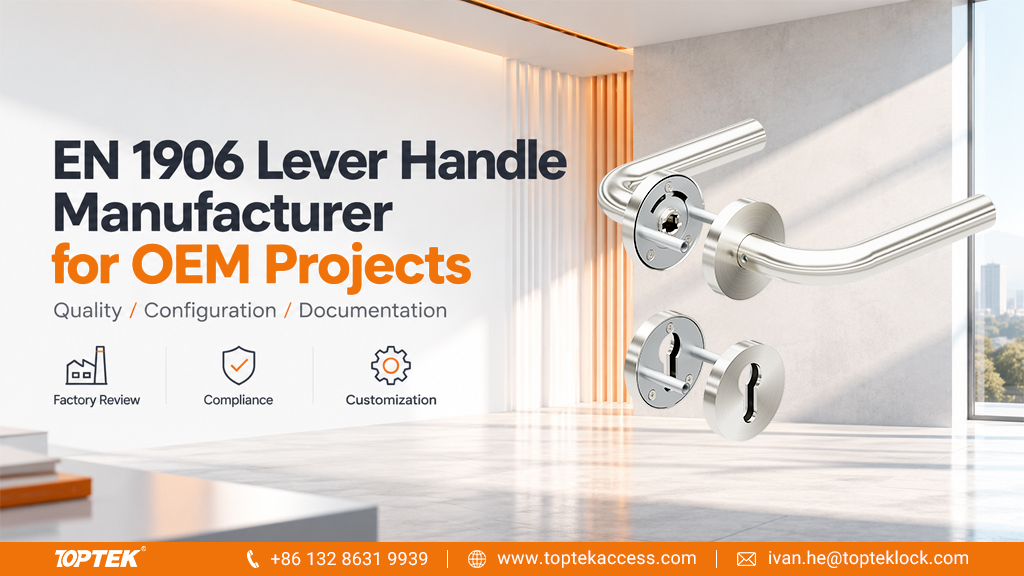

Choosing an EN 1906 lever handle manufacturer is a decision about the complete product you will sell or install: how it operates, how it fits the door and how consistently it can be supplied. TOPTEK manufactures commercial door hardware and supports OEM/ODM projects with product configuration, engineering, sample development and production inspection. For importers and door manufacturers, the useful starting point is a defined handle set and an identified application.
TL;DR
- Choose a handle platform that suits the door and lock before finalising the appearance.
- Connect the quoted configuration with the relevant performance documentation.
- Define the parts, finish and branding included in the supplied set.
- Compare the supplier’s repeat-order process as well as the first sample.
Quick Answer
Choose an EN 1906 lever handle manufacturer that can connect a specific handle configuration with its performance evidence, door interface and production process. TOPTEK’s LHEU001 spring-loaded handle provides a concrete example: its product specification identifies the lever, rose and spindle options, while Intertek report 260618137GZU-001 records compliance with the applicable EN 1906:2012 clauses for the stated classification. Combine that product evidence with the required finish, door thickness, lock case and OEM scope to obtain a meaningful quotation.
What matters most to an OEM buyer?
A door factory needs a handle that fits its production preparation. An importer needs a clear product specification for its sales team and replacement orders. A private-label brand also needs control over appearance and presentation. These requirements overlap, but they should not produce an identical brief. State which of these buying models applies when approaching a manufacturer.
Start with a specific TOPTEK handle configuration
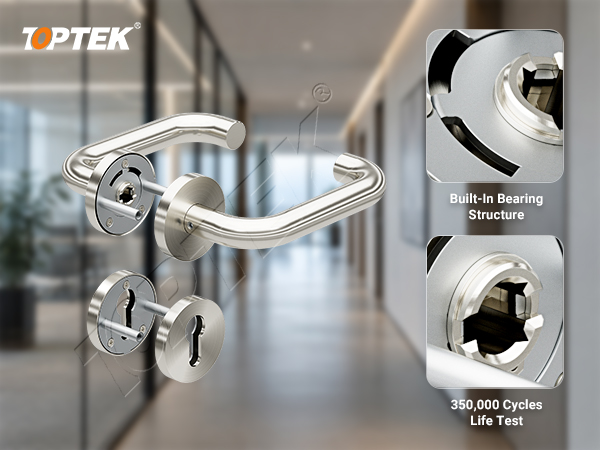
The LHEU001 specification gives buyers a practical basis for discussing a commercial handle set. It lists a 140 mm handle length, 53 or 55 mm cover plates and 7, 8 or 9 mm square spindle options. The visible handle and rose are specified as SS304, while the base plate is specified separately as iron. This component detail matters when comparing products described only as stainless steel handles.
| Configuration detail | What it helps the buyer decide |
|---|---|
| 140 mm handle length | Whether the lever proportions suit the intended door furniture design. |
| 53 or 55 mm cover plate | Which rose size fits the planned appearance and preparation. |
| 7, 8 or 9 mm spindle options | Which supplied spindle must match the selected lock follower. |
| Spring-loaded operation | How lever return will work with the chosen lock or latch. |
Use the TOPTEK EN 1906 lever handle range to discuss the required style. Send the lock drawing and door section with the enquiry so the offered set can be specified as a complete assembly. A choice of spindle sizes does not mean one spindle fits every lock.
Turn EN 1906 performance into a clear purchasing decision
EN 1906 concerns lever handles and knob furniture. The BSI standard listing provides the official scope and edition information. For the buyer, the important connection is between that standard, the actual handle and the configuration being ordered.
Intertek report 260618137GZU-001, dated 7 August 2026, identifies TOPTEK as the manufacturer and records a category-of-use Grade 4 classification for the stated handle configuration. LHEU001 is the reference model used for the complete test programme. This gives a purchaser a specific product and report to discuss rather than a general quality claim. TOPTEK’s product certification and test resources provide the enquiry route for supporting documents.
For a fire-door order, match the handle and installation to the applicable doorset evidence. Keep that requirement in the purchase specification; EN 1906 classification alone is not a universal fire-door approval.
Define the OEM package around your sales model
TOPTEK’s OEM/ODM services support private-label products and project-specific configurations. An established platform can be the starting point for an importer building a range, while a door factory may prioritise the supplied spindle, fixings and assembly arrangement. A development project may also involve drawings and changes to the product configuration.
Describe the requested logo, finish, packaging and set contents together. For example, a handle pair supplied with a specific spindle and fastening pack should be quoted differently from a lever-only component. Agree the scope of any design or tooling work before treating it as a standard option. This makes supplier offers easier to compare and helps prevent a low component price from being mistaken for a complete door-set price.
Look beyond the first delivery
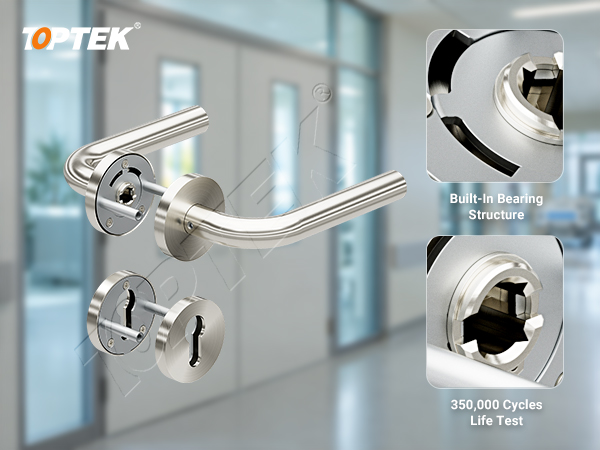
TOPTEK’s development process moves from requirements and drawings through samples, pilot production and controlled production delivery. Its quality procedures include first article inspection and checks during manufacturing. For a recurring order, the commercial benefit is a shared product definition that purchasing, production and inspection can all use.
Ask how the approved configuration will be identified on subsequent orders, how finish references will be retained and how changes will be communicated. These are practical supply questions for a commercial door hardware manufacturer. Once the supplier and configuration have been chosen, use the separate OEM lever handle sample approval guide to organise the detailed sample review.
Request a handle proposal that fits your project
For an initial selection, send the door type, lock reference, preferred lever style and target market to ivan.he@toptekaccess.com. TOPTEK can use that information to discuss suitable configurations and the relevant product documents.
For a formal quotation, include quantities, door thickness, spindle size, rose preference, finish, branding and packaging requirements. Identify any required classification or fire-door application. The best proposal should make clear what will be supplied and how it answers your buying requirements.
Frequently asked questions
What should an EN 1906 lever handle manufacturer provide?
A defined handle configuration, relevant performance documentation, interface dimensions and a clear supply specification covering finish, components and OEM requirements.
Does Grade 4 mean the entire door is certified?
No. The handle classification relates to the product and scope covered by its documentation. The complete door assembly has its own application requirements.
Can TOPTEK support private-label lever handle orders?
TOPTEK offers OEM/ODM and private-label services. The requested branding, configuration, finish and packaging should be agreed as part of the quotation.
Which information is most useful for an initial enquiry?
Provide the door type, lock reference, preferred handle style, target market and quantity. Add the required spindle, finish and branding details when available.