

Quick Answer
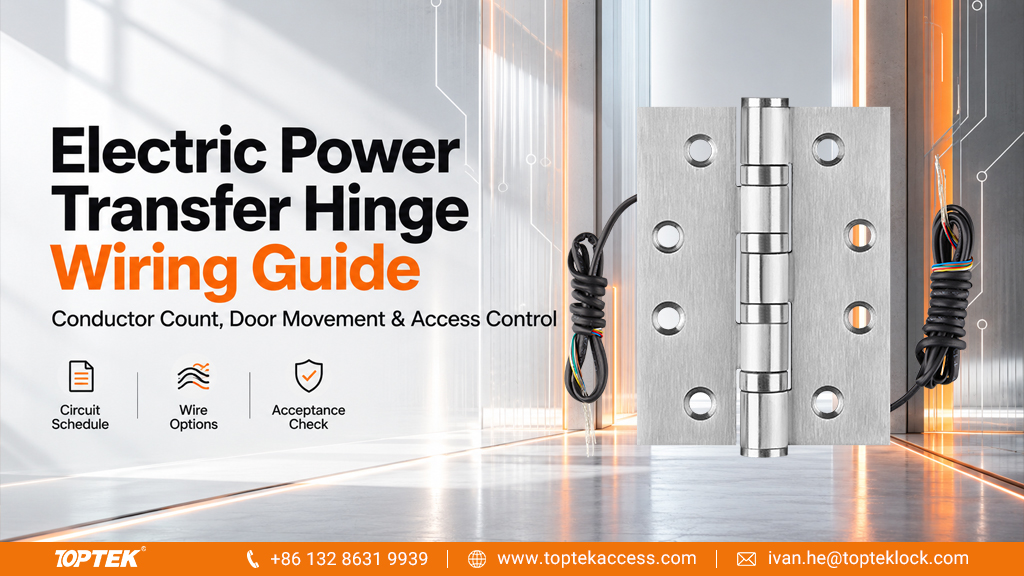
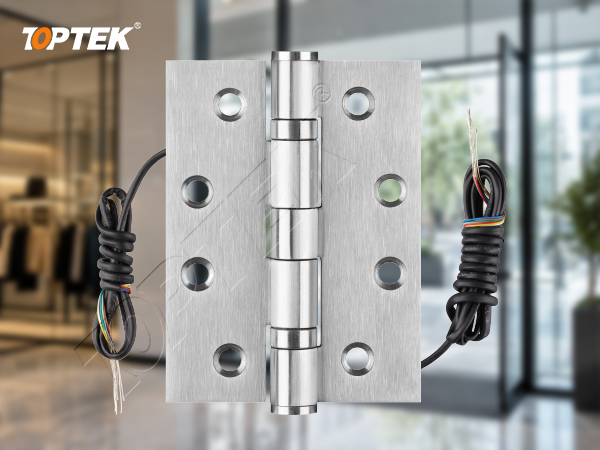
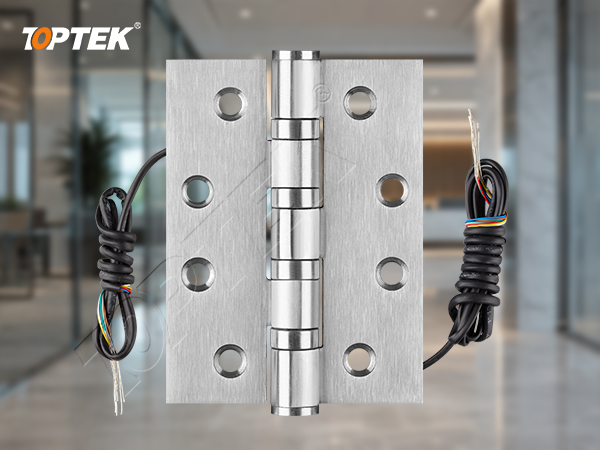
Electric power transfer hinge wiring should be selected from the devices on the door: identify their power and signal circuits, choose a suitable conductor configuration, then match the hinge to the door preparation. TOPTEK offers electric butt hinges with two-wire 18 AWG or four-, eight- and twelve-wire 28 AWG configurations, subject to the selected model. This gives door manufacturers and access control integrators options for routing connections through the hinge while keeping the door assembly visually tidy.
TL;DR
- Count the required power and signal connections from the device wiring diagrams.
- Select wire gauge and circuit capacity together; more wires do not mean more current capacity.
- Match hinge size, thickness and fixing positions to the door and frame.
- Check the finished assembly while the door moves through its intended opening range.
Start with the lock and monitoring devices
The hinge is one part of the electrical path. Its wiring needs to suit the lock and any door-mounted monitoring devices, together with the controller and power supply. A circuit schedule should identify each connection, its function and the requirements stated by the device manufacturer.
Power connections and monitoring signals can have different requirements. An electric lock may need a power pair, while additional status contacts need their own connections. Count the actual conductors shown in the wiring diagrams rather than assuming that every installation uses the same arrangement.
For a door factory, settling this early helps coordinate the hinge preparation, concealed cable route and lock position. For an integrator, it provides a clear interface between the door package and the access control equipment. TOPTEK’s commercial lock and access control capabilities support that product discussion.
Choose the conductor configuration
| TOPTEK configuration | Selection question | Information needed |
|---|---|---|
| 2 wires, 18 AWG | Does the circuit require a pair with this conductor size? | Device load, voltage and the complete cable route |
| 4 wires, 28 AWG | Can the required connections fit within four suitable conductors? | Device wiring diagram and per-circuit requirements |
| 8 or 12 wires, 28 AWG | Are additional separate circuits needed? | Power and signal allocation for every conductor |
These are alternative configurations. The correct choice depends on the selected hinge model and its electrical specifications. Confirm the permitted load for each circuit, including any starting demand from the connected device. Wire count alone is not an electrical rating.
Also account for voltage drop across the complete route from the power supply to the device. The hinge leads are only one part of that route. If a design changes from a simple lock connection to several monitoring circuits, revisit the conductor allocation before the door package is ordered.
Match the hinge to the door preparation
TOPTEK’s electric hinge and power transfer range includes the following size options. Check the drawing against the actual door and frame, including fixing positions and cable access, when selecting the order configuration.
| Model | Nominal size | Thickness |
|---|---|---|
| 2BB4040 | 4 × 4 inches | 3.0 mm |
| 2BB4545 | 4.5 × 4.5 inches | 3.0 or 3.4 mm |
| 4BB4545 | 4.5 × 4.5 inches | 4.6 mm |
| 4BB5050 | 5 × 5 inches | 4.8 mm |
The 2BB electric butt hinge and 4BB electric butt hinge pages provide product starting points. Choose the mechanical specification for the door application and the electrical configuration for the circuits. The bearing arrangement does not determine how much electrical load a conductor can carry.
Make installation straightforward for the next team
Agree the cable exit positions and the space available for connections inside the door and frame. Route the leads so they are protected from sharp edges and fixing screws, and use the connection method specified for the supplied assembly. A clear conductor identification schedule helps the installer connect the correct circuits without guessing from wire colour.
After installation, check continuity and device operation with the door closed and throughout its intended travel. Movement can reveal a trapped lead or stressed connection that is not apparent with the door stationary. Compare the results with the approved wiring arrangement before handing the assembly over.
Common ordering errors include selecting by hinge size alone, assuming all multi-wire options have the same electrical capacity, and leaving cable routing until the door is finished. Resolving those points during procurement helps avoid changes at installation.
Why source the hinge with TOPTEK?
TOPTEK offers both electric hinge options and door lock hardware, allowing door manufacturers and project buyers to discuss the transfer component alongside the equipment it serves. The practical advantage is a coordinated product conversation about dimensions, wiring requirements and the installation interface.
Use the TOPTEK quality and testing resource when requesting documentation for the selected configuration. For a fire-rated door, match the proposed hardware with the applicable doorset approval and installation instructions.
Request an electric hinge selection and quotation
Send the door and frame drawing, hinge dimensions, device wiring diagrams, operating voltage, load requirements, conductor count and expected quantities. Include the finish and cable termination requirements. These details let TOPTEK identify suitable hinge options and quote the complete configuration.
Discuss your electric power transfer hinge requirements with TOPTEK before finalising the door package.
Frequently Asked Questions
How many wires does an electric power transfer hinge need?
Count the conductors required by the connected devices’ wiring diagrams, including separate power and monitoring circuits. Select a hinge configuration that supports those connections and their electrical requirements.
Are twelve wires better than two?
They provide more separate connections, but they are not automatically suitable for a higher electrical load. Choose the wire count, gauge and permitted circuit load together.
Can an electric hinge replace an existing standard hinge?
Only where the dimensions, fixing pattern, door application and cable route are suitable. Compare the proposed hinge drawing with the existing preparation before ordering a replacement.
What should a door manufacturer send for a quotation?
Provide the door and frame drawing, hinge dimensions, device wiring diagrams, voltage and load requirements, conductor count, finish, termination details and quantities.