

TL;DR
- Choose the action required after access is granted: retract the exit-device latch, or enable the outside handle.
- Describe inside exit, outside entry and any automatic operator as separate functions.
- Confirm the exact device, trim, power arrangement and approved application before ordering an electrical option.
- Test physical movement at the door; a relay click or controller event cannot demonstrate successful release.
Quick Answer: Electric Latch Retraction vs Electrified Trim
Electric latch retraction uses an electrical command to draw back the exit device’s latch mechanism. Electrified trim controls whether the outside lever or knob can operate; the user normally still turns that handle to retract the latch. The choice depends on the entry action your opening requires. A door that must unlatch for an automatic operator has a different sequence from a door where an authorised user operates a lever. Confirm the selected hardware’s instructions, electrical requirements and approved door application. Neither term alone defines every power-loss or monitoring behaviour.
Start with the User’s Entry Action
A hardware schedule that says only “electrified panic bar” leaves an important question unanswered: what should move when access is granted? The reader, controller, outside handle, exit device and door operator each perform a different job. A useful specification describes the complete movement from credential presentation to the door closing again.
For manual entry, the intended sequence might be credential accepted, outside lever enabled, user turns the lever, latch retracts, and user pulls the door open. For an operator-assisted entrance, the sequence may require the latch to retract before the operator starts moving the leaf. These are design examples, not instructions for a particular lock. Write the required action before comparing part numbers or prices.
Also identify whether the door needs access control throughout the day or only during selected periods. A scheduled entry arrangement can affect the electrical duty and the required return to latching. The permitted sequence must remain consistent with the opening’s fire, escape and security requirements.
Compare the Two Release Functions
The distinction is supported by Allegion’s explanation of its EL and E functions: its latch-retraction function moves the latch, while its electric trim function enables operation from the pull side. Those manufacturer codes belong to that product family. Use the functional description, then ask each supplier to identify its corresponding configuration.
| Selection question | Electric latch retraction | Electrified trim |
|---|---|---|
| What does the command control? | A mechanism that retracts the exit-device latch. | The operating state of the outside trim. |
| What does an authorised user do? | Open the released door as the approved arrangement requires. | Usually turn the enabled lever or knob, then open the door. |
| What must an operator designer confirm? | Release is completed before the operator moves the leaf. | Enabling a handle alone may not provide automatic unlatching. |
| What is the ordering reference? | Exact device model, electrical option and installation documents. | Exact trim model, function and exit-device interface. |
Do not turn this table into a universal compatibility list. Rim, mortise and vertical-rod exit devices have different mechanisms and installation constraints. The right comparison is between documented combinations for the same opening, not between two generic labels on unrelated quotations.
Keep Inside Exit Separate from Outside Access
The inside touchpad and the outside access-controlled trim serve different users. Your schedule should state how an occupant exits, how an authorised person enters, and what happens when the outside credential is rejected. Verify each action on the actual assembly. An outside handle that remains secure must not be treated as evidence about the inside exit function.
Where a request-to-exit switch is included, identify whether it reports an action, initiates another control response, or does both under the selected design. A monitoring switch is not the same component as a latch-retraction actuator. A controller can record a valid exit request while a mechanical obstruction still prevents the door from moving.
For a product starting point, review the TOPTEK panic exit device range. State the required inside and outside functions in the enquiry, including the door arrangement and any operator. Availability and compatibility must be confirmed for the exact quoted configuration.
Coordinate the Device, Trim and Door Construction
Record the exit-device model, door width, stile profile, thickness, handing and strike arrangement. Add the outside trim model and its mechanical interface. These references help a supplier determine whether a proposed electrical configuration belongs to the existing platform or requires a different assembly.
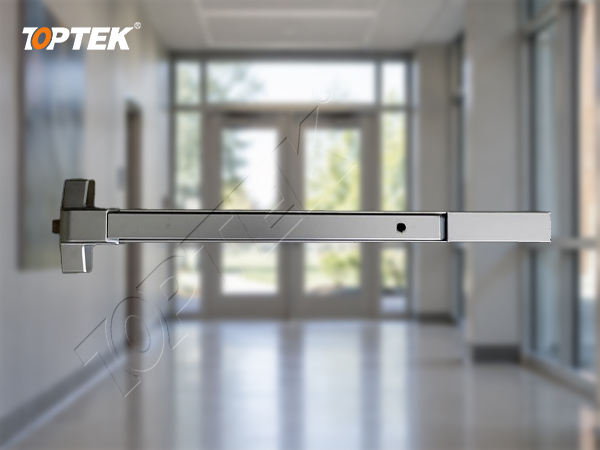
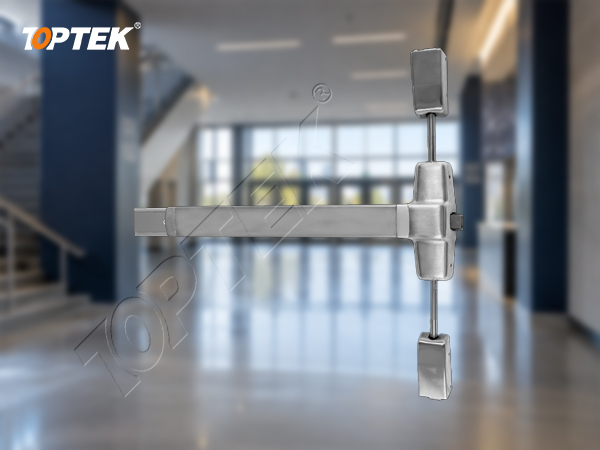
For vertical-rod devices, include the upper and lower latching arrangement and the complete rod configuration. For rim devices, identify the strike and any mullion. For mortise exit devices, include the lock case and trim relationship. A photograph of the touchpad is useful for identification but cannot replace the dimensions and labels needed for a final selection.
The TOPTEK PEDAM001 product page provides a reference for a vertical-rod product enquiry. Ask for the documents corresponding to the supplied version. Do not infer electrical retrofit approval, powered trim availability or an automatic-operator interface from its appearance.
Confirm Power, Commands and Return to Latching
Request the specified supply type, voltage, operating demand, duty limits and connection diagram. Identify where the power supply is located and how conductors cross from frame to leaf. The cable route must suit the door’s movement and the selected hardware; a working bench sample does not validate the final cable installation.
Document what happens when an access command ends. Does the latch return immediately, after a configured event, or according to another documented sequence? For trim control, determine when the outside handle changes state. Coordinate this with door position and closing behaviour instead of assuming one timer can describe every stage.
Power loss needs its own entry in the function schedule. Confirm the resulting latch and outside-trim states from the exact product documentation. Keep emergency interfaces and fire-door latching decisions within the approved project design. Electrical retraction, mechanical dogging and door holding are different functions and must not be substituted for each other casually.
Use a Door Trial to Expose Sequence Problems
Agree a controlled test with the installer and responsible project team. Maintain a safe exit arrangement during the work. Start with normal mechanical operation, then test authorised entry and rejected access. Observe the latch, outside handle and door movement separately. Record the result, rather than writing only “reader works.”
- Present an authorised credential and observe the exact release action.
- Operate the outside handle where the design requires a manual action.
- Where an operator is fitted, confirm that its movement follows successful release.
- Allow the door to close and verify the intended latching and access state.
- Repeat the approved power-loss and recovery scenarios without bypassing protective interfaces.
A short video showing the credential event and door mechanism together can make a fault report easier to interpret. Include the controller setting, hardware identification and the condition in which the problem occurs. Keep a failed trial open until the cause is resolved and the corrected sequence is demonstrated.
Common Ordering Mistakes and Their Consequences
The most costly mistake is ordering electrified trim when the design requires the latch to retract without a person turning a handle. The hardware may respond correctly to the command while still failing the intended entrance sequence. The reverse mistake is requesting latch retraction without defining when positive latching must be restored.
Other errors include treating every electrical option as a field-retrofit kit, copying a competitor’s power requirements, and assuming matching voltage proves compatibility. A retrofit needs a supported model, installation method and application scope. Changes to an existing assembly can also affect the documents on which that opening was accepted.
After installation, use a structured panic bar maintenance checklist to keep mechanical checks visible alongside electrical checks. A functioning access-control output cannot compensate for a worn strike, loose mounting or a device that fails to return correctly.
Prepare the RFQ and Review TOPTEK Evidence
TOPTEK’s quality-management information describes its approach to process and product verification. For your order, connect that general capability to a specific device, trim and function schedule. Ask which documents accompany the proposed combination and which trial results will define acceptance.
Include the following in an RFQ: door and frame drawings, device and trim identifiers, inside exit action, outside entry action, operator requirements, controller command, power arrangement, monitoring needs, project location, required evidence and quantities. Mark replacement work separately from new construction. Include photographs and existing labels for retrofit enquiries.
Why involve TOPTEK at this stage? An enquiry organised around an opening and its intended function gives the team a concrete basis for reviewing product fit and supply scope. It also lets procurement compare quotations against the same required result, rather than accepting the broadest marketing description.
Frequently Asked Questions
Does electrified trim automatically retract the latch?
Typically it enables the outside lever or knob. The user still operates that handle to retract the latch. Confirm the exact trim function in its documentation.
Is electric latch retraction the same as a request-to-exit switch?
No. Latch retraction moves a mechanism; a request-to-exit switch provides a signal. The signal may be used by the controller, but it does not itself prove the latch has moved.
Can every mechanical exit device be converted?
No universal conversion should be assumed. Confirm a supported kit or assembly for the exact model, version and door application before changing the hardware.
Which option is suitable for an automatic operator?
The opening needs an approved sequence that releases the latch before the operator moves the door. Enabling an outside handle alone may not meet that requirement.
What proves that the complete arrangement works?
A documented door trial should demonstrate authorised entry, inside exit, closing, return to latching and the approved failure and recovery behaviours.
Request an Exit Device Configuration Review
Choose by the required physical action: latch movement or outside-handle control. Then confirm the complete hardware and electrical combination. Send TOPTEK a door schedule and function description for an initial review. For a formal quotation, include drawings, quantities and the required acceptance documents through the commercial door hardware enquiry page.