

TL;DR
- Identify the mechanical lock function and model before collecting compliance documents.
- Control lockcase, forend, strike, cylinder and follower interfaces on revisioned drawings.
- Link each sample to its bill of materials, inspection record and evidence scope.
- Review changes before carrying forward the previous approval or product declaration.
Quick Answer
A CE mortise lock OEM program should use one controlled product specification linking the buyer’s application to drawings, samples, test evidence and order references. Define the lock function, dimensions, materials, finish and supplied accessories, then check the complete fitted arrangement. Record which documents apply to that exact configuration and which party maintains them. An OEM/ODM hardware manufacturer can reproduce the agreed product more reliably when every change has an owner and a revision, rather than relying on separate emails describing an apparently similar commercial door lock.
Separate platform selection from customization
First decide whether the project uses an existing platform with limited changes or requires a substantially different design. Branding and packaging, alternative trim interfaces and a revised operating mechanism do not create the same engineering work. Describe each requested change and ask how it affects drawings, samples, manufacturing and supporting documents.
The TOPTEK EN 12209 mortise lock range includes sash, passage, deadbolt, night-latch, classroom, roller, escape and bathroom configurations across its documented series. These names represent different operating tasks. A buyer should select the function before assuming that a common-looking case or matching centres makes two products equivalent.
For example, EN72SL sash mortise lock provides a latch-and-deadbolt configuration, while EN72LL is a passage configuration. An OEM program that includes both needs distinct product references and function descriptions. Combining them under a single informal name can lead to incorrect purchasing, labels or installation instructions.
Create a drawing package the door factory can use
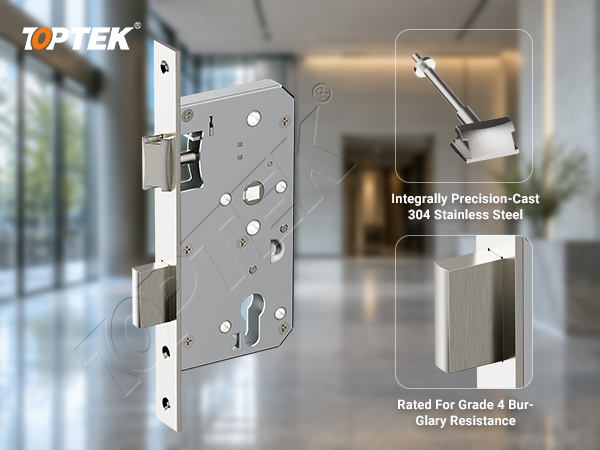
A drawing package should define the lock and the preparation around it. Include the backset, operating centres, case envelope, follower interface, cylinder profile, forend and strike. Show the datum for each dimension. A number without a clear measurement origin can be interpreted differently by the lock supplier and the door factory.
Specify the forend end shape, width, thickness, fixing positions and screw details. Then identify the corresponding strike rather than treating it as a generic accessory. Confirm its location relative to the closed door, stop and seals. If the door factory proposes a different strike, evaluate the substitution before retaining the existing lockset approval.
| Controlled item | Required information | Reason for control |
|---|---|---|
| Lockcase drawing | Model, function, envelope and interface datums | Prevent use of an incompatible preparation |
| Forend and strike | Shapes, fixings, recesses and matched references | Maintain alignment and engagement |
| Component list | Material, finish and accessory references | Make substitutions visible |
| Sample record | Sample identity, drawing revision and observations | Reproduce the accepted configuration |
| Document register | Product identifier, document edition and scope | Connect claims to the supplied product |
Use drawings for dimensions and photographs for orientation and visible details. Photographs can explain a roller, reversible latch or privacy control, but perspective makes them unsuitable for machining dimensions. Keep preparation drawings available to the team cutting the door, including the permitted tolerances and any installation constraints.
Request an early drawing review: provide the door section, required function and current lock preparation. If a complete specification is unavailable, start with the required opening behaviour and clear photographs. TOPTEK can identify the missing interface details needed before a meaningful sample is made.
Define what each sample is intended to prove
A development sample may demonstrate geometry, appearance or operation. Identify that purpose on its record. A finish sample without the final mechanism cannot prove lock function; a mechanism sample without the intended coating cannot prove the final appearance. The buyer should know which questions a sample can answer before accepting it.
For a production-intent sample, fit the proposed cylinder, spindle, lever furniture and strike to a representative door. Check latch retraction and return, cylinder operation, fixing stability and clearance. For the selected function, record how the lock behaves from each side. Use installation instructions applicable to the exact model instead of borrowing steps from another product in the series.
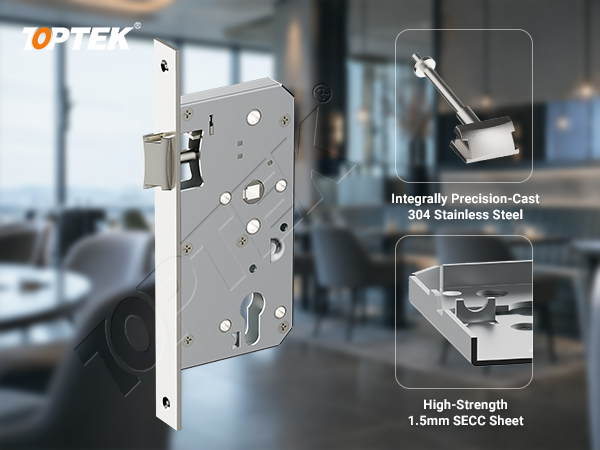
TOPTEK’s European lock materials describe a one-piece investment-cast latch and a dust-cover feature on relevant configurations. In a sample review, connect these details to the specified model and inspect how the lock fits the preparation. A dust cover does not remove the need to clear machining debris or protect the mechanism during installation.
Retain an agreed sample after the buyer and supplier resolve the observations. Include photographs, labels and any controlled deviations. If the physical sample contains a modification that is absent from the drawing, correct the drawing before treating the sample as the production reference. Otherwise, inspection personnel receive two different definitions of the accepted product.
Keep declarations and test evidence tied to the product
The document register should identify the product reference, manufacturer, intended use and relevant document versions. For a CE-marked product, request the applicable Declaration of Performance and supporting certification information, then check their relationship to the supplied model. The TOPTEK Declaration of Performance guide explains the buyer’s matching task.
Do not replace a document’s standard reference with a newer edition merely to make the paperwork look current. BSI’s BS EN 12209:2024 entry describes mechanical locks and locking plates and excludes assessment of their contribution to specific fire-resistant doorsets. Product-standard scope and doorset fire evidence therefore need separate attention. Confirm the applicable edition and market requirements for the project.
Where the opening is fire-rated, request evidence for the intended assembly, installation and hardware configuration. A family name or a photograph of a certificate does not establish coverage of every modified component. Similarly, an internal development test does not become independent certification because the test equipment follows a recognized method.
Agree document responsibilities with the supplier and the party placing the product on the target market. Private branding should not obscure the relationship between the product identifier and its supporting records. Keep labeling artwork, product references and the document register consistent when the brand presentation changes.
Use change control throughout the OEM program
Create a change request before substituting a material, altering a follower, adjusting a case or changing the strike. State the reason, affected references and proposed implementation point. Ask engineering to identify the fit, operation, manufacturing and evidence checks that the change requires. Then update the sample and document package together.
| Proposed change | Review focus | Release evidence |
|---|---|---|
| Forend or strike geometry | Preparation, fixing and engagement | Revised drawing and fitted check |
| Follower or cylinder interface | Engagement, movement and operating function | Interface review and new observations |
| Material or finish process | Specified composition, appearance and relevant tests | Updated component record and test plan |
| Branding or packaging | Identification, instructions and document traceability | Accepted artwork and reference mapping |
Avoid approving an entire range from a single sample unless the scope and rationale are explicitly agreed. Variants may share components while using different functions or interfaces. List which characteristics the sample represents and which variants need separate examination. This is particularly useful when one commercial order contains several lock functions.
For repeat orders, check the latest accepted revision against the purchase order. Record whether previous stock, labels or accessories remain valid after the change. Agree how different revisions will be separated in packing and identification so the receiving team can match each item to its intended door preparation.
Why TOPTEK: connect engineering with production control
TOPTEK’s documented OEM/ODM process includes modification of existing platforms and development against customer requirements. Its production controls include first-article inspection, in-process checks and comparison of surface finishes with retained references. These practices provide a practical basis for an OEM program when the accepted specification is clear.
Review the quality management process with the inspection requirements for your order. Ask which dimensions and functions will be checked, how nonconforming parts are handled, and which identification links the inspected batch to the drawing. These questions are more useful than requesting a general promise of identical production.
TOPTEK supplies several architectural hardware families, including European, ANSI and Australian mortise locks, cylinders and lever furniture. This range can support a broader sourcing discussion, but the CE mortise lock program should keep its own bill of materials and document scope. A material option available for one component is not automatically the standard material for the complete assembly.
RFQ checklist and project risk controls
- Identify the target country, application and mechanical lock function.
- Provide the model or required operating description, including both door sides.
- Attach door, frame, case, forend and strike drawings with revision dates.
- Specify follower, spindle, cylinder and trim interfaces.
- List material and finish requirements by component.
- Define private-brand marks, labels, instructions and packaging.
- State the performance and doorset evidence the project requires.
- Identify sample purposes, sample quantities and acceptance responsibilities.
- Provide order quantities, variant breakdown and delivery milestones.
- Agree retained samples, change triggers and repeat-order references.
The main avoidable risks are ambiguous functions, conflicting drawing revisions, undocumented component substitutions and evidence attached to the wrong product. Resolve each through an identifiable record and an owner. Do not allow a commercial description such as “same as sample” to replace the drawings and references needed to reproduce that sample.
Frequently asked questions
What is a CE mortise lock OEM program?
It is a controlled development and supply process linking the buyer’s requirements to the lock configuration, drawings, samples, production records and applicable product documents.
Can a finish sample approve the mechanical function?
No. A finish sample establishes an appearance reference. Function should be checked on the intended mechanical configuration with the relevant interfaces fitted.
Can every model use the same Declaration of Performance?
Only use a document where its product identification and scope cover the supplied configuration. Check the model relationship rather than assuming family-wide coverage.
When should an OEM change trigger another review?
Review changes that affect fit, function, materials, finish, identification or supporting evidence. Define the affected checks before releasing the revised product.
Does a lock standard prove a modified fire doorset?
No. A specific fire doorset requires its own applicable evidence and installation limits. Check the proposed hardware configuration against that evidence.
Request a controlled OEM quotation
A successful program preserves the connection between the product a buyer chooses and the product the factory repeats. Define the function, resolve the interfaces, identify the sample and maintain the document trail when anything changes.
Explore TOPTEK OEM/ODM manufacturing support. Send your existing preparation or a preliminary requirements list to start the discussion. For a formal quotation, send the model breakdown, drawings, evidence requirements and quantities to ivan.he@toptekaccess.com so the team can review the configuration and propose the sample route. Smart Design. Strong Security.