
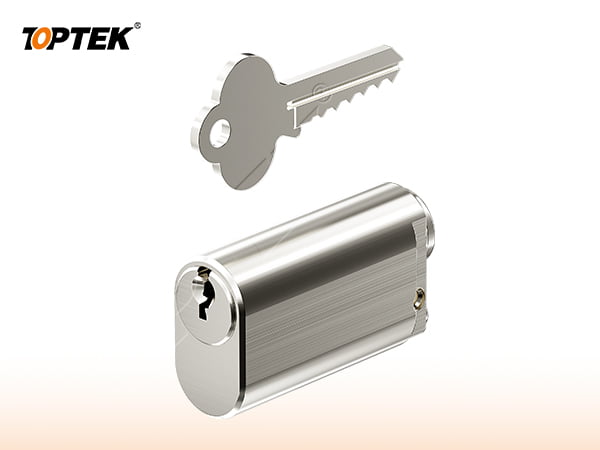

Focus: Australian vs Scandinavian oval cylinder
Construction Cylinder Buyer Guide | 21 August 2026
Author: Ivan He, TOPTEK | Technical review status: final engineering sign-off required before publication.
TL;DR
- “Oval cylinder” describes a family of shapes, not one universal interface.
- Australian oval cylinders must match the specified Australian lock case, trim, fixing and actuator.
- Scandinavian oval cylinders must match the Nordic modular lock platform, inside/outside components and fixing geometry.
- Do not select from a front photo; use dimensioned drawings and a complete reference sample.
- Approve the production-intent cylinder in the actual lock, trim and representative door before bulk release.
Quick Answer
What is the difference between an Australian and Scandinavian oval cylinder? They belong to different regional door-hardware platforms. Although both are described as oval, their exact profile, mounting, component arrangement, actuator, trim and compatible lock case may differ. Select the cylinder from the approved lock interface and project market, then verify drawings, keying and a fitted sample.
Why “Oval” Is Not a Complete Specification
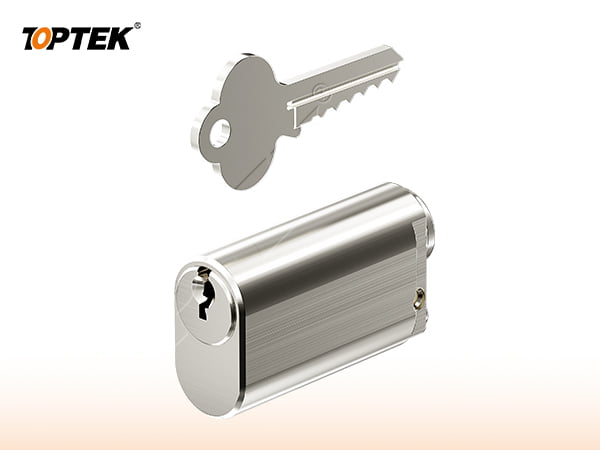
Regional cylinder names are useful shorthand, but they can create a false sense of interchangeability. Australian and Scandinavian systems evolved around different lock cases, trim practices, installation methods and service networks. A buyer who orders an “oval cylinder” without naming the platform can receive a product that resembles the opening yet cannot be secured or cannot operate the lock.
The selection should start with the installed hardware: exact lock case, trim, door preparation and required function. Then identify the cylinder profile, fixing, actuator, inside/outside arrangement, keyway and evidence route. A product photo supports identification but cannot prove critical dimensions.
This page compares two oval platforms. It does not repeat the wider six-format intent of the commercial cylinder-types guide or the hierarchy design in TOPTEK’s Project Cylinders and Master Key Systems guide.
| Checkpoint | Australian oval | Scandinavian oval |
|---|---|---|
| Primary reference | Specified Australian mortice lock/trim platform | Specified Nordic modular lock/trim platform |
| Profile proof | Dimensioned AU oval opening and sample | Dimensioned Scandinavian oval components and sample |
| Fixing | Confirm project lock and trim mounting | Confirm outside/inside components, screws, rings or sleeves |
| Actuation | Confirm cam/tailpiece/turn interface | Confirm lock-case actuator and component arrangement |
| Key system | Australian project keyway and hierarchy | Nordic key profile, optional protection route and hierarchy |
| Approval | Fitted Australian lock/door sample | Fitted Scandinavian lock/door sample |
1. Australian Oval Cylinder Selection
Begin with the Australian lock platform
Identify the exact mortice lock or trim model and the target Australian or New Zealand market. Confirm that the cylinder preparation, fixing and actuator belong to the intended platform. TOPTEK’s published Australian lock range provides context through the AS 4145 Mortise Lock category, but cylinder compatibility remains model-specific.
Record profile and fixing from drawings
Provide the oval outline with reference dimensions, fixing centres and door/trim section. Show which side is external, which side is internal, and whether each face uses a keyed cylinder, turn, blank or other component. Include retaining hardware and any escutcheon or protector.
Confirm actuator and lock function
The rear operating interface must move the intended latch, deadbolt or lock component through the correct rotation. Ask for a dimensioned actuator drawing or use an approved reference sample. Test the complete cycle under normal door alignment rather than only turning a loose cylinder.
Map the Nordic modular lock system
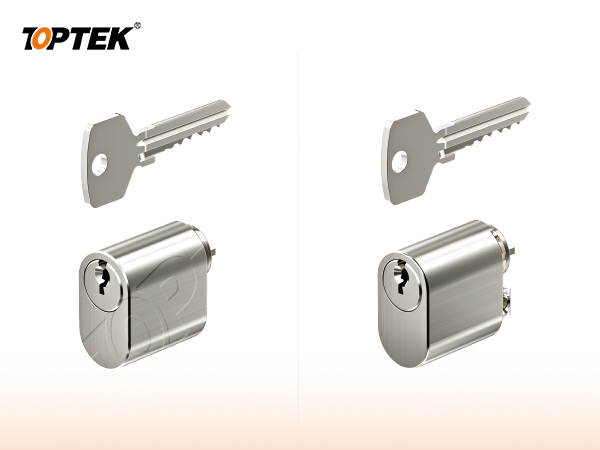
Scandinavian oval cylinders are commonly selected within a modular lock and trim architecture. The outside and inside components may be separate, with project-specific fixing hardware, rings or sleeves. Buyers should send the lock case, trim set and a section drawing showing how the parts assemble through the door.
Use SOC01 as a product reference, not a universal template
TOPTEK’s verified SOC01 product page lists brass housing/core construction, six pins, a TV-3D key-profile reference, optional protected profile/security card, module-series application, and anti-pick/anti-drilling features. These claims belong to SOC01 and the stated configuration; they should not be transferred to an Australian oval model or another Nordic configuration without evidence.
Confirm the key-profile route
State whether the project uses the standard reference profile or a protected/custom route, who owns the key system, how blanks are controlled and how replacement keys will be supplied. A security-card option requires an operational policy, not just a line on a quotation.
3. Why the Two Oval Formats Are Not Automatically Interchangeable
A shared descriptive word does not establish identical geometry. Differences can appear in height, width, fixing points, plug position, actuator, rings, sleeves, internal/external component pairing and how the lock case accepts rotation. Even when a cylinder enters the visible opening, it may not seat, retain or operate correctly.
For retrofit, remove and photograph the complete existing cylinder from front, back and both sides with a scale. Record the lock case and trim branding/model, door thickness and screw arrangement. Never identify only from the key face.
A shared master-key objective is separate. TOPTEK may review a coordinated key-management concept across regional formats when compatible keyways and engineering permit, but the original physical cylinder standards and lock interfaces remain distinct.
4. Seven-Step Project Selection Process
- Name the market and opening: door number, building area, function and service plan.
- Freeze the lock: exact lock case, trim and door preparation.
- Select the regional platform: Australian oval or Scandinavian oval.
- Draw the interface: profile, fixing, components, actuator and orientation.
- Coordinate keying: keyway, KD/KA/master hierarchy, blanks and handover.
- Fit the sample: use production-intent cylinder, lock, trim and representative door.
- Freeze revision control: sign drawings, sample, evidence scope and bulk-release record.
5. Buyer Compatibility Checklist
- Target country/market and door numbers
- Exact lock case and trim models
- Australian or Scandinavian oval platform
- Dimensioned cylinder profile
- Fixing centres, screws, rings and sleeves
- Inside/outside component arrangement
- Cam, tailpiece or turn interface
- Rotation and required lock function
- Door thickness and complete trim stack
- Keyway, hierarchy and key-control route
- Finish, marking, packaging and evidence
- Production-intent fitted sample
Review the broader TOPTEK Construction Cylinder range when a project contains more than one regional platform.
6. Common Buyer Mistakes
- Assuming every oval cylinder uses one standard profile.
- Selecting from the front photo without the lock model.
- Ignoring inside/outside components and fixing hardware.
- Copying an actuator from another regional platform.
- Designing the key hierarchy before physical compatibility.
- Approving a loose cylinder instead of a fitted sample.
- Assuming one model’s EN or AS-related statement covers another cylinder.
- Failing to plan local replacement keys and locksmith support.
7. Project Risks and Controls
| Risk | Consequence | Control |
|---|---|---|
| Wrong regional format | Cylinder cannot fit or retain | Lock-model and profile drawing review |
| Wrong fixing | Loose assembly or trim conflict | Door-section drawing and fitted sample |
| Wrong actuator | Lock does not complete its cycle | Dimensioned interface and functional test |
| Unsupported key route | Replacement or expansion problems | Keyway ownership and service plan |
| Evidence overreach | Unsupported compliance claim | Verify exact document/model scope through TOPTEK Resources |
8. TOPTEK Evidence and Product Boundary
TOPTEK’s current Construction Cylinders material identifies Australian and Scandinavian oval cylinders as separate product platforms. The internal image register provides AOC01 and SOC01 references. The live SOC01 page supplies model-specific construction, key-profile and feature statements; a dedicated live AOC01 page was not confirmed during this execution, so this article does not invent AOC01 specifications.
Internal inspection and testing can support development and quality control but must not be called third-party certification. Ask for the exact certificate, report, revision and product coverage required by the project.
9. Oval Cylinder RFQ Checklist
- Market, project and door schedule
- Exact lock/trim models and function
- Australian or Scandinavian platform
- Dimensioned profile and fixing drawing
- Inside/outside component arrangement
- Actuator geometry and rotation
- Door and trim section
- Keyway and KD/KA/master-key plan
- Key blank/protection/duplication requirements
- Finish, marking and packaging
- Required documents and exact model scope
- Reference sample and comparison method
- Production-intent fitted sample
- Approved revision and change-control owner
10. Why TOPTEK for Regional Cylinder Coordination
TOPTEK’s Construction Cylinder program covers multiple regional formats, enabling one project team to discuss Australian and Scandinavian lock interfaces while preserving each platform’s physical requirements. The useful deliverable is a coordinated schedule of cylinder, lock, trim, actuator, key plan and evidence.
The boundary remains explicit: oval appearance does not prove interchangeability, and cross-format key management requires engineering review. Clear drawings and fitted samples protect both quotation accuracy and field installation.
Frequently Asked Questions
Do not assume so. Their profile, fixing, inside/outside component arrangement, actuator and compatible lock-case conventions may differ. Confirm the exact lock and trim drawings and approve a fitted sample.
How do I identify an Australian oval cylinder?
Start with the Australian lock-case or trim model, door preparation and a dimensioned cylinder profile. Record fixing, actuator, orientation, keyway and installed trim rather than identifying it from the word “oval” alone.
Confirm the Nordic modular lock platform, outside and inside cylinder components, fixing geometry, sleeve or ring, actuator and key profile. Use the lock manufacturer’s interface drawing or an approved reference sample.
Can both oval formats use one master key system?
A coordinated key plan may be technically reviewed where compatible keyways and system capacity permit, but it is not automatic. Shared authorization does not make the cylinder bodies physically interchangeable.
What should be tested on an oval cylinder sample?
Test seating, fixing, trim clearance, actuator engagement, key insertion and withdrawal, full lock/unlock cycles, operation from required sides and repeatability in the actual lock and representative door.
What should an oval cylinder RFQ include?
Include target market, exact lock and trim models, dimensioned profile and fixing, inside/outside arrangement, actuator, door and trim details, keyway and hierarchy, finish, quantities, evidence requirements and fitted-sample approval plan.
Conclusion
Australian and Scandinavian oval cylinders should be treated as separate regional platforms. Start with the lock case, prove the profile, fixing and actuator, coordinate the key route, and approve the complete fitted assembly before bulk release.