

American Mortise Cylinder vs Bored Lock Cylinder: Lock Interface, Installation and RFQ Guide
Focus: American mortise cylinder vs bored lock cylinder
Construction Cylinder Buyer Guide | 20 August 2026
Author: Ivan He, TOPTEK | Technical review status: final engineering sign-off required before publication.
TL;DR
- An American mortise cylinder normally uses a threaded body and selected cam in compatible mortise hardware.
- A bored lock cylinder belongs to a specific cylindrical lock, lever, knob or trim chassis and normally uses a compatible tailpiece.
- The formats are not direct substitutes even if the keyway or visible plug looks similar.
- Freeze retention, length, cam/tailpiece, trim stack, function and keying before sample approval.
- Approve a production-intent cylinder in the exact lock and representative door, not as a loose component.
Quick Answer
Which should a buyer choose: an American mortise cylinder or a bored lock cylinder? Choose the cylinder interface the specified lock or trim was engineered to accept. Use a threaded mortise cylinder when the hardware requires that threaded body and cam. Use the correct bored lock cylinder when the cylindrical lock chassis or key-in-lever/knob trim requires its retained cylinder and tailpiece. Then confirm length, actuator, keyway, function and fitted operation.
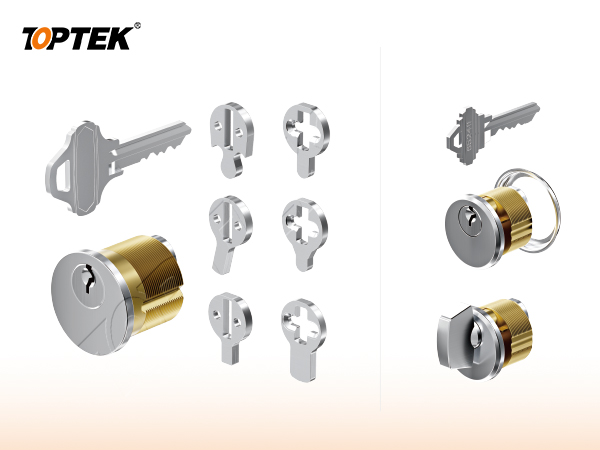
Why the Lock Interface Decides the Cylinder
“American cylinder” is not a complete specification. Two products may accept a familiar key blank or show a similar round plug while connecting to the lock in entirely different ways. The lock chassis, trim and door preparation determine the correct platform.
An American mortise cylinder commonly threads into a compatible mortise lock, exit-device trim, deadlock or other housing. A retaining screw or related hardware secures the body, while a cam at the rear transfers plug rotation to the lock. A bored lock cylinder is captured by the cylindrical lock, lever, knob or trim assembly and usually drives it through a selected tailpiece or actuator.
This guide focuses on those interfaces, installation and RFQ inputs. It does not repeat the six-format matrix in TOPTEK’s commercial cylinder-types guide or the hierarchy design in the Project Cylinders and Master Key Systems guide.
Mortise Cylinder vs Bored Lock Cylinder Comparison
| Checkpoint | American mortise cylinder | Bored lock cylinder |
|---|---|---|
| Body interface | Threaded into compatible lock or trim | Retained inside specified chassis/lever/knob/trim |
| Typical actuator | Selected cam | Selected tailpiece or chassis actuator |
| Length control | Thread engagement plus collar/trim relationship | Chassis, door thickness, trim and actuator engagement |
| Key decision | Cam shape/home/rotation | Tailpiece shape/length/orientation |
| Common error | Wrong cam or excessive/recessed projection | Wrong tailpiece or incompatible chassis retention |
| Approval proof | Installed lock/trim cycle test | Installed cylindrical lock cycle test |
1. American Mortise Cylinder Interface
Threaded body and retention
The external threads position the cylinder in compatible hardware. The installer typically rotates the body to establish the correct projection through the finished trim, then uses the hardware’s approved retaining method. Too little engagement can reduce stability; excessive insertion can bind the cam or place the key face too deep. Follow the lock or trim instructions rather than applying a universal turn count.
Cam selection controls operation
The cam converts key rotation into lock movement. Its profile, radial projection, thickness, home angle and permitted rotation must suit the exact lock function. A visually similar cam may fail to pick up the mechanism, over-travel, bind or prevent key withdrawal. Request a dimensioned cam reference or an approved physical sample.
Length and collar must suit the finished trim
The cylinder must present a usable key face without excessive projection. Account for door thickness, reinforcement, escutcheon, collar, cylinder guard and trim. The correct body length is therefore a lock-and-trim decision, not door thickness alone.
TOPTEK’s verified AMMC01 product page lists brass construction, six pins, different cams and lengths from 1 inch through 1-3/4 inches, plus keyed-different, keyed-alike and master-key options. These are published range references; the RFQ must select one exact configuration.
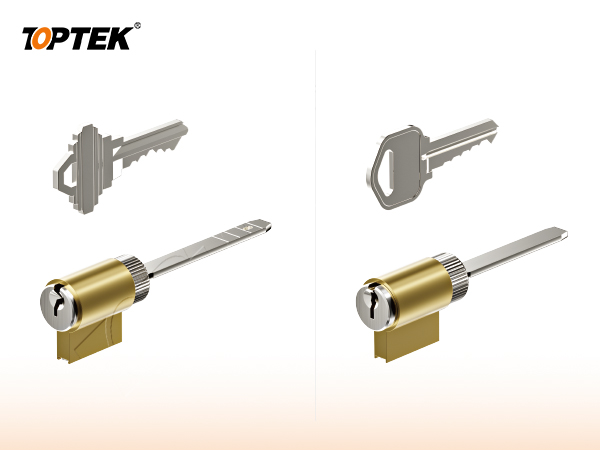
2. Bored Lock Cylinder Interface
The cylinder belongs to the lock chassis
A bored or cylindrical lock is installed through bored holes in the door, but that door preparation alone does not specify the replacement cylinder. The cylinder is retained inside the selected lever, knob, rose, escutcheon or chassis components. Its body shape, retaining features and actuator must match that lock platform.
Tailpiece selection is the critical operating step
The tailpiece transfers plug rotation into the chassis. Confirm its cross-section, end form, orientation, effective length and engagement. A tailpiece that is too short may fail to operate; one that is too long may bottom out, bind or prevent correct assembly. The correct tailpiece can also vary with lock function or trim.
Door and trim thickness affect engagement
Record the installed door thickness and complete trim stack. Do not copy only the cylinder plug diameter or keyway from an old component. A replacement should be compared with the lockset model, existing retention, tailpiece and function, then tested in the actual chassis.
TOPTEK’s verified AMBLC01 product page lists SC1 or KW1 standard keyway references, different keyways, different tails, multiple finishes and brass technical-table construction. The descriptive page also mentions brass or zinc material, so the order drawing and bill of materials must confirm the selected configuration.
3. Why They Are Not Directly Interchangeable
The mortise cylinder expects threads, a specific retaining approach and a cam interface. The bored cylinder expects retention within a particular lock chassis and a compatible tailpiece. Changing only the key plug or choosing a shared keyway does not convert one physical platform into the other.
This matters in retrofit RFQs. A buyer may photograph only the front face and ask for a matching cylinder. The front view hides the threads, housing, retaining clips, cam, tailpiece and installed depth. Photograph the removed cylinder from multiple sides, retain the existing lockset model, and provide measurements against a scale.
Where a coordinated key system must cover both formats, the supplier may review compatible keyways and pinning. Shared key management remains an engineered system question and does not create body interchangeability.
4. Installation and Sample Approval Process
- Identify the lock platform: record manufacturer/interface reference, model, function, trim and door preparation.
- Select the physical cylinder: threaded mortise or chassis-specific bored cylinder.
- Freeze the actuator: dimensioned cam or tailpiece, home position, rotation and engagement.
- Confirm installed depth: body length, door/trim stack, collar or retention, and key-face projection.
- Coordinate keying: keyway, KD/KA/master-key hierarchy, quantities and handover.
- Fit the production-intent sample: install it in the exact lock and representative door.
- Test every state: lock/unlock, latch or bolt movement, key withdrawal, lever/knob return and both sides where applicable.
- Freeze the record: sign the sample, drawing revision and approved bill of materials before bulk release.
5. Buyer Interface Checklist
- Exact lockset, trim, device or housing model
- Cylinder format and retention method
- Body length and finished projection
- Thread and collar details for mortise cylinder
- Chassis retaining features for bored cylinder
- Cam or tailpiece dimensioned reference
- Rotation, home position and key-removal positions
- Door thickness and complete trim stack
- Lock function and inside/outside operation
- Keyway, keying hierarchy and key quantities
- Finish, marking, packaging and door reference
- Fitted sample and revision approval
Buyers comparing the wider range can use the TOPTEK Construction Cylinder hub. Keep the final approval at exact model and configuration level.
6. Common Buyer Mistakes
- Ordering from the front-face photo only.
- Calling every round American cylinder a mortise cylinder.
- Assuming a shared keyway proves physical interchangeability.
- Selecting a mortise cam without the lock interface drawing.
- Copying a bored-cylinder tailpiece without confirming lock function.
- Ignoring collar, rose, escutcheon or cylinder-guard thickness.
- Approving a loose cylinder rather than a fitted lock sample.
- Transferring one model’s certificate claim to another cylinder or lock combination.
7. Project Risks and Controls
| Risk | Likely result | Control |
|---|---|---|
| Wrong platform | Cylinder cannot be retained | Identify exact lock/chassis before quotation |
| Wrong cam | Mortise hardware fails to operate | Dimensioned cam plus fitted cycle test |
| Wrong tailpiece | Bored lock binds or does not unlock | Chassis/function reference and installed test |
| Wrong installed depth | Loose, recessed or projecting cylinder | Final door/trim stack and approved sample |
| Evidence overreach | Unsupported compliance claim | Verify exact model, document and scope through TOPTEK Resources |
8. TOPTEK Evidence and Product Range
The current internal Construction Cylinders material identifies American mortise and bored lock cylinders as separate platforms within TOPTEK’s multi-market range. The official AMMC01 and AMBLC01 pages provide model-level construction, keyway, length or actuator options. Use those pages for initial reference and request the latest drawing and evidence pack for the exact purchase configuration.
TOPTEK’s internal inspection and testing resources can support development and quality control. Internal verification must remain labelled as internal, not third-party certification. A standard or certificate statement should be accepted only when the exact document covers the ordered model and configuration.
9. American Cylinder RFQ Checklist
- Project, market, door number and quantities
- Exact lockset/trim/device model
- Mortise or bored cylinder format
- Existing cylinder photos and reference sample for retrofit
- Thread/retention/body dimensions
- Cam or tailpiece drawing and material
- Home position, rotation and lock function
- Door thickness and finished trim section
- Keyway and KD, KA or master-key hierarchy
- Operating, master, control and blank quantities where applicable
- Finish, logo, marking and packaging
- Required certificates/reports and exact scope
- Production-intent fitted sample
- Approved drawing revision and change-control owner
10. Why TOPTEK for American Cylinder Coordination
TOPTEK supports both American mortise and bored lock cylinder formats within its Construction Cylinder program. A useful project deliverable connects the cylinder body, lock interface, actuator, length, key plan, evidence and fitted sample rather than treating the cylinder as an isolated SKU.
The engineering boundary is equally important: TOPTEK should not infer a hidden interface from a front photo, promise universal compatibility or apply evidence beyond its documented scope. Clear lock references and samples reduce quotation loops and replacement risk.
Frequently Asked Questions
What is the main difference between an American mortise cylinder and a bored lock cylinder?
An American mortise cylinder normally has a threaded body retained in compatible mortise hardware and uses a selected cam. A bored lock cylinder is retained inside the specified cylindrical lock, lever, knob or trim chassis and normally connects through a compatible tailpiece or actuator.
Can a mortise cylinder directly replace a bored lock cylinder?
Usually not. The body shape, retention, actuator and lock interface are different. Identify the complete lockset and use the cylinder platform designed for that chassis unless the manufacturer provides an approved conversion.
How do I select a cam for a mortise cylinder?
Use the lock or trim manufacturer’s interface drawing or an approved reference. Confirm cam shape, width, projection, home position, rotation and required lock function; do not select from a photo alone.
How do I select a tailpiece for a bored lock cylinder?
Match the tailpiece to the exact lock chassis, function, trim and installed door thickness. Confirm shape, length, orientation, engagement depth and permitted movement with a fitted sample.
Can mortise and bored cylinders use the same key system?
They may be coordinated under a compatible keyway and engineered hierarchy, but shared key management does not make the cylinder bodies physically interchangeable. Confirm feasibility before finalizing the schedule.
What should the RFQ include for American commercial cylinders?
Include the exact lockset or trim model, cylinder format, body retention, length, cam or tailpiece drawing, door and trim thickness, keyway, keying hierarchy, finish, quantities, evidence requirements and fitted-sample approval plan.
Conclusion
The correct choice is determined by the lock interface. Threaded mortise cylinders and bored-lock chassis cylinders use different retention and actuators. Identify the hardware, freeze the cam or tailpiece, control installed depth and approve the complete fitted sample before bulk ordering.