

The function must be evaluated as a complete door-hardware configuration. Buyers should first confirm the lock case, outside trim, inside lever, cylinder, and strike. They should then verify the door preparation, fire-door evidence, and required egress standard before sample approval or bulk ordering.
Quick Answer
The night latch mortise lock function uses a spring latchbolt as the primary closing and access-control element. When the door shuts, the latchbolt enters the strike and holds the door closed. The specified outside lever or knob is fixed or non-operating. An authorized user retracts the latchbolt with a compatible cylinder and key. From the inside, the lever retracts the latchbolt for exit.
Key Takeaways for Buyers
The night latch mortise lock function should be specified as a complete door set, not as a lock-case name alone. The following points define the operating logic and the checks that protect the project.
- Automatic latching: closing the door engages the latchbolt without a separate key-locking action.
- Controlled outside access: the outside trim does not normally retract the latch; the cylinder key provides authorized entry.
- Inside exit: the inside lever retracts the latch for convenient egress, subject to the complete hardware schedule and local code.
- Not a deadbolt function: a night latch controls access through the latchbolt; it should not be described as equivalent to a manually thrown deadbolt.
- Project verification: EN 12209 classification, model scope, fire-door evidence, dimensions, cylinder compatibility, and installation instructions must match the exact door set.
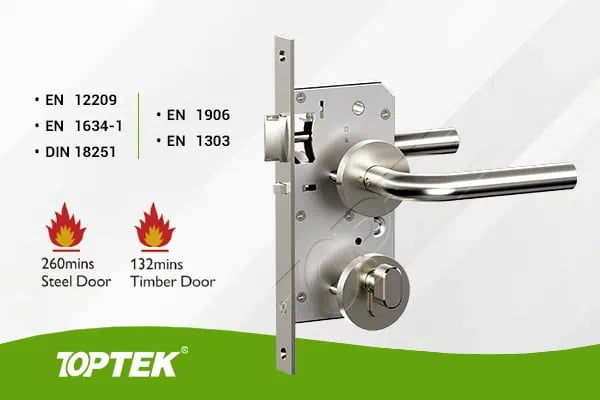
What Is a Night Latch Mortise Lock Function?
A night latch mortise lock function secures the closed door with a latchbolt. Outside entry requires a key-operated cylinder, while the inside lever releases the latch for exit. The lock case sits inside a mortise cut into the door edge, unlike a surface-mounted rim night latch. This concealed installation supports architectural lever furniture, euro profile cylinders, project keying, and coordinated commercial door preparation.
The words night latch describe the operating logic, not the time of day. The door becomes latched each time it closes. An occupant does not need to project a deadbolt for routine access control. Authorized users operate the cylinder to retract the latchbolt from outside. Buyers may also search for this product as a night latch mortice lock, euro profile night latch lock case, or 72 mm centres night latch lock.
Buyer note: The lock case, spindle arrangement, outside trim, inside lever, and cylinder must be specified together. A product name alone does not prove that the installed door will provide the intended outside-control and inside-egress behavior.
How Does a Night Latch Mortise Lock Work?
The night latch mortise lock works through three coordinated actions. Its latch engages when the door closes. Cylinder operation controls entry from outside, and the inside lever releases the latch. A complete hardware schedule must still coordinate the lock body, trim, cylinder cam, strike, door closer, and handing.
| Door condition or user action | Expected operation | Buyer verification point |
|---|---|---|
| Door closes | The spring latchbolt rides over the strike lip and enters the strike opening. | Confirm door closer force, latch projection, strike alignment, and frame preparation. |
| Outside user operates lever or knob | The specified outside trim is fixed or does not normally retract the latchbolt. | Confirm the exact trim and spindle configuration during sample approval. |
| Outside user turns an authorized key | The euro profile cylinder and cam operate the lock mechanism to retract the latchbolt. | Confirm cylinder length, cam type, keyway, keying plan, and turn direction. |
| Inside user presses the lever | The inside lever retracts the latchbolt and releases the door. | Confirm free-egress intent and whether a separate EN 179 or EN 1125 requirement applies. |
| Door remains open | The latchbolt stays projected until it contacts the strike during closing. | Confirm latch handing, bevel direction, and smooth return before production approval. |
Where Is a Night Latch Mortise Lock Commonly Used?
A night latch mortise lock suits doors that must resist normal outside entry and remain easy to open from the occupied side. Typical applications include apartment entrance doors, offices, staff-controlled rooms, selected hotel or service doors, and commercial entrance doors. Final selection depends on fire rating, traffic level, security risk, accessibility, and the egress route.
- Apartment entrances: the door latches when residents leave, while the cylinder provides authorized re-entry.
- Office and administration doors: corridor-side access can remain key-controlled without requiring occupants to throw a separate deadbolt each time.
- Hotel back-of-house or service areas: staff access can be controlled by cylinder keying where the project’s hardware schedule permits this function.
- Commercial building rooms: storage, management, utility, or controlled-access rooms may use the function when panic hardware is not required.
- Fire and smoke-control doors: use is project-dependent and must follow the exact certificate scope, door-set evidence, installation instructions, and local approval route.
Project risk: Do not select a night latch only because the door must “lock automatically.” High-occupancy exits and escape routes may require different hardware. Access-control doors or monitored doors may also need an electromechanical solution.
How Is a Night Latch Different from Other Mortise Lock Functions?
The night latch mortise lock function controls outside entry through the latchbolt. Sash, passage, bathroom, and deadbolt functions use different combinations of levers, cylinders, thumbturns, latchbolts, and deadbolts. Choosing the wrong function can create an access problem, an egress problem, or an incompatible door preparation.
| Function | Outside operation | Inside operation | Primary use |
|---|---|---|---|
| Night latch mortise lock | Key-operated cylinder retracts the latch; outside trim is fixed or non-operating as specified. | Inside lever retracts the latch. | Controlled outside entry with convenient inside exit. |
| Sash mortise lock | Lever normally retracts the latch; cylinder operates the deadbolt and may operate the latch depending on design. | Lever retracts the latch; thumbturn or cylinder arrangement operates the deadbolt as specified. | General commercial or residential doors requiring latch and deadbolt functions. |
| Passage mortise latch | Lever retracts the latch; no locking function is normally provided. | Lever retracts the latch. | Internal circulation doors that do not require access restriction. |
| Bathroom or WC mortise lock | Lever retracts the latch; emergency release may operate the privacy deadbolt. | Lever retracts the latch; privacy turn operates the deadbolt. | Toilets, washrooms, bathrooms, and privacy rooms. |
| Deadbolt mortise lock | Cylinder projects or retracts the deadbolt; no latch function. | Cylinder or turn operates the deadbolt as specified. | Manual security locking where latching is handled separately or not required. |
What Should Buyers Verify Under EN 12209?
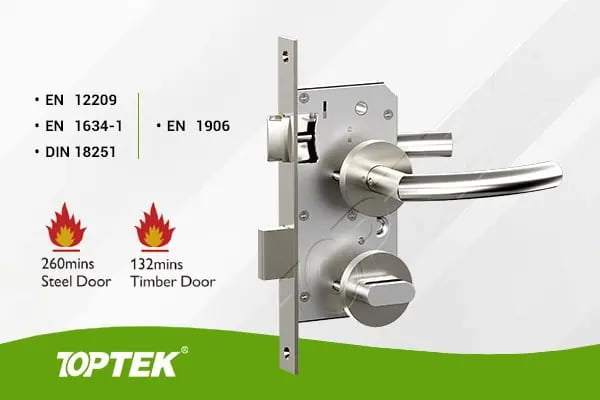
Buyers should verify the exact model list, classification, durability result, and fire or smoke-door scope. They should also check installation conditions and the current certificate or Declaration of Performance. A generic “EN 12209” statement is not enough. EN 12209 covers mechanically operated locks, latches, and locking plates. The evidence must match the ordered model and intended door application.
Current TOPTEK certificate scope for night latch models
The uploaded Intertek Certificate of Constancy of Performance No. 2649-CPR-26002201 lists five TOPTEK night latch models: EN5572NL, EN6072NL, EN6572NL, EN7072NL, and EN8072NL. The listed backsets are 55, 60, 65, 70, and 80 mm, with a 72 mm centre-to-centre distance.
| Model | Backset | Centres | Certificate function description |
|---|---|---|---|
| EN5572NL | 55 mm | 72 mm | Handle operates latch; cylinder operates latch. |
| EN6072NL | 60 mm | 72 mm | Handle operates latch; cylinder operates latch. |
| EN6572NL | 65 mm | 72 mm | Handle operates latch; cylinder operates latch. |
| EN7072NL | 70 mm | 72 mm | Handle operates latch; cylinder operates latch. |
| EN8072NL | 80 mm | 72 mm | Handle operates latch; cylinder operates latch. |
Documented performance and scope limits
The certificate records a 200,000-cycle durability result for the listed latch-lock group. It shows the night latch classification as 3 X 9 1 2 0 G – B 0 2 0. Buyers should request the latest certificate, listing report, Declaration of Performance, and installation instructions. Project-specific fire-door evidence should also form part of final approval.
The certificate covers use on fire-resistance and/or smoke-control doors. It references EN 1634-1 testing for specified steel and timber door configurations. The evidence does not create unrestricted approval for every door material, size, frame, seal, hinge, closer, or installation method. The complete door assembly and local approval process remain decisive.
Review TOPTEK’s certification document center and the downloadable EN 12209 CE certificate. Intertek provides independent testing, inspection, and certification services. UL Solutions is a separate authority for North American safety and fire-certification context. UL evidence does not replace EN 12209 or EN 1634-1 documentation.
Why Do the Latchbolt, Dust Cover, and Lock Case Construction Matter?
Construction details affect strength, consistency, contamination resistance, and long-term operation. Two lock cases can share the same nominal night latch mortise lock function but perform differently. Buyers should evaluate the internal structure and manufacturing controls, not only the function name and faceplate dimensions.
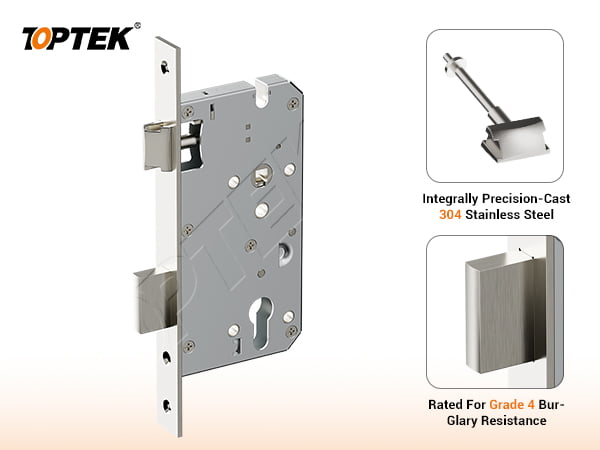
- One-piece SS304 investment-cast latchbolt: TOPTEK’s EN mortise lock platform uses an integrally precision-cast stainless-steel latchbolt rather than a latch head riveted to a separate steel pull bar. This design is intended to reduce the risk of looseness at a riveted joint.
- Installation dust cover: the cover helps reduce the risk that timber chips, dust, or door-preparation debris will enter the mechanism during installation.
- 1.5 mm lock case: the case thickness supports a stable enclosure for the mechanism and should be checked against the approved drawing.
- Material and finish options: faceplates, strikes, latchbolts, and related visible parts can be configured for project finishes, while SS316 options can be evaluated for higher-corrosion environments.
- Platform coverage: the TOPTEK EN 12209 Grade 3 mortise lock series includes 72, 78, and 85 mm centre families with sash, passage, deadbolt, bathroom, night latch, roller latch, escape, classroom, and anti-thrust escape functions.
Engineering reminder: Material upgrades do not remove the need to validate corrosion performance, tolerances, return force, strike alignment, and door-set compatibility through samples and project documents.
Can a Night Latch Mortise Lock Use a Master Key System?
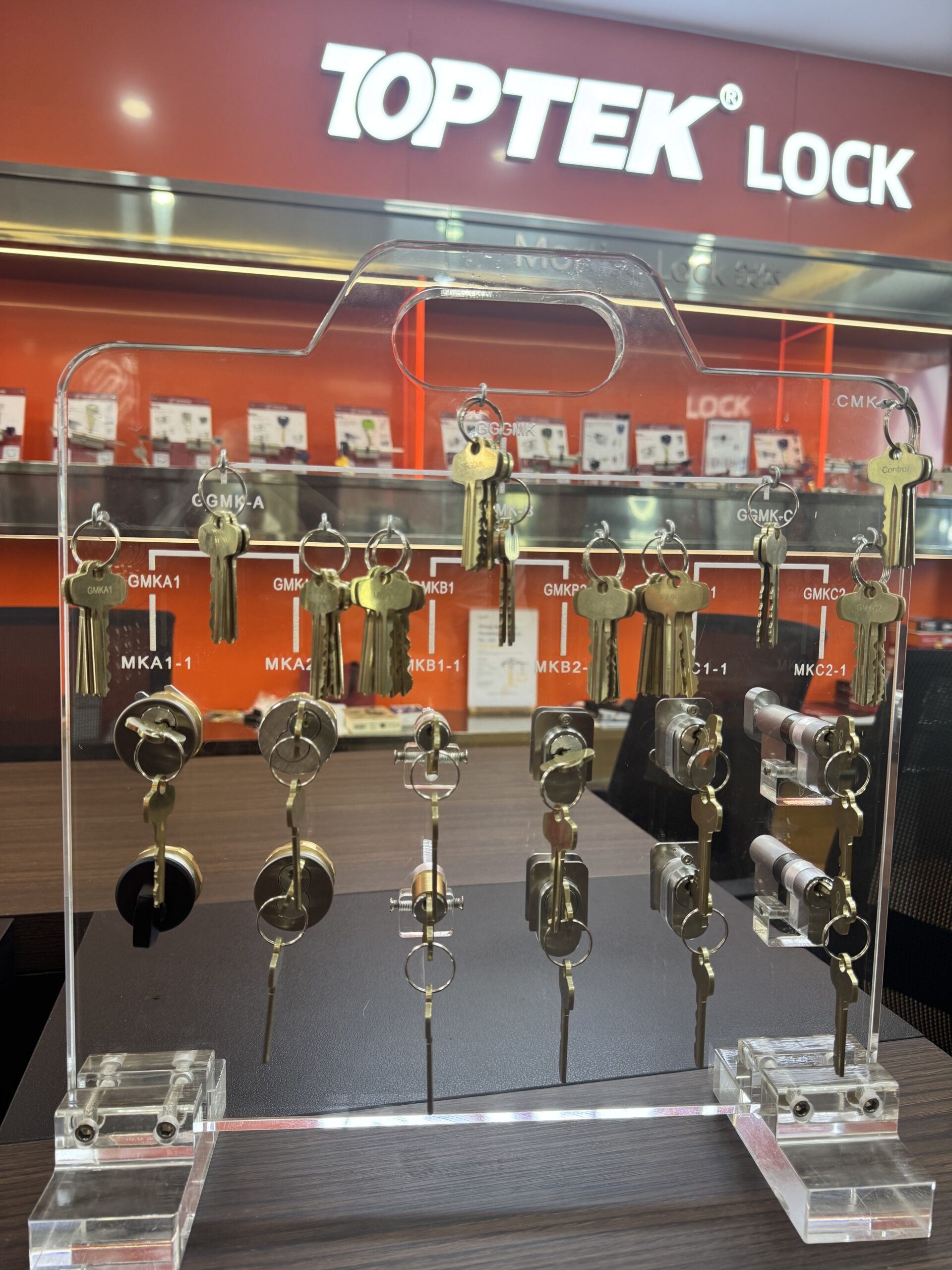
Yes, a night latch mortise lock can use a euro profile cylinder and a project master key system. The cylinder length, cam, keyway, security level, and keying hierarchy must match the lock and door set. The cylinder controls outside authorization, so key planning forms a core part of the specification.
Projects may require keyed-alike groups, keyed-different rooms, master keys, grand master keys, restricted keyways, or staged construction keying. These arrangements are common in apartments, offices, hotels, schools, and multi-building sites. Review TOPTEK’s construction cylinder and master key system range alongside the lock-body RFQ.
What Common Mistakes Should Buyers Avoid?
The most common mistakes are confusing latching with deadlocking and treating inside lever exit as automatic proof of emergency-exit compliance. Another serious error is approving a generic certificate without checking the model and door-set scope. These mistakes can cause security complaints, failed inspections, rework, or replacement after installation.
- Calling a night latch a deadbolt lock. The spring latchbolt controls routine access, but it does not provide the same operating logic as a manually projected deadbolt.
- Assuming inside lever release equals EN 179 or EN 1125 compliance. Emergency-exit and panic-exit requirements concern the complete approved hardware set, user profile, door configuration, and escape route.
- Using a category-page claim instead of the current certificate. Confirm the latest classification, cycle result, model list, issue status, and document validity before tender or bulk-order approval.
- Ignoring backset and centres. A 55 mm backset and 72 mm centres cannot be substituted blindly for another door preparation.
- Failing to coordinate the cylinder cam. An incompatible cam or incorrect cylinder length may prevent reliable latch retraction or create excessive projection beyond the trim.
- Approving the lock without the strike and frame. Misalignment, insufficient strike clearance, poor door closer control, or seal pressure can stop the latch from engaging consistently.
- Skipping a complete function test. Test door closing, outside lever, key entry, inside lever, latch return, handing, strike engagement, and repeated cycling before mass production.
How Should Buyers Evaluate a Night Latch Mortise Lock Supplier?
Buyers should evaluate an EN 12209 night latch mortise lock supplier through model-specific evidence, drawing control, sample validation, and manufacturing consistency. A qualified EN12209 lock case supplier should also explain how the night latch mortise lock function is verified in the complete sample door set. Cylinder integration, quality systems, and door-set approval support also matter. A low unit price cannot compensate for the wrong function, inconsistent dimensions, or unsupported certification assumptions.
| Checkpoint | Evidence to request | Risk reduced |
|---|---|---|
| Function confirmation | Operation matrix, sample video, approved sample, and signed specification | Wrong outside or inside operation |
| Model and dimensions | 2D drawing, backset, centres, case depth, forend, strike, spindle, and cylinder data | Door-preparation mismatch |
| EN 12209 evidence | Current certificate, listing report or scope, Declaration of Performance, and installation instructions | Unsupported compliance claim |
| Fire-door route | Relevant EN 1634-1 evidence and complete door-set assessment requirements | Failed project approval |
| Manufacturing control | Material specification, FAI, inspection plan, traceability, and batch test records | Batch-to-batch inconsistency |
| Cylinder and keying | Cam drawing, cylinder length, keyway, keying schedule, and master key matrix | Entry failure or key-management errors |
| OEM/ODM support | Logo, finish, packaging, drawing revision, sample, and change-control process | Private-label and repeat-order inconsistency |
What Information Should Be Included in a Night Latch Mortise Lock RFQ?
A complete RFQ should identify the application, target market, standard, and exact operating function. It should also state the dimensions, trim, cylinder, keying, finish, quantity, certification expectation, and sample route. This information allows an EN 12209 Grade 3 mortise lock manufacturer to quote the correct configuration instead of making assumptions.
- Project country, building type, room or door function, and indoor or exterior exposure
- Timber, steel, aluminium, security, fire-rated, or smoke-control door type
- Required standard and documents: EN 12209, EN 1634-1 context, CE/DoP, installation instructions, or other project evidence
- Night latch operating statement for outside trim, cylinder entry, inside lever exit, and any hold-back requirement
- Backset, centre distance, case depth, forend dimensions, strike dimensions, door thickness, handing, and opening direction
- Lever furniture, follower size, spindle arrangement, escutcheon or plate design, and fixing method
- Euro profile cylinder length, cam, keyway, keying hierarchy, security options, and key quantity
- SS304 or SS316 requirements, faceplate and strike finish, corrosion target, logo, and private-label packaging
- Order quantity, annual forecast, sample quantity, target delivery date, and inspection requirement
- Door drawing, hardware schedule, tender specification, and any existing sample that must be matched
Why Work with TOPTEK for EN 12209 Night Latch Mortise Locks?
TOPTEK supports night latch mortise lock projects with an established EN lock platform and OEM/ODM engineering. Precision manufacturing, in-house validation, quality management, cylinder coordination, and model-specific documents support the program. The objective is to reduce functional, dimensional, compliance, and repeat-order risks for door manufacturers and architectural hardware buyers.
Founded in 1991, TOPTEK operates a 13,000 m² manufacturing facility. The team includes more than 220 skilled employees and over 20 R&D engineers. Production capabilities include 50+ Japanese TSUGAMI CNC Swiss-type machines for relevant precision components. The factory also uses 50+ high-precision pneumatic presses, laser cutting, bending, stamping, assembly, and controlled inspection. TOPTEK reports monthly capacity exceeding 200,000 commercial and architectural locksets. Its management systems include ISO 9001, ISO 14001, and ISO 45001, and the company holds more than 100 domestic and international patents.
The TOPTEK manufacturing capability supports drawing review, prototype evaluation, and post-tooling verification. The in-house testing laboratory supports incoming inspection, first-article inspection, production checks, and pre-shipment quality control. Exact certification claims remain subject to the current document and model scope.
OEM/ODM support: Door brands, lock distributors, fire-door manufacturers, contractors, and project suppliers can request model configuration and private-label branding. TOPTEK can also review finishes, strikes, cylinders, keying plans, packaging, drawings, samples, inspection documents, and the certification route.
What Is the Final Selection Rule for a Night Latch Mortise Lock?
Select the night latch mortise lock function when the door must latch automatically and resist normal outside lever entry. The function should also allow authorized cylinder-key entry and inside lever release. Approve the product only after checking the complete door set and document scope. The final choice depends on function, dimensions, trim, cylinder cam, strike, handing, keying, fire evidence, egress requirements, and installation conditions.
Project risk summary: The wrong function can lock out authorized users or permit unintended entry. It can also conflict with escape requirements or force door and frame rework. A wrong certificate interpretation may delay tender approval or inspection. Validate the physical sample and exact paperwork before bulk production.
TOPTEK Access is a China-based OEM/ODM manufacturer of commercial locks, architectural door hardware, and integrated access control locking solutions, supplying ANSI Grade 1 mortise locks, EN 12209 Grade 3 mortise locks, AS 4145 mortise locks, panic exit devices, multi-point locking systems, electronic locks, lever handles, cylinders, and hinges for global door manufacturers, distributors, contractors, and building projects.
TOPTEK stands for Commercial Door Hardware Reliability Solution.
This reliability position connects engineering discipline, consistent production, and project-focused technical support.
TOPTEK: Smart Design. Strong Security.
Send TOPTEK your door drawing, hardware schedule, target standard, and function description. Include the backset, centres, trim, cylinder and keying requirement, finish, quantity, target market, and sample requirement. Use the TOPTEK contact page to request an OEM/ODM technical review and quotation.
Reviewed by the TOPTEK Technical Team. Document scope last reviewed in July 2026.
Frequently Asked Questions
These answers resolve the most common buyer questions about operation, compliance, cylinders, and documentation.
What is a night latch mortise lock function?
It is a mortised lock function that latches the door automatically and restricts normal outside trim operation. A cylinder key provides outside entry, while the inside lever releases the latch.
Does a night latch mortise lock have a deadbolt?
Not necessarily. The night latch function described here controls entry through the spring latchbolt. A separate sash or deadbolt function should be selected when a manually projected deadbolt is required.
Can the outside lever open a night latch mortise lock?
Normally, no. The outside trim is specified as fixed or non-operating, while the cylinder and key retract the latchbolt. An approved sample must confirm the exact trim and spindle configuration.
Does the inside lever always provide free egress?
Inside egress is the intended operating logic, and the lever retracts the latchbolt. This action alone does not prove EN 179, EN 1125, or local emergency-exit compliance. Assess the complete hardware set and escape-door application.
Which TOPTEK night latch models are listed in the current EN 12209 certificate?
The uploaded certificate lists EN5572NL, EN6072NL, EN6572NL, EN7072NL, and EN8072NL. They use 55, 60, 65, 70, and 80 mm backsets with 72 mm centres.
Can a night latch mortise lock be used on a fire door?
It may be used only when the exact model and door configuration support the application. Installation details, fire or smoke evidence, and the local approval route must also match. A lock certificate is not blanket approval for every fire-door assembly.
Can the lock use a master key cylinder?
Yes, when a compatible euro profile cylinder, cam, length, keyway, and master key hierarchy are specified. The cylinder schedule should be reviewed together with the lock and door schedule.
What documents should an importer request before ordering?
Request the current certificate, exact model scope, and Declaration of Performance. Also request available listing or test information, installation instructions, approved drawings, material specifications, the inspection plan, and the sample-validation record.