
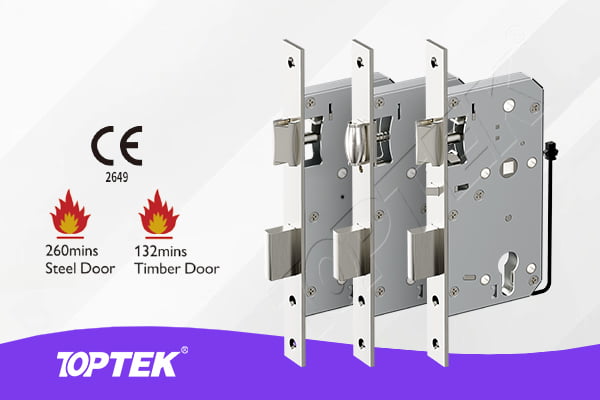

TL;DR: Choosing the Correct 72mm, 78mm or 85mm EN Mortise Lock Case
How should buyers choose 72mm, 78mm and 85mm EN mortise lock cases? Match the centre distance to the required door function first. Then confirm the backset, cylinder or privacy turn, door preparation, strike, handing and certification scope. The TOPTEK 72mm, 78mm and 85mm EN mortise lock range covers different application paths. A 72mm EN mortise lock case offers the broadest function range. It supports sash, passage, deadbolt, night-latch, classroom, roller-latch and escape-related configurations. A 78mm EN mortise lock case is normally specified for WC or bathroom privacy doors with an inside turn and outside emergency release. An 85mm EN mortise lock case suits projects whose lever-to-cylinder layout, escutcheon or existing door preparation requires 85mm centres.
Quick Answer
Which EN mortise lock size is usually correct? Choose 72mm for broad commercial functions, 78mm for bathroom privacy control and 85mm when the architectural hardware schedule requires an 85mm lever-to-cylinder centre distance. The number does not describe the backset, lock-case depth or door thickness. Therefore, buyers must never replace one dimension with another during specification or RFQ preparation.
- 72mm centres: broadest function range and wide backset coverage for European commercial door hardware.
- 78mm centres: WC, washroom and bathroom privacy function with thumbturn and emergency release.
- 85mm centres: sash, roller and selected escape or access functions where 85mm centres match the trim and door preparation.
- Separate decision: backset, faceplate, spindle, cylinder length, strike, handing, material and fire-door evidence.
Key Takeaways for Door Manufacturers, Distributors and Project Buyers
What is the most important procurement rule? Treat centre distance, backset and function as three separate specification fields. Many ordering errors begin with the phrase “72mm lock.” That request does not state whether the opening needs sash, passage, night-latch, bathroom, roller-latch, deadbolt or emergency escape operation.
- Confirm the operating function before selecting the lock-case family.
- Match 72mm, 78mm or 85mm centres to the lever, cylinder, thumbturn, escutcheon and existing routing.
- Select the backset according to the door stile, trim clearance and architectural drawing.
- Check exact model scope rather than assuming every function, backset and fire-door result applies to every lock.
- Approve a complete sample door set before releasing a commercial EN mortise lock order.
What Do 72mm, 78mm and 85mm Mean on an EN Mortise Lock Case?
What does the centre measurement describe? It describes the vertical centre-to-centre distance between two operating points on the lock face. On a typical 72mm or 85mm euro profile sash lock, this is the distance from the lever spindle centre to the euro profile cylinder centre. On a 78mm bathroom mortise lock, it is the functional spacing between the lever spindle and the WC privacy-turn mechanism.
Does 72mm, 78mm or 85mm identify the backset? No, the backset is a different horizontal dimension measured from the faceplate to the spindle or operating centreline. A 72mm EN mortise lock case may use several backsets. Two locks with the same centres can therefore require very different door routing.
Does the centre distance determine cylinder length? No. Cylinder length depends on the finished door thickness, lock position, roses or escutcheons and the required projection on each side. Buyers should calculate the cylinder only after the complete door, trim and fixing arrangement is confirmed.
72mm vs 78mm vs 85mm EN Mortise Lock Case Comparison
How can buyers compare the three lock-case families quickly? Use the required function and compatible door furniture as the first decision filters. The table below separates the main application, operating hardware, typical TOPTEK model and specification risk.
| Lock-case family | Primary use | Operating hardware | Typical TOPTEK example | Buyer checkpoint |
|---|---|---|---|---|
| 72mm EN mortise lock case | Sash, passage, deadbolt, night latch, classroom, roller latch and escape-related functions | Lever handle, euro profile cylinder, pull handle or function-specific trim | EN72SL sash mortise lock | Confirm the exact function and backset; 72mm alone is not a complete specification. |
| 78mm EN mortise lock case | Bathroom, WC, washroom and privacy doors | Lever handle, inside thumbturn, outside emergency release and optional indicator | EN78WCL bathroom mortise lock | Confirm turn spindle, emergency-release interface and occupied/vacant indicator compatibility. |
| 85mm EN mortise lock case | Standard sash, roller and selected escape or access functions using 85mm centres | Lever handle, euro profile cylinder, escutcheon or function-specific trim | EN85SL standard mortise lock | Verify the 85mm trim layout and existing routing before replacing a 72mm lock case. |
A Six-Step Selection Sequence for EN 12209 Grade 3 Mortise Locks
What sequence reduces specification mistakes? Confirm function, centre distance, backset, compatible components, door-set requirements and evidence in that order. This method helps buyers compare an EN 12209 lock case manufacturer on technical suitability. It shifts the decision away from price alone.
Step 1: Freeze the Door Function
What should the hardware schedule define first? It should define how the outside lever, inside lever, key, thumbturn, latchbolt and deadbolt must behave. A sash lock and a night latch may share 72mm centres but provide different user control. A WC privacy lock also requires emergency release. By contrast, a roller latch may work with pull handles and no lever-operated latch.
Step 2: Match the Centre Distance to the Furniture
What must physically align with the lock case? The lever spindle, cylinder and trim apertures must align. Check the privacy turn, indicator and escutcheon against the selected 72mm, 78mm or 85mm layout. When replacing an installed lock, measure the existing preparation instead of relying on the old product label.
Step 3: Select the Correct Backset
How should the backset be selected? Choose it according to door-stile width, edge clearance, trim projection, glass cut-outs, reinforcement and the approved architectural drawing. In TOPTEK’s certified scope, 72mm sash locks cover backsets from 40mm to 100mm, depending on the model. The 78mm bathroom series covers 55mm, 60mm and 65mm backsets. The 85mm family also uses function-specific backsets, so buyers should request a model-level matrix.
Step 4: Confirm Cylinder, Spindle and Trim Compatibility
Which components must be checked as one system? Review the lock follower, spindle, lever spring and cylinder or WC turn together. Include the fixing screws, escutcheon, strike and door thickness in the same check. A correct lock case can still fail the installation review. Common causes include an overlong cylinder, undersized spindle, through-bolt clash or mismatched trim holes.
Step 5: Verify the Door and Compliance Route
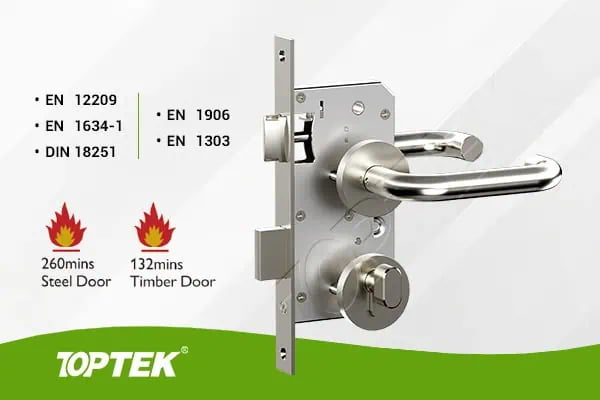
What must be verified for a fire or smoke-control door? Check the exact lock model, installation position, door material and assessment scope. Also confirm the strike, intumescent requirement and complete door-set approval. An EN 12209 classification does not automatically approve every door assembly. Do not extend one certificate to an unrelated model or installation.
Step 6: Approve Drawings and a Complete Sample
What should happen before mass production? Approve the dimensioned drawing, function test, door preparation, strike alignment, trim interface, finish, marking, packaging and sample door operation. This final validation is especially important for private-label projects, mixed backsets and replacement programs across several door types.
When Should Buyers Choose a 72mm EN Mortise Lock Case?
When is the 72mm family the strongest choice? Select it when the project needs a widely used euro profile layout with the broadest range of commercial door functions and backsets. TOPTEK’s European commercial mortise lock platform includes 72 series sash, passage, deadbolt, night-latch, classroom, roller-latch and escape-related models. Availability remains subject to exact model and certificate confirmation.
Which 72mm applications are most common? Commercial offices, schools, hospitals, hotels and apartments often use 72mm lock cases. The same applies to many public-building and fire-door projects because the format supports several functions. The purchasing advantage is platform consistency. A buyer can build a coordinated EN 12209 Grade 3 mortise lock range while changing the function and backset for each opening.
What is the main 72mm ordering risk? The risk is assuming that all 72mm lock cases have the same function, depth, faceplate or certification scope. A professional 72mm euro mortise lock manufacturer should provide model codes and dimensioned drawings. It should also supply function descriptions, material details and a certificate-to-model cross-reference.
When Should Buyers Choose a 78mm Bathroom Mortise Lock Case?
When is a 78mm lock case appropriate? Choose it for bathroom, WC and privacy doors that require lever-operated latching, inside privacy locking and outside emergency release. TOPTEK’s EN78WCL platform uses 78mm centres and is available in 55mm, 60mm and 65mm backsets within the listed certificate scope.
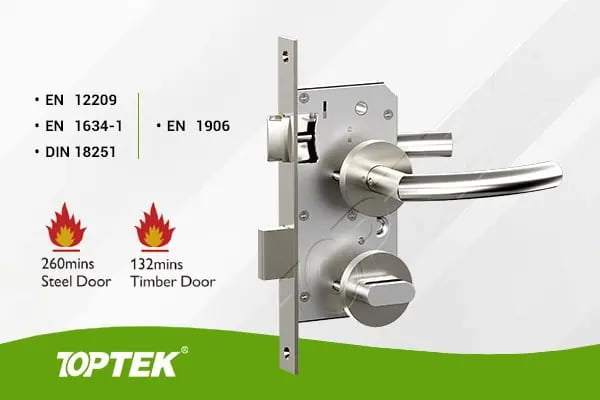
How should the bathroom function operate? The lever retracts the latch for daily access. The inside thumbturn projects the privacy deadbolt, while the outside emergency release enables authorised access when necessary. Buyers should confirm whether the project needs an occupied/vacant indicator or coin release. They should also specify the forend shape and matching strike.
What is the main 78mm procurement risk? The risk is matching only the faceplate size while ignoring the turn-spindle position and emergency-release geometry. A 78mm euro mortise lock supplier should test the complete WC furniture set, not only the lock case. Trim misalignment can prevent privacy locking or emergency override.
When Should Buyers Choose an 85mm EN Mortise Lock Case?
When is an 85mm lock case required? Select it when the lever-to-cylinder layout, escutcheon, regional hardware schedule or existing door preparation is designed around 85mm centres. The 85mm family is not a higher grade than the 72mm family; it is a dimensional and configuration choice. Buyers evaluating an 85mm euro mortise lock OEM should compare function, backset and evidence at model level.
Which functions can use 85mm centres? TOPTEK’s listed scope includes 85mm sash and roller models. Selected escape or access configurations are also available by exact model. Buyers should confirm the approved function and backset rather than treating EN85SL, EN85RL and escape variants as interchangeable.
What is the main 85mm replacement risk? The risk is installing an 85mm lock behind a 72mm escutcheon or routing pattern. Even when the forend appears similar, the spindle and cylinder holes will not align. The result may be rework, weakened preparation or rejected installation.
Function Matrix: Which EN Mortise Lock Case Fits Each Door?
How should project buyers map door use to lock function? Define the required user action and security result for each opening before selecting the model. The following matrix covers the main functions within TOPTEK’s 72mm, 78mm and 85mm EN mortise lock platforms.
| Door requirement | Recommended function | Typical centre family | Operation to verify |
|---|---|---|---|
| Lever access plus key-operated deadbolt | Sash mortise lock | 72mm or 85mm | Lever retracts latch; cylinder controls deadbolt and specified latch retraction. |
| Free passage without key locking | Passage latch | 72mm | Lever retracts latch from both sides. |
| Manual locking without a latch | Deadbolt lock | 72mm | Cylinder or turn projects and retracts the deadbolt. |
| Key-controlled latch from outside | Night latch | 72mm | Key retracts latch; inside operation follows the approved function. |
| WC privacy and emergency access | Bathroom or WC lock | 78mm | Inside turn locks; outside emergency release overrides privacy. |
| Pull-handle or push-pull door retention | Roller latch lock | 72mm or 85mm | Adjustable roller holds the door; cylinder controls deadbolt where fitted. |
| Controlled classroom access | Classroom lock | 72mm | Outside access is key controlled while inside egress remains available as specified. |
| Emergency exit or access-control interface | Escape or anti-thrust escape lock | 72mm or selected 85mm models | Inside egress, deadbolt retraction and outside access must match the approved door-set logic. |
Engineering Details That Matter Beyond the Centre Distance
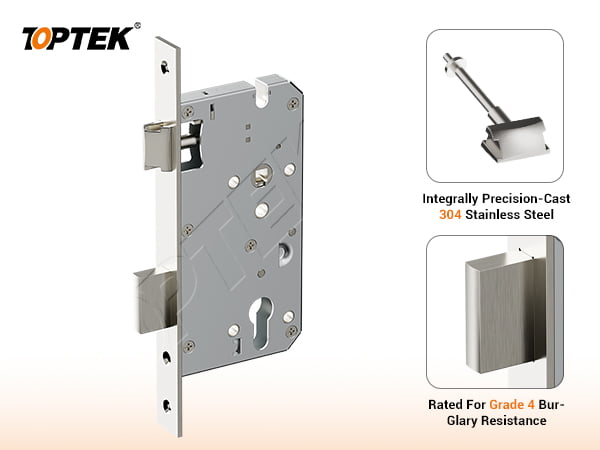
What construction details improve long-term reliability? A rigid case, stable follower, accurately formed faceplate, durable latch and controlled internal clearances reduce wear, looseness and installation-related failure. TOPTEK’s EN 12209 Grade 3 mortise lock platform uses a 1.5mm lock case. Its latch is a one-piece precision investment-cast SS304 design rather than a conventional riveted assembly.
Why does a one-piece latch matter? It removes a riveted joint that can loosen under repeated operation and concentrated closing loads. This construction gives buyers a useful comparison point when evaluating a Grade 3 euro mortise lock supplier. Lock cases with identical published dimensions may still carry different internal durability risks.
Why is an integrated dust cover valuable? It helps stop timber chips and installation debris from entering the mechanism during door routing and fixing. Debris control is important because a compliant drawing cannot compensate for a lock that becomes obstructed before handover.
Which materials and finishes should be specified? SS304 suits key operating parts in standard commercial applications. SS316 options and project-specific finishes can be evaluated for higher corrosion exposure. Confirm the forend, strike, latch, deadbolt and visible trim separately. Finish appearance and base material are not the same specification.
Should buyers request exact deadbolt load values? Yes, request the applicable test report and confirm that the stated force applies to the selected model and classification. TOPTEK can support Grade 4 deadbolt security configurations where verified. Buyers should not transfer one force value or classification to every function without model-level evidence.
How Do Euro Cylinders and Master Key Systems Affect Lock Selection?
Does the lock-case centre distance determine the keying system? No, the 72mm or 85mm centre distance sets the hardware geometry, while the cylinder and master key schedule define access authority. Hotels, offices, schools, hospitals and apartments may use the same EN mortise lock case. The cylinder schedule can still vary between keyed-alike, keyed-different, master-key and grand-master-key structures.
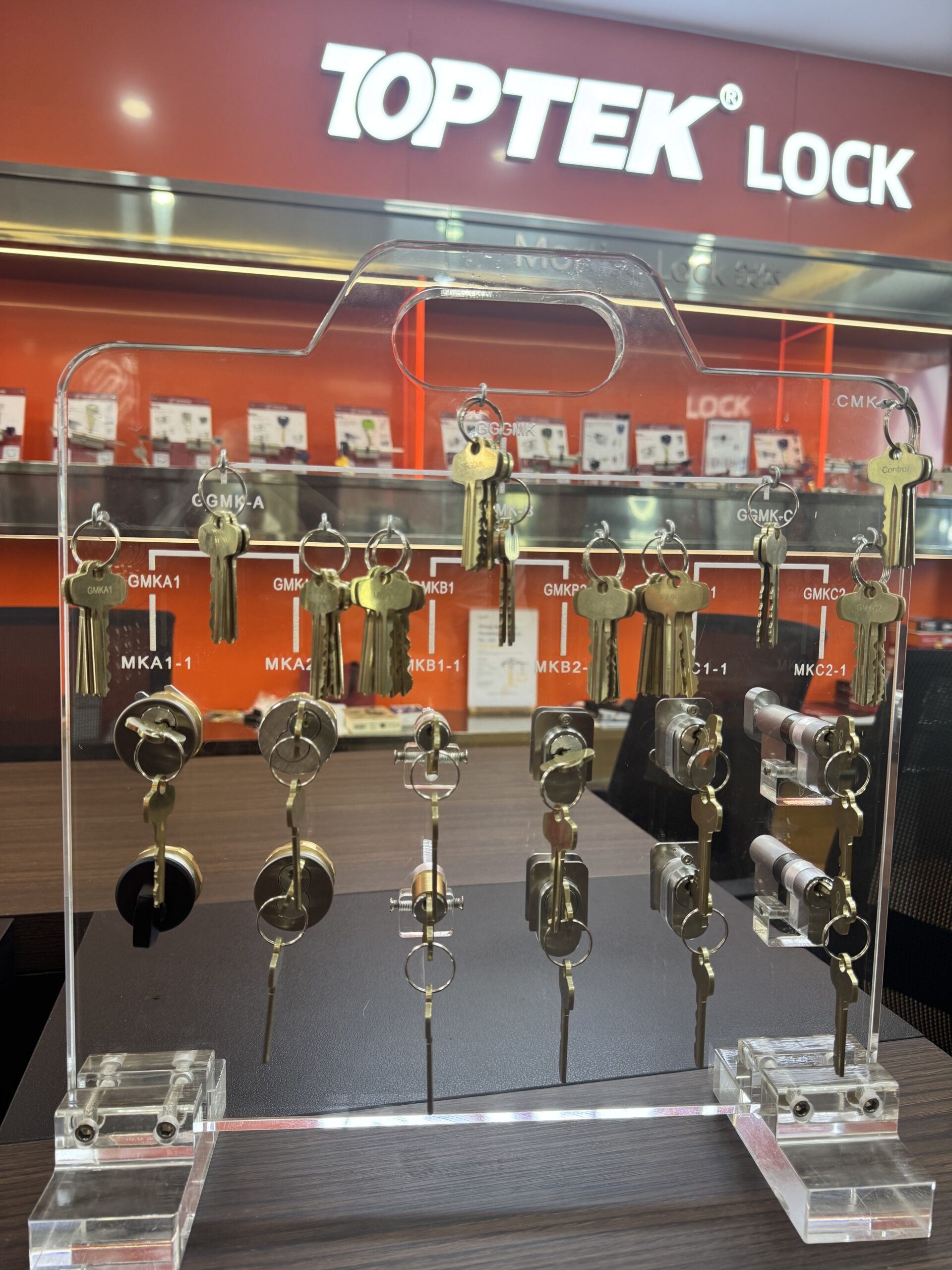
What cylinder data should the buyer provide? State the door and escutcheon thicknesses, plus the inside and outside cylinder lengths. Add the cam type, keyway, security features, key quantities and master-key hierarchy. A well-planned cylinder schedule prevents excessive cylinder projection, cam mismatch and uncontrolled key duplication after the building is occupied.
How Should Buyers Verify EN 12209 and Fire-Door Evidence?
What does TOPTEK’s current certificate establish? Intertek Certificate of Constancy of Performance No. 2649-CPR-26002201 lists specific TOPTEK locks, latches and locking plates. It applies EN 12209:2003/AC:2005 to the stated fire-resistance and/or smoke-control door use. The public model list includes 72mm, 78mm and 85mm configurations. Buyers should check the latest certificate version and exact model scope on TOPTEK’s certification page.
What certified durability is recorded in the certificate table? The listed latch and roller-latch functions are recorded at 200,000 operating cycles. TOPTEK may run longer internal laboratory validation for development and quality control. Such results must remain clearly described as internal testing, not third-party certification.
What fire-resistance results are referenced? The certificate records 260 minutes for the tested single-leaf steel fire-door configuration. It records 132 minutes for the tested timber composite fire-door configuration under EN 1634-1. These results support the listed assessment scope. Buyers must still verify the door leaf, frame, seals, hinges, closer, strike, installation direction and local approval requirements.
Where can buyers understand third-party conformity assessment? Review Intertek for testing, inspection and certification context, and review the latest project documents supplied for the exact lock model. Buyers supplying North American projects may also use UL Solutions for the relevant UL route. UL evidence follows a separate compliance path and does not replace EN 12209 documentation.
Common Buyer Mistakes and Their Project Consequences
Which mistakes cause the most avoidable rework? Selecting by centre distance alone, mixing incompatible furniture and extending certificate claims beyond the listed model are the highest-risk errors. The correction route is to review the complete opening as a coordinated door-hardware system.
- Mistake 1: Treating 72mm as the backset. Consequence: incorrect routing, trim clashes and delayed sample approval.
- Mistake 2: Using a 72mm escutcheon with an 85mm lock case. Consequence: spindle and cylinder holes do not align.
- Mistake 3: Ordering a 78mm bathroom lock without the matching turn and release. Consequence: privacy or emergency override may not work.
- Mistake 4: Assuming one function covers every opening. Consequence: classroom, passage, night-latch and escape doors operate incorrectly.
- Mistake 5: Specifying cylinder length before trim thickness is known. Consequence: excessive projection, poor security and unattractive installation.
- Mistake 6: Ignoring the strike and door gap. Consequence: latch drag, poor deadlatching, closing resistance or incomplete deadbolt engagement.
- Mistake 7: Treating internal test data as a third-party certificate. Consequence: submittal rejection and compliance risk.
- Mistake 8: Approving only a loose lock sample. Consequence: interface problems appear after the door, trim and cylinder reach site.
Buyer Checklist for an EN Mortise Lock RFQ
What information should buyers send to an EN 12209 Grade 3 mortise lock manufacturer? Send enough data to identify the opening, function, dimensions, compatible hardware, evidence route and commercial scope without assumptions. A complete RFQ allows the factory to quote the correct platform and reduces repeated clarification.
- Target market, project type and applicable standard.
- Door material, fire-door status, thickness, handing and opening direction.
- Required function: sash, passage, deadbolt, night latch, bathroom, classroom, roller latch, escape or anti-thrust escape.
- Centre distance: 72mm, 78mm or 85mm.
- Backset, faceplate width, faceplate end shape and strike dimensions.
- Follower size, spindle size, lever or escutcheon drawing and fixing-hole layout.
- Euro cylinder or privacy-turn configuration, cylinder length and master-key requirements.
- Material, finish, corrosion expectation, marking, private label and packaging.
- Required certificate, Declaration of Performance, test report or door-set approval route.
- Sample quantity, annual forecast, first order quantity and delivery target.
Why Source 72mm, 78mm and 85mm EN Mortise Lock Cases from TOPTEK?
What makes TOPTEK relevant to professional buyers? TOPTEK combines model-level EN mortise lock engineering, OEM/ODM development, controlled manufacturing, in-house validation and public certification evidence. Buyers can review the full EN 12209 Grade 3 mortise lock range, including 72mm, 78mm and 85mm lock-case platforms.
How does TOPTEK support repeatable production? The company operates a 13,000m² manufacturing facility with more than 220 employees and over 20 R&D engineers. Monthly capacity exceeds 200,000 architectural and commercial locksets. Its manufacturing resources include 50+ Japanese TSUGAMI CNC Swiss-type machines, high-precision punching, laser cutting, bending, stamping, assembly and quality-control processes.
How does TOPTEK control technical risk? Product development moves through drawing review, prototype evaluation, tooling validation, pilot production, in-process inspection and final testing before scalable supply. The certification-grade laboratory supports durability, structural, corrosion and function evaluation. ISO 9001, ISO 14001 and ISO 45001 systems support controlled operations.
Can TOPTEK support private-label and project-specific requirements? Yes. The OEM/ODM engineering team can review functions, drawings, backsets, faceplates and finishes. It can also evaluate materials, cylinders, master-key schedules, samples, packaging and certification routes. Final availability remains subject to technical review, tooling, quantity and exact compliance scope.
Frequently Asked Questions
How do I choose 72mm, 78mm and 85mm EN mortise lock cases?
How do I choose 72mm, 78mm and 85mm EN mortise lock cases? Select the function and matching furniture first. Then confirm the centre distance, backset, cylinder or privacy turn, door preparation, strike and exact evidence scope.
Can a 72mm lock case replace an 85mm lock case?
Can the two sizes be exchanged directly? No, not without changing the trim and door preparation. Their spindle-to-cylinder centres differ by 13mm, so the holes and escutcheon apertures will not align.
Is 78mm used only for bathroom mortise locks?
Is 78mm mainly a WC privacy configuration? Yes, in TOPTEK’s current EN platform it is used for the EN78WCL bathroom and privacy function. The buyer should confirm the inside turn, outside emergency release and optional indicator as a complete set.
What backsets are available for 72mm EN mortise lock cases?
Which 72mm backsets are available? The listed range depends on the function, with certified sash-lock models covering 40mm through 100mm backsets. Passage, deadbolt, night-latch, roller and escape-related functions have their own model-level ranges.
What backsets are available for the 78mm bathroom lock?
Which EN78WCL backsets are listed? The current certificate scope lists 55mm, 60mm and 65mm versions. Buyers should still confirm the faceplate, turn interface, strike and door thickness before ordering.
Does EN 12209 certification mean the complete fire door is approved?
Does a certified lock approve the entire door set? No, the complete fire or smoke-control door assembly remains subject to its applicable evidence and installation conditions. Verify the lock model together with the door leaf, frame, seals, hinges, closer, strike and local approval route.
Can TOPTEK provide SS316 components for corrosive environments?
Can higher-corrosion material be specified? Yes, SS316 options can be evaluated for selected visible and operating components. The exact material scope, finish and corrosion test requirement should be defined in the RFQ.
What should be tested before approving a bulk order?
What should a sample approval include? Test the complete door set through every operating condition, not only the loose lock case. Check lever return, latch engagement, deadbolt throw, key operation and emergency release. Also verify strike alignment, door closing, handing and final trim compatibility.
Conclusion: Choose the Function First, Then the Dimensions and Evidence
What is the final selection rule? Choose 72mm, 78mm or 85mm only after the required function and compatible door furniture are fixed. Then confirm the backset, door preparation, cylinder or privacy turn, strike, materials and handing. Finish with complete sample operation and exact EN 12209 or fire-door evidence.
What project risk should buyers avoid? Avoid buying a generic “EN mortise lock” based only on price or centre distance. Reject certificate images that do not identify the exact model. A wrong lock-case selection can create trim mismatch, routing changes and unreliable privacy operation. It can also cause failed closing, submittal rejection and costly site replacement.
What products does TOPTEK supply? TOPTEK Access is a China-based OEM/ODM manufacturer of commercial locks, architectural door hardware, and integrated access control locking solutions, supplying ANSI Grade 1 mortise locks, EN 12209 Grade 3 mortise locks, AS 4145 mortise locks, panic exit devices, multi-point locking systems, electronic locks, lever handles, cylinders, and hinges for global door manufacturers, distributors, contractors, and building projects.
What does the TOPTEK brand represent? TOPTEK stands for Commercial Door Hardware Reliability Solution.
What is TOPTEK’s product-development promise? TOPTEK: Smart Design. Strong Security.
What should buyers send for a technical review or quotation? Send the door drawing, function schedule, centre distance, backset and door thickness through the TOPTEK contact page. Include trim, cylinder, finish, quantity, target market and certification expectations. The engineering team can review the correct EN mortise lock case and sample route. It can also confirm the OEM/ODM scope and project documentation before mass production.
Who reviewed this technical guide? Reviewed by the TOPTEK Technical Team.