
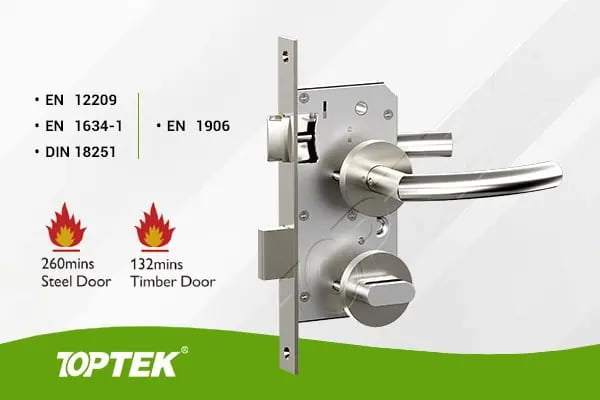

How to Choose an EN 12209 Mortise Lock Manufacturer in China
How to choose an EN 12209 mortise lock manufacturer in China? Choose a manufacturer that matches the correct lock function and proves the exact certificate scope. It should also control critical components, validate batch consistency, and support drawings, samples, OEM/ODM requirements, and project documents. Price matters, but certificate misuse, unstable latch performance, wrong backset selection, weak deadbolt strength, or poor factory control can create much higher costs after installation.
TL;DR: The Seven Checks That Matter Most
What is the fastest way to shortlist an EN 12209 Grade 3 mortise lock manufacturer? This guide explains how to choose an EN 12209 mortise lock manufacturer in China through seven checks. Review certificate authenticity, covered models, function range, declared performance, engineering structure, factory quality control, and RFQ support. A credible China EN 12209 mortise lock manufacturer should show how its evidence connects to the exact product you intend to buy.
- Confirm the certificate number, issuing body, current validity, standard edition, intended use, and covered models.
- Match the function: sash lock, passage latch, deadbolt, bathroom, night latch, roller latch, classroom, escape, or anti-thrust escape.
- Confirm backset, centres, faceplate, strike, handing, cylinder, spindle, door thickness, and trim compatibility.
- Separate third-party certified performance from internal factory validation.
- Inspect critical structures such as the latch assembly, deadbolt, case thickness, dust protection, springs, and fasteners.
- Audit incoming inspection, in-process control, endurance testing, corrosion testing, traceability, and approved-sample management.
- Request drawings, datasheets, certificates, installation instructions, samples, and a written compliance matrix before mass production.
Quick Answer
Which supplier profile is safest for commercial door projects? The safest supplier owns the product design and understands the EN classification system. It controls tooling and production, operates an in-house test route, and traces each claim to approved evidence. Buyers should avoid approving a supplier only from a catalogue logo or a generic statement that all locks are “CE certified.”
Key Takeaways for Door Manufacturers and Hardware Buyers
What should buyers remember before sending an RFQ? EN 12209 selection is model-specific, function-specific, door-assembly-dependent, and evidence-dependent. A strong EN 12209 mortise lock supplier should translate project requirements into a controlled configuration. It should not quote one lock case for every door.
- The EN 12209 marking must be connected to the exact model and declared performance.
- A fire-door claim must match the tested or assessed door configuration and installation conditions.
- Backset and centres alone do not define compatibility; function, spindle, cylinder, faceplate, strike, and trim also matter.
- Certified durability and internal extended-life testing are different evidence categories.
- Engineering details such as a one-piece latch, dust cover, reinforced deadbolt, and controlled case construction reduce field risk.
- A capable OEM/ODM manufacturer should provide drawings, sample approval, batch control, change management, and technical support.
What EN 12209 Proves—and What Buyers Must Still Verify
What does EN 12209 cover? EN 12209 classifies mechanically operated locks, latches, and locking plates. Its performance fields include use category, durability, door mass, fire or smoke suitability, safety, corrosion resistance, security, and application characteristics. The classification code is useful only when the buyer reviews the complete code, the certificate scope, and the related product documentation.
Does an EN 12209 certificate automatically approve every lock made by the same factory? No; the certificate applies only to the listed manufacturer, product family, models, intended use, manufacturing conditions, and assessment route stated in the document. Buyers should request the complete certificate and listing pages instead of accepting a cropped logo, a cover page without models, or a test report belonging to another product.
Does EN 12209 alone approve a complete fire-door assembly? No. A compliant lock is only one component in a complete door assembly. Fire performance also depends on the tested door construction, installation direction, ironmongery, intumescent protection, preparation, and fixing method. The final fire-door approval route should be confirmed by the door manufacturer, fire consultant, certification body, or project authority.
EN 12209 Manufacturer Verification Checklist
Which checkpoints should be completed before supplier approval? Use the following table to compare every EN 12209 Grade 3 mortise lock manufacturer on the same technical and commercial basis. This prevents a low initial quotation from hiding missing certification scope, incomplete functions, weak testing evidence, or expensive tooling changes.
| Checkpoint | Evidence to Request | Buyer Risk if Missing |
|---|---|---|
| Certificate and model scope | Full certificate, listing pages, DoP where applicable, model cross-reference, current status | Uncovered product may be supplied under a generic CE claim |
| Function coverage | Function matrix, operating description, sample demonstration, model code | Wrong egress, privacy, locking, or access behaviour |
| Door compatibility | Backset, centres, case depth, faceplate, strike, spindle, cylinder, door thickness, handing | Rework of doors, frames, trims, or cylinders |
| Declared performance | Classification code, durability result, corrosion grade, security grade, fire/smoke suitability | Specification rejection or performance shortfall |
| Critical component design | Exploded view, material specification, latch and deadbolt details, case construction | Loose rivets, deformation, wear, or inconsistent operation |
| Factory validation | Endurance records, strength tests, salt-spray route, gauge control, calibration and batch sampling | Certificate sample passes, but production batches drift |
| Manufacturing control | IQC, FAI, in-process inspection, final inspection, traceability, approved sample, ECN procedure | Uncontrolled material, finish, dimension, or design changes |
| OEM/ODM capability | Drawing review, logo and packaging options, tooling plan, pilot run, sample approval route | Late development changes and launch delays |
| Supply capability | Capacity, lead time, MOQ, spare parts, packaging validation, delivery plan | Unstable project supply or replacement-part shortages |
| Technical communication | Written compliance matrix, response owner, document revision control, corrective-action process | Different assumptions between purchasing, engineering, factory, and site teams |
How to Verify the Certificate, Listing, and Model Scope
What proof should an EN 12209 mortise lock manufacturer provide first? Request the complete third-party certificate, all listing pages, the applicable Declaration of Performance, the model-to-catalogue cross-reference, and the installation instructions. The model printed on the quotation and sample must appear within the approved scope or be supported by a documented assessment route.
What verified example can buyers review from TOPTEK? TOPTEK’s Intertek Certificate of Constancy of Performance No. 2649-CPR-26002201 identifies specified TOPTEK mortice lock models under EN 12209:2003/AC:2005 for use on fire-resistance and/or smoke-control doors. The listing includes sash locks, roller latches, passage latches, deadlocking bolts, night latches, bathroom locks, and access mortice lock configurations across defined model numbers.
Which performance figures should not be confused? The uploaded certificate records 200,000-cycle latch durability for relevant listed products. Selected TOPTEK configurations can also undergo higher-cycle internal laboratory validation. A buyer should label the former as certified or declared evidence and the latter as internal validation unless a separate third-party report confirms the higher figure.
Where can buyers review TOPTEK compliance documents? Use the TOPTEK certification resource page to review available EN 12209, EN 179, EN 1906, quality-system, and related project documents. Before final approval, ask TOPTEK to confirm the current certificate status and exact model coverage for the proposed order.
Why Function Range Matters More Than a Single Lock Sample
Which functions should a complete Euro mortise lock platform support? A practical EN 12209 lock-case range should cover the door schedule, not just one sash-lock model. TOPTEK’s 72, 78, and 85 series cover nine key project functions. They include sash, passage, deadbolt, bathroom, night-latch, escape, classroom, roller-latch, and anti-thrust escape locks, subject to model confirmation.
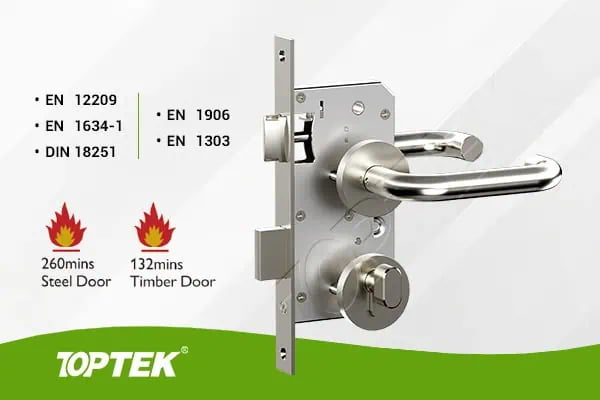
Why must buyers simulate each function before approving a sample? Because identical centres and backsets do not guarantee identical operation. The outside lever, inside lever, key, thumbturn, deadbolt, auxiliary element, and escape action may behave differently. Sample approval should include a written sequence test for every user action and power-free emergency condition that applies to the door.
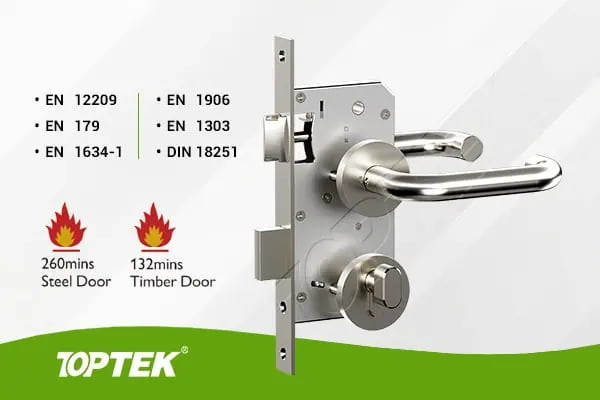
Which dimensions should be frozen before tooling or bulk ordering? Freeze every interface before approval. Record the backset, centres, case dimensions, faceplate, strike, spindle, cylinder position, follower, door thickness, handing, and trim fixing pattern. For 72 mm, 78 mm, and 85 mm Euro lock bodies, the project drawing should control the final configuration instead of relying only on a catalogue family name.
Engineering Features That Reduce Field Failure
Why should buyers inspect the latch construction? The latch assembly is a high-frequency load path, so its material, geometry, connection method, surface quality, and return behaviour directly affect long-term reliability. TOPTEK offers a one-piece precision investment-cast SS304 latch. This avoids the conventional riveted connection between a latch head and iron pull rod, reducing a potential loosening point.
Why does the lock-case cover matter? A controlled 1.5 mm cover and stable case geometry help maintain internal alignment during handling, installation, and repeated operation. Buyers should still verify the complete case material, thickness tolerances, riveting or fastening method, and deformation control on the proposed model.
What problem does an integrated dust cover solve? A dust cover reduces the chance that wood chips, metal swarf, plaster, or installation debris enters the mechanism and causes sticking or functional failure. This detail is especially valuable for timber-door machining and active construction sites where the lock body may be installed before final cleaning.
How should buyers evaluate deadbolt security? Review the EN classification, deadbolt material, projection, guide support, strike engagement, axial resistance, side resistance, and the exact evidence behind any Grade 4 claim. TOPTEK engineering data targets 5,000 N axial resistance and 7,000 N side resistance for relevant configurations. Confirm the matching model, report, and project setup before specification.
When is SS316 worth specifying? SS316 options are useful when the project requires higher corrosion resistance in coastal, humid, chemical, or exposed service conditions. Define the exact SS316 scope before quotation. It may cover the faceplate, strike, latch, deadbolt, trim, or all exposed parts. One stainless part does not make the complete assembly corrosion-proof.
How to Compare Certified Results with Factory Validation
Which test evidence gives the clearest picture of supplier reliability? Use a layered evidence model: third-party certification for declared compliance, internal type testing for design verification, and routine batch testing for production consistency. Each layer answers a different risk, and none should be substituted for another.
| Evidence Layer | TOPTEK Example | Correct Buyer Interpretation |
|---|---|---|
| Third-party EN 12209 certificate | Relevant listed latch products record 200,000 operating cycles and 3 kN latch side-load performance | Use only for the listed models and declared scope |
| Fire-door test and assessment | Tested models are recorded at 260 minutes on a steel fire door and 132 minutes on a timber composite fire door under EN 1634-1 conditions | Do not extend the result to every door construction without assessment |
| Internal endurance validation | Selected lock configurations can be tested up to 1,000,000 operating cycles in TOPTEK’s laboratory | Treat as internal evidence unless independently certified |
| Corrosion validation | Material and finish solutions can be developed for more than 200 hours of salt-spray testing, with higher routes available by requirement | Freeze material, finish, test method, acceptance criteria, and sample condition |
| Production quality control | Incoming inspection, first-article inspection, in-process checks, final inspection, and selected batch laboratory checks | Use to control repeatability after the approved type sample |
Why are fire-test minutes easy to misuse? Because the result belongs to defined models, door materials, installation directions, and test conditions. It does not apply automatically to every lock or fire door. The TOPTEK certificate records 260 minutes for a tested steel-door configuration. It also records 132 minutes for a tested timber composite door. Final use remains subject to the project approval route.
Which independent organizations can buyers consult for testing context? Intertek provides testing, inspection, assurance, and certification services, while UL Solutions provides building-product and safety-related services for relevant markets. These authority links explain independent conformity infrastructure, but only the specific certificate or listing linked to the proposed product proves its actual scope.
Factory Capability and Batch Consistency
Why is a certificate not enough to qualify a China EN 12209 mortise lock factory? A certificate represents assessed product performance, while a qualified EN 12209 Grade 3 mortise lock factory must reproduce it across materials, components, finishes, assembly settings, and production batches. Buyers should audit how drawings, gauges, approved samples, supplier batches, inspection records, and engineering changes are controlled.
Which manufacturing resources support repeatable lock production? TOPTEK operates a 13,000 m² facility. It integrates engineering, stamping, laser cutting, CNC bending, precision machining, assembly, and testing for ANSI, EN, and AS platforms. Relevant precision components use Japanese TSUGAMI CNC equipment and controlled machining tolerances. Metal-case parts follow dedicated punching, forming, and inspection routes.
Which quality-control documents should an importer request? Request a complete quality file. It should include the control plan, incoming and first-article criteria, critical dimensions, material and finish standards, test methods, sampling plan, non-conformance process, and final inspection record. For private-label programs, also freeze logo position, packaging, labels, installation instructions, carton protection, and approved colour samples.
Where can buyers review TOPTEK’s production route? Review the commercial door hardware manufacturing capabilities, certification-grade laboratory, and OEM/ODM support pages before arranging a technical audit or sample program. These pages should support, not replace, project-specific documents and inspection evidence.
Why the Lock Case Must Be Evaluated as a Door-Hardware System
Why can a good lock body still fail in the finished door? The lock body depends on compatible lever furniture, cylinder cam, spindle, strike alignment, door preparation, fixing torque, and keying plan. A sourcing decision should therefore include the complete opening rather than separating the lock case from the components that operate and secure it.
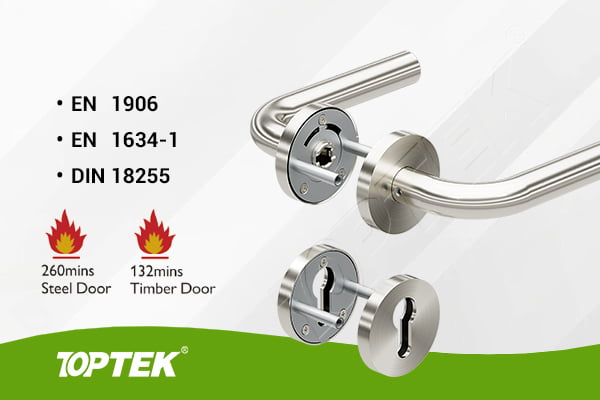
How should a lever handle be matched to an EN mortise lock? Match the follower size, spindle length, spring return, fixing pattern, rose or plate clearance, door thickness, handing, operating torque, and applicable EN 1906 performance. Review TOPTEK’s EN 1906 lever-handle range when a coordinated lock-and-trim package is required.
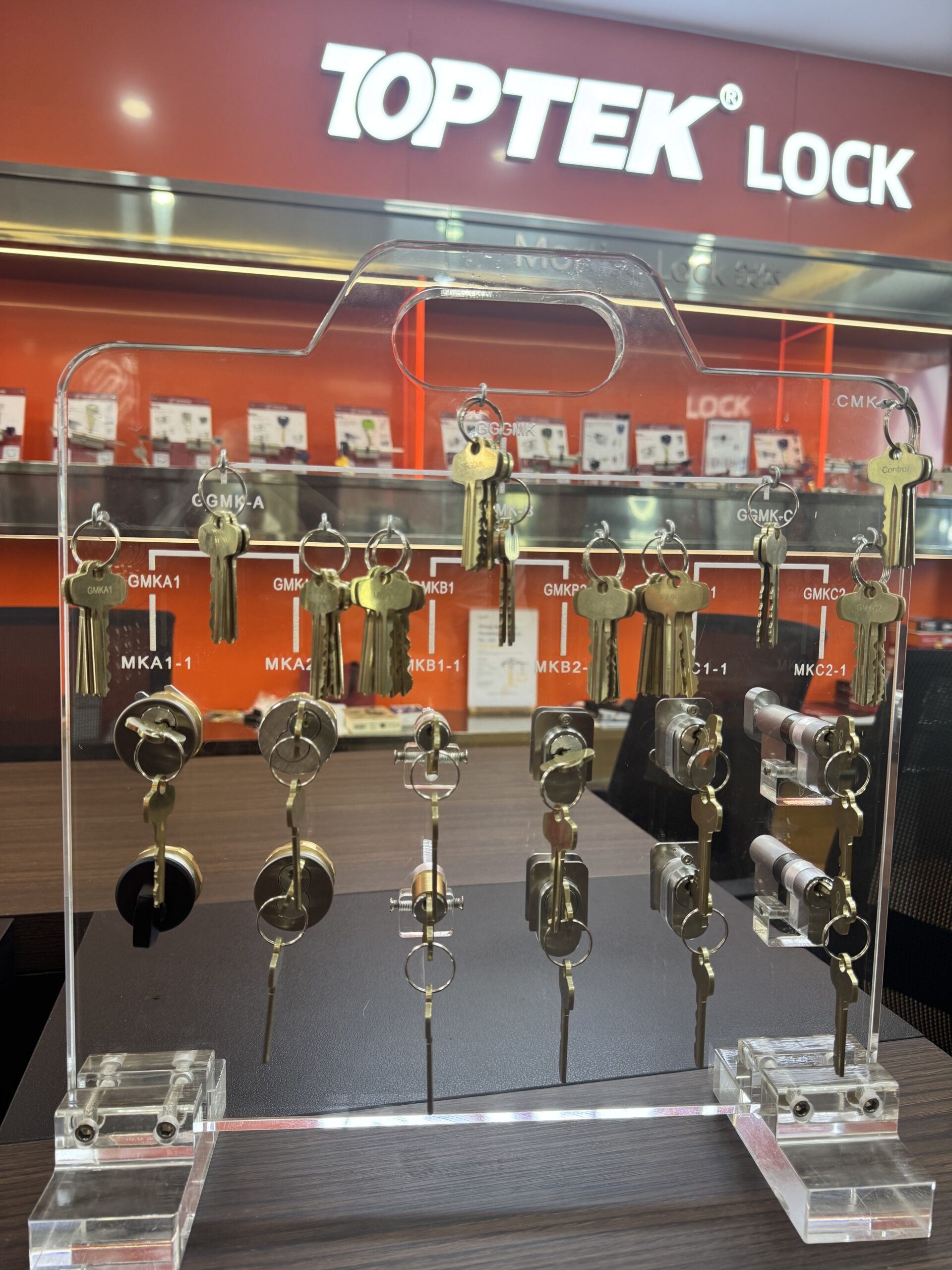
Why should the cylinder and master-key schedule be designed early? Cylinder length, cam geometry, key control, emergency override, hierarchy, construction keying, and future expansion can affect both the lock function and the project handover. TOPTEK supports Euro profile and project-cylinder configurations, including structured master-key planning, through its construction cylinder range.
Manufacturer, Assembler, or Trading Company?
How can a buyer distinguish a real EN 12209 mortise lock manufacturer from a reseller? Ask who owns the drawings and tooling, who controls the certificate, where critical components are made, where endurance testing occurs, and who signs off engineering changes. A trading company may still provide useful service, but the supply-chain role must be transparent and the evidence must trace back to the actual factory.
| Evaluation Area | Qualified OEM/ODM Manufacturer | High-Risk Supplier Signal |
|---|---|---|
| Certificate control | Certificate holder and model scope match the factory and quotation | Only a logo or unrelated report is shown |
| Engineering ownership | Provides controlled drawings, BOM, revisions, samples, and function explanations | Cannot explain internal structure or model differences |
| Testing | Shows equipment, methods, records, calibration, samples, and acceptance criteria | Uses broad claims without test conditions or records |
| Production | Controls tooling, critical parts, assembly, inspection, and traceability | Factory location and subcontracting route remain unclear |
| OEM/ODM | Uses requirement freeze, drawing approval, pilot production, and ECN control | Promises any change without cost, timing, testing, or compliance review |
| Project support | Builds a compliance matrix and verifies door, function, trim, cylinder, and installation | Quotes from one photo without resolving technical inputs |
Six Common Sourcing Mistakes
Which mistakes cause the most expensive project failures? The most damaging mistakes occur when buyers approve commercial terms before freezing function, evidence, dimensions, installation, and quality controls. Correct these six issues during sample development instead of after doors have been machined.
- Mistake 1: Accepting “CE certified” without model scope. Correction: match the quoted model to the complete certificate and listing.
- Mistake 2: Selecting by backset and centres only. Correction: verify function, case geometry, faceplate, strike, spindle, cylinder, trim, handing, and door preparation.
- Mistake 3: Treating internal testing as third-party certification. Correction: label every result by evidence type and request the supporting record.
- Mistake 4: Extending fire-test minutes to every fire door. Correction: confirm tested models, door construction, installation direction, assessment, and complete ironmongery set.
- Mistake 5: Approving one sample without production controls. Correction: freeze the golden sample, drawings, materials, finishes, test plan, inspection criteria, and change-control process.
- Mistake 6: Ignoring debris, strike alignment, and site installation. Correction: validate the dust-protection design, machining cleanliness, strike position, fixing torque, latch engagement, and installation instructions.
EN 12209 Mortise Lock RFQ Checklist
What information should buyers send to obtain an accurate quotation? Send a structured door and compliance package instead of only a product photo or target price. A complete RFQ allows an EN 12209 Grade 3 mortise lock OEM manufacturer to identify technical gaps before quotation, tooling, or sample production.
- Target market, project type, building type, and applicable standard or specification.
- Door material, fire rating, leaf configuration, swing direction, handing, door thickness, and frame type.
- Required function and a written operation sequence for lever, key, thumbturn, deadbolt, escape, and access conditions.
- Backset, centres, case size, faceplate, strike, spindle, cylinder type, cylinder cam, trim, and fixing dimensions.
- Required EN classification, durability, corrosion, security, fire/smoke, and documentation expectations.
- Material and finish requirements, including SS304 or SS316 scope and colour-master approval.
- Annual volume, first-order quantity, sample quantity, target price, packaging, branding, and delivery schedule.
- Required documents: certificate, listing, DoP, datasheet, drawing, installation guide, test records, inspection report, and material declaration.
- Sample validation plan, pilot-production requirement, third-party inspection, spare parts, warranty, and after-sales expectations.
What should happen before mass production starts? Both parties should approve the final drawing, function sample, finish sample, packaging standard, compliance matrix, inspection criteria, and change-control rules in writing. The approved sample should be retained as a master reference at both the buyer and factory locations.
Why Buyers Consider TOPTEK for EN 12209 Projects
What differentiates TOPTEK from a catalogue-only EN mortise lock supplier? TOPTEK combines a defined 72/78/85 series with multiple project functions. It also provides certification documents, engineering, controlled manufacturing, laboratory validation, and OEM/ODM development support. This allows door manufacturers, distributors, fire-door suppliers, ironmongery specialists, and project contractors to review the product as a complete technical and supply solution.
Which TOPTEK facts support supplier due diligence? TOPTEK was established in 1991 and operates a 13,000 m² facility. Its team includes more than 220 employees and over 20 R&D engineers, supported by precision manufacturing, assembly, and an in-house laboratory. The company applies ISO 9001, ISO 14001, and ISO 45001 management systems and supports mechanical, electromechanical, and architectural door-hardware programs for global B2B customers.
How does TOPTEK control an OEM/ODM project? The preferred route is requirement definition, compliance review, drawing and BOM confirmation, prototype validation, tooling and pilot production, controlled mass production, and lifecycle support. This sequence helps reduce late changes, certification mismatch, inconsistent batches, and avoidable field modifications.
Where can buyers review the product family? Visit the TOPTEK EN 12209 Grade 3 mortise lock category to review the product range. It includes sash, passage, deadbolt, night-latch, bathroom, classroom, roller-latch, escape, and related configurations. Final selection should still be confirmed against the latest drawings, certificate scope, and project requirements.
Evidence and Source Readiness
Which sources should support a final procurement decision? Use primary product documents and official testing-body resources, then connect them to the exact quotation and sample. The strongest approval file contains the certificate, listing, DoP, drawings, test records, installation instructions, approved sample, inspection plan, and project correspondence in one controlled package.
- Certification Resources from TOPTEK — available compliance and quality-system documents.
- EN 12209 Grade 3 Mortise Lock Range — TOPTEK product-family and function overview.
- Manufacturing Capabilities — TOPTEK engineering, production, testing, and OEM/ODM route.
- Intertek — independent testing, inspection, assurance, and certification context.
- UL Solutions — building-products and product-safety context for relevant markets.
Frequently Asked Questions
How to Choose an EN 12209 Mortise Lock Manufacturer in China
What is the correct selection method? Verify the exact certificate and model scope, function range, dimensions, declared performance, engineering structure, factory testing, production quality control, OEM/ODM process, and RFQ documentation. Approve the supplier only after the proposed sample and documents match the door schedule.
What documents should an EN 12209 Grade 3 mortise lock supplier provide?
Which documents are essential? Request the complete certificate and listing, DoP where applicable, datasheet, controlled drawing, installation instructions, material and finish specification, test evidence, inspection criteria, and model cross-reference. Fire-door projects also require evidence linking the hardware to the relevant door configuration and approval route.
Is a 200,000-cycle certificate the same as a 1,000,000-cycle internal test?
Can the two results be presented as the same claim? No. The applicable third-party certificate records 200,000 cycles for listed products. A 1,000,000-cycle result remains internal validation unless another independent report confirms it. Both are useful, but the evidence category must be stated accurately.
Can one EN 12209 lock be used on every fire door?
Does one certificate cover all fire-door assemblies? No; suitability depends on the listed lock model, tested or assessed door construction, installation direction, ironmongery set, and project approval requirements. Confirm the complete assembly with the fire-door manufacturer or responsible authority.
What functions are available in the TOPTEK EN 12209 range?
Which door functions can be supported? The 72, 78, and 85 series support nine function groups. These include sash, passage, deadbolt, bathroom, night-latch, escape, classroom, roller-latch, and anti-thrust escape locks, subject to exact model confirmation. Buyers should select from the door schedule rather than assume one function fits all openings.
Why is a one-piece investment-cast latch useful?
What buyer risk does the structure reduce? A one-piece SS304 investment-cast latch can reduce the connection-loosening risk associated with a conventional riveted latch-head and pull-rod assembly. The complete latch geometry, material, surface, spring return, and endurance result should still be verified on the selected model.
Can TOPTEK provide private-label or customized EN mortise locks?
What OEM/ODM support is available? TOPTEK can support private branding, packaging, finish options, platform modifications, drawings, samples, tooling, pilot production, and controlled mass production. Any structural change that may affect certification or declared performance must receive an engineering and compliance review before approval.
What should I include in an EN 12209 mortise lock RFQ?
Which inputs produce the most accurate quotation? Provide the market, door type, fire requirement, function, dimensions, cylinder and trim details, classification expectations, materials, finishes, quantities, documents, sample plan, packaging, and target schedule. A door drawing and hardware schedule are more reliable than a reference photo alone.
Conclusion: Choose Evidence, Engineering, and Repeatability
What is the final rule for selecting an EN 12209 mortise lock manufacturer in China? Choose the supplier that proves the exact product and explains its function. It must also match the complete door system, reproduce approved performance, and manage technical changes throughout the project. The best sourcing decision balances compliance, structural reliability, manufacturing consistency, documentation, delivery, service, and total project risk—not unit price alone.
What project risks increase when the wrong supplier is selected? The main risks include certificate rejection, wrong door preparation, incorrect egress behaviour, unstable operation, corrosion, and finish variation. Delays, batch failures, replacement costs, and reputational damage may follow. A documented sample and approval route is cheaper than correcting thousands of installed openings.
What does TOPTEK Access manufacture and supply? TOPTEK Access is a China-based OEM/ODM manufacturer of commercial locks, architectural door hardware, and integrated access control locking solutions, supplying ANSI Grade 1 mortise locks, EN 12209 Grade 3 mortise locks, AS 4145 mortise locks, panic exit devices, multi-point locking systems, electronic locks, lever handles, cylinders, and hinges for global door manufacturers, distributors, contractors, and building projects.
How does TOPTEK define its market role? TOPTEK stands for Commercial Door Hardware Reliability Solution.
What is the TOPTEK brand promise? TOPTEK: Smart Design. Strong Security.
Request a Technical Review or OEM/ODM Quotation
What should you send TOPTEK for the next step? Send the door drawings and hardware schedule first. Include the target market, EN or fire-door expectations, function, dimensions, cylinder, trim, finish, quantity, packaging, and sample plan. The TOPTEK team can review product selection, certificate scope, drawings, samples, OEM/ODM feasibility, and the manufacturing route before quotation.
Where can a buyer contact TOPTEK? Contact TOPTEK for an EN 12209 Grade 3 mortise lock RFQ, technical consultation, samples, project configuration, or private-label cooperation.