

Multipoint Lock Cylinder and Handle Compatibility Guide: Centres, Spindle, Cam and Deadlocking Sequence
TL;DR
A multipoint lock, cylinder and handle set must match at several interfaces: handle-to-cylinder centres, follower and spindle geometry, door thickness, fixing pattern, cylinder format and length, cam or tailpiece action, and the mechanism’s locking sequence. A component that fits the prepared holes can still fail to project, retract or deadlock the remote points correctly.
Start with the Multi-point Locking Systems product hub, then use this narrower guide to define the required function and approval evidence.
Quick Answer
Identify the exact multipoint mechanism and write its operation first: automatic projection, lift-to-lock or key-operated. Then measure centres and door thickness, confirm spindle engagement and handle function, and match the cylinder format, length and cam to the central case. Approve the complete assembly on a representative door before releasing production.
Begin with the operating sequence
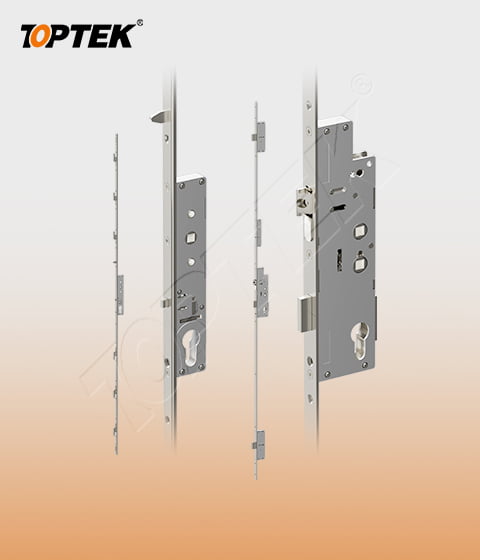
TOPTEK internal multipoint material separates automatic, lift-to-lock and key-operated families. In an automatic family, closing contact or a trigger initiates projection. In a lift-to-lock family, the handle projects the points before the cylinder deadlocks them. In a key-operated family, cylinder movement projects or controls the locking points. The cylinder and handle therefore perform different jobs in each family.
Write who or what projects the hooks, bolts or rollers, what retracts them, and what the cylinder changes after projection. If the sequence is wrong, a technically compatible spindle or cylinder may still appear defective. Demonstrate the intended sequence before choosing interfaces or diagnosing resistance.
Confirm centres from one controlled datum
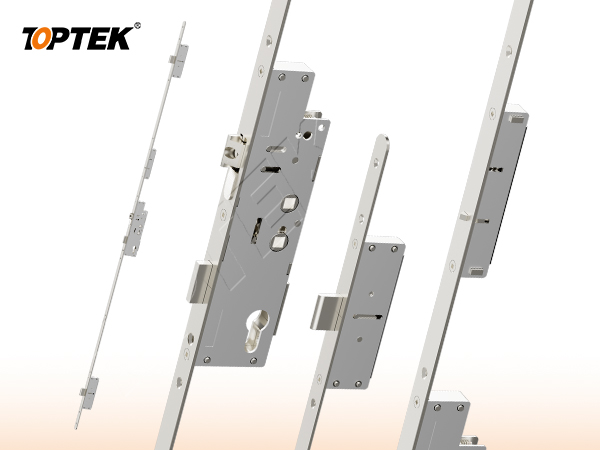
Handle-to-cylinder centres are often described by a PZ or centre-distance value, but buyers should not rely on a family label alone. Measure from the spindle centre to the relevant cylinder centre on the current drawing and identify which cylinder profile is shown. Record backset, central-case envelope and fixing positions on the same sheet.
A replacement escutcheon may cover existing holes yet put the spindle or cylinder under side load. For a new door, coordinate lock, furniture and preparation before machining. For a replacement, record old holes separately from the required functional centres so cosmetic coverage does not become the compatibility decision.
Match the spindle and follower
Confirm spindle cross-section, length, material specification where required, split or solid form, and engagement into the follower for the exact handle set and lock. Door thickness, rose or plate build-up and fixing arrangement all affect usable engagement. A spindle that is too short may operate intermittently; one that is too long may prevent the trim from seating or create axial load.
The handle also needs the correct return behaviour and operating travel for the mechanism. Lift-to-lock systems can require deliberate upward movement, while other families should not be forced through that path. Check lever clearance, springing responsibility, fixing torque and free return on the representative door.
Match the cylinder format, length and cam
Do not order a cylinder from overall length alone. Confirm the profile accepted by the central case, the inside/outside length split, fixing location, cam or tailpiece shape, rotation and required key or thumbturn functions. Check clearance between the cam and internal mechanism across the complete operating cycle.
A cylinder cam can enter the case yet drive the wrong surface, over-travel or fail to reach the deadlocking point. Never file or bend a cam as a production solution. Compare the proposed cylinder with the approved current drawing and a matched sample, and include the keyway and master-key requirements in the same order record.
| Interface | Define | Complete-assembly check |
|---|---|---|
| Centres | Spindle-to-cylinder dimension and reference profile | Drawing matches prepared holes |
| Spindle/follower | Section, length, engagement, travel and return | Handle seats and operates without side load |
| Cylinder | Profile, inside/outside split and fixing | Correct projection on both faces |
| Cam or tailpiece | Shape, rotation and driven function | Projects, retracts and deadlocks as intended |
| Door load | Keeps, seals, alignment and faceplate condition | Full sequence open and closed under approved test |
Verify the deadlocking sequence under door load
Bench movement is useful for identifying the basic sequence, but it does not reproduce keep alignment, seal compression, door sag or long-faceplate stress. Test with the door open only under an approved procedure, then repeat in representative closed-door preparation. Note whether resistance begins at handle projection, cylinder rotation or a remote lock point.
If the cylinder will not complete its intended movement, stop before forcing the key. Check that all points are fully aligned and projected as required. An apparent cylinder problem can be a keep or compression problem; an apparent door problem can be a mismatched cam or spindle. The evidence should separate those paths.
Approve the opening as a system
Multi-point Locking Systems is only one part of the opening. The door leaf, frame, strike or rod interfaces, trim, cylinder, closer, power components where applicable, and the installation conditions all influence the result. Use the TOPTEK Auto Lock reference and PD1000 family reference to identify the enquiry, while the current configuration drawing controls centres and interfaces. A catalogue family name cannot replace a coordinated opening schedule.
Give every opening a unique number. Attach the current elevation, door and frame construction, thickness, swing, handing, hardware interfaces, finish, evidence requirements and sample reference. When one field changes, reopen the affected checks instead of assuming that the earlier approval remains equivalent.
Use a state-based approval test
Write the normal, locked, authorised-entry, emergency-egress, override and abnormal states that apply. For each state, record what the user does and what each latch, bolt, rod, lever, key or electrical input must do. Mark a state N/A when it truly does not apply; a blank field hides a decision.
Operate the labelled sample in the same sequence. Review from both sides of the door, then repeat the critical checks in representative preparation. Photograph labels and interfaces, but preserve the signed state table as the controlling approval record. Appearance alone cannot prove function.
Separate product evidence from project approval
A certificate, test report or declaration applies only to the product, construction, standard and configuration named in its scope. A project still needs to determine whether that evidence is the document it requires. Request current original records and compare model identifiers with the quotation, drawing and sample.
Do not turn an internal development test, a website badge, a similar model or a customer statement into third-party certification. If evidence remains open, record the missing document, responsible reviewer and due date. This draft intentionally avoids unsupported cycle, load, corrosion, fire or material claims.
Buyer approval checklist
- Opening number, door type, frame and swing
- Plain-language operating sequence from both sides
- Exact product, trim and interface references
- Door preparation and installation tolerances
- Required model-specific evidence and revision
- Labelled sample and acceptance owner
- Packaging, site inspection and handover controls
- Repeat-order change-control reference
Common mistakes and project risks
Common errors include ordering furniture from visible hole coverage, assuming all followers use the same spindle, selecting a cylinder by overall length without checking the split, copying a cam from another central case and forcing the key when hooks are not fully aligned. These mistakes can damage the cylinder, central case, handle or prepared door and can conceal the actual installation cause.
The practical consequences can include re-machining, replacement hardware, revised wiring or keying, delayed inspection and uncontrolled site modification. Stop approval when the operating sequence, physical interface or evidence scope is unclear. A question recorded before production costs less than an assumption discovered across installed doors.
TOPTEK evidence and product scope
TOPTEK uses product-family material, model images and internal engineering observations to frame the buyer questions in this guide. These sources support a configuration discussion; they do not make every option, dimension or approval universal. The supplied configuration still has to be identified on a current drawing.
Use the TOPTEK resources centre for product documents and the applicable evidence request. Where a source describes internal testing, treat it as internal verification unless an original third-party document for the quoted configuration is separately reviewed.
RFQ checklist
- Exact multipoint family and plain-language operating sequence
- Handle-to-cylinder centres, backset and central-case envelope
- Follower and spindle cross-section, length, engagement and springing
- Cylinder profile, length split, fixing, cam and rotation
- Door thickness, furniture build-up and fixing pattern
- Every lock point, keep, seal and closed-door alignment state
- Required evidence list and market/project basis
- Sample quantity, acceptance tests and owner
- Drawing, quotation and order revision control
- Production labels and packaging requirement
Why TOPTEK: turn selection into a controlled record
TOPTEK can review a marked-up schedule, translate shorthand into operating and interface questions, and identify missing information before quotation. The objective is not to guess the designer’s decision; it is to give the responsible parties a clear configuration to approve.
Quotation, drawing, sample label and order acknowledgement should carry the same reference. This lets door manufacturers, distributors, integrators and project teams detect substitutions or later changes. It also creates a practical basis for repeat-order inspection.
Two-level CTA
For an initial review, send the opening list, door images or elevations and the required user sequence. Highlight unknowns. TOPTEK can return a focused question list without presenting assumptions as confirmed facts.
For a formal RFQ, submit the approved schedule, drawings, interfaces, evidence requirements and sample protocol through the TOPTEK contact page. Request a configuration-specific response and identify the person authorised to approve deviations.
Conclusion
Good hardware selection is a controlled translation from user behaviour to product configuration. Define the function, verify the physical interfaces, check the applicable evidence and demonstrate the identified sample. Do not let a general product name carry decisions it cannot contain.
Preserve the result through procurement, production, installation and handover. That discipline reduces avoidable replacement risk while keeping every TOPTEK statement inside the evidence and configuration actually reviewed.
Frequently asked questions
How do I know whether a cylinder is compatible with a multipoint lock?
Confirm the accepted profile, length split, fixing position, cam or tailpiece, rotation and the exact mechanism sequence on current drawings and a matched sample.
Are multipoint lock handle centres universal?
No. Measure the exact spindle-to-cylinder centres and coordinate them with the current lock and furniture drawings.
Why does spindle engagement matter?
Door thickness and trim build-up change how much spindle enters the follower. Inadequate or excessive engagement can create intermittent operation or prevent correct seating.
Why can the cylinder resist after the handle is lifted?
The locking points may not be fully projected or aligned, the door may be under load, or the cylinder/cam interface may be incorrect. Stop and isolate the cause before forcing the key.
What should be supplied for a compatibility RFQ?
Send the mechanism identity, sequence, centres, door thickness, spindle/follower data, cylinder and cam details, furniture, keying, keeps, drawings and a sample protocol.