

TL;DR
- Agree on the supplier’s handing convention before using left or right abbreviations.
- Distinguish door swing, handle shape and the operating function on each side.
- Check reversibility at assembly level, including the spring, spindle and fixings.
- Approve a representative left and right opening, then carry the same references into packing labels.
Quick Answer
How do you specify lever handle handing? Identify the door from a stated viewing position, draw the hinges and swing arc, and label the two faces. Then ask the handle supplier to confirm the corresponding assembly and whether conversion is permitted. Check the lever’s shape, resting position, travel, spring return and interaction with the lock on both sides. A photograph of a loose handle cannot establish all of these points. Use a signed drawing and assembled sample to connect the door schedule to the supplier’s order codes.
Start with the TOPTEK lever handle range and send an annotated opening sketch when requesting a handing review. Include the lock reference so that appearance and operation can be considered together.
Separate the three meanings of handing
A door schedule may use one short code to describe several different things. Door handing describes the opening under a particular convention. Handle handing identifies an orientation or assembly. Lock handing concerns the lock’s latch, followers or side-specific functions. These decisions are related, but they are not interchangeable. A correctly facing lever can still be paired with the wrong function on the secure side.
Write the convention beside the first schedule entry instead of expecting every participant to infer it. Suppliers working in different markets may describe the same physical opening differently. The installer, door fabricator and hardware distributor should all be able to point to the same drawing and identify the same side without relying on a verbal description.
| Decision | Record to provide | What it prevents |
|---|---|---|
| Door orientation | Viewing side, hinges and swing arc | Opposite interpretations of a left or right code |
| Lever configuration | Shape, resting position and face label | Reversed curved handles or mismatched pairs |
| Operating function | Required action from each face | Correct appearance with incorrect access behaviour |
| Supply condition | Factory assembled or approved field conversion | Unexpected conversion work at installation |
Make the viewing side visible in the drawing
Use a plan view with the leaf, frame and swing arc, plus a simple elevation of each face. Label the faces with useful project names, such as corridor and room, rather than leaving two arrows marked only inside and outside. On an internal office door, those words may be ambiguous to a fabricator who has never seen the building.
For a pair of doors, identify each leaf separately. State which leaf is active and where the meeting stiles are located. Do not apply a single handle code to the whole opening unless the agreed schedule explicitly defines the two assemblies. Mirroring a single-door detail can change which handle is required on which face.
HOPPE’s purchase checklist illustrates why certain curved designs require left or right specification and explains its DIN-based viewing convention. Use that as an example of a defined convention; confirm the convention used for your own TOPTEK quotation instead of transferring another manufacturer’s order language.
Check what reversible actually includes
The word reversible needs a defined object. A mounting base may accept installation in either orientation while the decorative lever has a preferred direction. An assembly may allow the lever to be exchanged between sides but require an approved spring arrangement. Another product may arrive configured for the specified opening. Ask which components change and who is permitted to make that change.
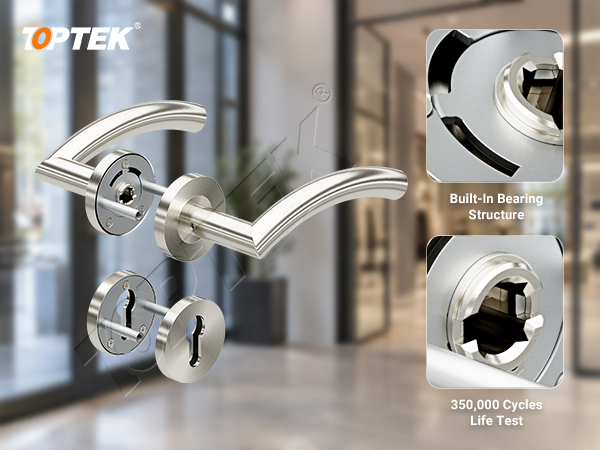
TOPTEK’s lever-handle product information describes a base that can serve left and right applications. Its catalogue installation illustration separates the lever, spindle, cover plate, base, metal frame and retaining fixings. This is useful when discussing configuration: the base is one part of the assembly. Obtain confirmation for the selected handle and lock combination before treating the whole set as universally reversible.
Ask for a defined conversion method
If field conversion is offered, request the current instructions, required tools and the components included in the pack. Establish whether conversion affects the spring position, retaining features or labels. Do not improvise by turning a decorative part upside down or altering a stop. A lever that sits horizontally after reassembly has not yet demonstrated correct operation.
For repeated projects, compare the cost of factory configuration with site labour and error risk. A common stock item can simplify inventory, but only if conversion is documented and practical for the installer. Factory-configured pairs may be preferable where many doors have different functions or where installation time is tightly controlled.
Confirm handle movement with the selected lock
Describe the required movement before discussing the sample. Does pressing the handle retract the latch on each side? Is one side controlled by a key or access-control function? Does the chosen application require an upward movement? Record the intended action separately for each face and let the lock and handle suppliers confirm the arrangement.
A lever’s ability to move upward does not establish compatibility with every lift-operated multipoint lock. The spindle arrangement, follower function, required travel and return behaviour must agree with that lock. Likewise, a handle that suits a simple latch may not provide the correct interface for a split-function assembly. The commercial lever specification guide covers the wider dimensional interfaces to check alongside handing.
Where a door has a documented fire or escape function, preserve its approved hardware configuration and installation requirements. Handing changes should not be treated as permission to substitute components. Ask for the evidence applicable to the complete configuration without assuming that a familiar handle shape carries the same approval on every door.
Approve both orientations on a representative sample
Build the sample with the actual lock, spindle, door thickness and fixing arrangement. Label the viewing side before taking photographs. Check that the intended lever appears on each face, rests in the specified position and moves in the intended direction. Operate it from both sides with the door open before carrying out controlled checks in the frame.
Observe whether the cover seats properly, the retaining fixing remains accessible as intended and the lever clears surrounding trim. Release the handle after each permitted action and record whether it returns freely. If one orientation binds while the other operates normally, keep the assemblies separate and investigate the configuration; do not hide the difference by reducing the required travel.
Photograph the accepted left and right samples from the same viewing position. Record the component references and instruction revision. These paired images make a useful reference for incoming inspection because the warehouse can compare physical assemblies without having to interpret a room plan.
Avoid order and packing mistakes
The most expensive handing error may occur after the technical sample has passed. If a drawing is revised but the packing list uses the previous room schedule, correct parts can be delivered to the wrong openings. Link every quantity to a door number or clearly defined opening type and keep the revision consistent across the purchase order, assembly drawing and carton label.
Common mistakes include ordering from a single catalogue photograph, assuming two curved levers are identical, mixing the viewing conventions of two suppliers, and treating all doors in a corridor as one orientation. Another frequent omission is the spare-parts plan: a spare labelled only by finish may be unsuitable for the function or assembly it is expected to replace.
For incoming checks, choose samples from each configuration rather than inspecting only one carton. Compare face labels, lever orientation, included spindle and fixing pack against the approved reference. Quarantine an inconsistent pack for clarification. The project risk is installation delay or incorrect door operation, not merely an aesthetic mismatch.
TOPTEK configuration evidence and RFQ checklist
Why TOPTEK for this review? The published range and component-level catalogue provide a starting point for discussing the whole lever assembly with the lock and door. Use the EUG4001 product page as a specific product reference and request its applicable drawing and configuration information. Select any performance classification from evidence for the exact supplied version.
For a commercial door hardware enquiry, use the TOPTEK project hardware capability page to frame the complete supply requirement. Ask how the accepted left and right assemblies will be identified within the order and checked under the quality-management process.
- Door numbers, quantities and the agreed handing convention.
- Plan and elevation showing the viewing side, hinges, swing and face names.
- Handle reference, finish, lock function, spindle arrangement and finished door thickness.
- Factory configuration or requested field-conversion method.
- Required evidence for the intended door application.
- Sample acceptance photographs, drawing revision, packing labels and spare requirements.
Frequently asked questions
Does a reversible base mean the whole handle set is non-handed?
No. Confirm the lever shape, spring arrangement, lock interface and approved conversion method for the complete assembly.
Can a photograph determine lever handle handing?
A photograph helps, but it should show a labelled viewing side and be supported by the door swing drawing and required function on each face.
Should left and right sample openings both be checked?
Yes. Check both intended configurations when the project uses them, and retain labelled photographs and component references for incoming inspection.
Can a lift-capable lever operate any multipoint lock?
No. Confirm the specific lock follower, spindle, movement and return requirements before approving the handle and lock together.
What should a distributor include in a handing enquiry?
Provide the door schedule, viewing convention, swing drawings, handle and lock references, quantities, conversion requirement and packing expectations.
Conclusion and request a handing review
Reliable lever handle handing starts with an unambiguous opening drawing and ends with correctly labelled assemblies. Treat base reversibility, lever orientation and door function as separate checks, then join them in the approved sample and order record. This reduces avoidable conversion work and keeps the hardware schedule useful through installation.
For an initial review, send TOPTEK one labelled opening sketch and the proposed handle reference. For a formal quotation, add the full quantities, finish, lock function, evidence requirements and sample acceptance criteria. TOPTEK is your Commercial Door Hardware Reliability Solution.