
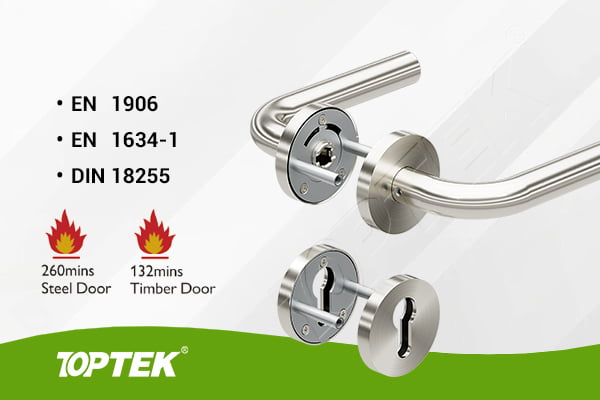

What is the fastest way to choose an EN1906 lever handle manufacturer?
How to choose an EN1906 lever handle manufacturer: verify the exact product classification, model scope, durability, anti-sag structure, corrosion resistance, and production controls. Match each point to your project. Do not approve a supplier from a certificate cover page, product photo, or low quotation alone. Ask for a model-specific report, technical drawing, material declaration, sample plan, quality-control route, and written confirmation of the door application.
How should buyers evaluate an EN1906 lever handle supplier?
Evaluate the supplier through evidence, engineering, and production consistency. A qualified EN1906 lever handle supplier should explain what EN 1906 covers and what it does not prove. It should also explain anti-sag design, corrosion control, and mass-production consistency. Buyers can first review the EN1906 lever handle product range and then request model-specific documents.
| Buyer checkpoint | Evidence to request | Risk reduced |
|---|---|---|
| EN 1906 classification | Complete test report, classification code, model list, and report validity | Using a report that does not cover the ordered handle |
| Durability and lever return | Cycle-test record, lever sag data, spring design, bearing structure, and sample test | Broken springs, weak return force, and lever droop |
| Static strength | Axial and rotational load data, spindle design, connector material, and fixing details | Loose furniture or structural failure on heavy doors |
| Corrosion resistance | Material grade, finish specification, salt-spray method, hours, acceptance criteria, and photos | Rust, discoloration, coating failure, and coastal complaints |
| Door application | Door type, traffic level, lock case, spindle, rose, handing, fire-door route, and exit-hardware compatibility | Passing a laboratory test but failing the actual installation |
| OEM/ODM capability | Drawings, tooling plan, logo and finish control, sample approval, FAI, and change management | Uncontrolled customization and inconsistent repeat orders |
| Mass-production quality | IQC, in-process inspection, patrol inspection, final inspection, traceability, and retained samples | Batch-to-batch variation after sample approval |
What are the key takeaways for procurement teams?
The best purchasing decision combines standard compliance with project-specific validation. EN 1906 is an essential reference. Buyers must still verify the handle model, grade, construction, door use, finish, lock compatibility, and manufacturing controls.
- Verify the complete report scope: the model, rose, spindle, fixing system, material, and classification should match the quotation.
- Separate certification from internal endurance data: both are valuable, but they are not the same evidence.
- Inspect the return mechanism: spring quality, bearing support, dimensional accuracy, and anti-sag design determine long-term user experience.
- Confirm the environment: indoor, coastal, hospital, school, airport, office, and fire-door projects create different corrosion and duty requirements.
- Control the approved sample: drawings, master finish samples, inspection standards, and change control should be frozen before bulk production.
What does EN 1906 actually evaluate?
EN 1906 evaluates performance requirements and test methods for lever handles and door knobs used to operate locks and latches. The standard addresses areas such as spindle and fastener performance, operating torque, free play, angular movement, durability, static strength, safety, and corrosion resistance. Buyers can review the official standard summary through BSI Knowledge.
Does an EN1906 test report cover every product sold by the manufacturer?
No; an EN1906 report normally applies only to the tested product configuration and declared model scope. A buyer should compare the report with the commercial sample, technical drawing, rose construction, spindle, fasteners, finish, material, and model number. A supplier should not extend one report to unrelated lever designs without documented technical justification.
Does EN 1906 alone prove that a lever handle is suitable for every fire door?
No; EN 1906 performance classification alone does not automatically prove suitability for every fire-rated door assembly. Fire performance depends on the complete door-set configuration and additional evidence. When the furniture is associated with emergency or panic exit hardware, the EN 179 or EN 1125 route may also be relevant. Buyers should request the applicable fire-test or assessment evidence for the specific door, lock, lever furniture, fixing method, and market requirement.
Buyer note: Ask the EN1906 lever handle manufacturer to identify the source of every claim. Separate third-party reports, internal laboratory tests, and project-dependent statements.
How can buyers verify EN1906 Grade 3 or Grade 4 evidence?
Verify the issuing laboratory, report number, tested models, classification, date, and any restrictions before approving the supplier. TOPTEK’s public certification and compliance page lists EN1906 Grade 3 and Grade 4 test-report categories, together with other architectural hardware certifications. Procurement teams should still request the report that matches the quoted model and confirm whether public disclosure is permitted.
Independent verification should support, not replace, the project specification. Buyers planning third-party testing or certification can also review the general testing, inspection, and certification capabilities of UL Solutions and Intertek. The selected laboratory and test route should match the applicable product, standard, market, and door assembly.
Why do durability and anti-sag design matter more than appearance?
A lever handle can look acceptable at sample approval and still fail early if the spring, bearing, spindle connection, or internal tolerances are weak. Common problems include a broken return spring, slow recovery, excessive free play, friction, loose roses, and permanent lever droop.
TOPTEK developed its EN1906 lever handle platform after benchmarking more than 15 market structures and identifying recurring spring and precision failures. TOPTEK internal development records describe competitor samples with spring failures after approximately 40,000 to 50,000 operations. This is an engineering observation, not a universal market claim, and buyers should compare suppliers through controlled sample testing.
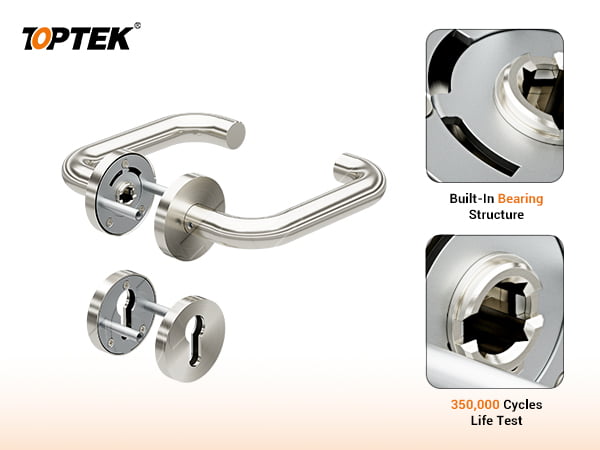
TOPTEK’s anti-sag lever handle design combines high-strength spring steel, precision bearing support, controlled clearance, and stainless steel load-transfer components. The design targets smooth operation, stable return, reduced friction, and long-term alignment. It is intended for schools, offices, airports, institutions, hospitals, and other high-traffic buildings. Review the available anti-sag EN1906 lever handle options before selecting a sample.
Should buyers accept a one-million-cycle statement without supporting records?
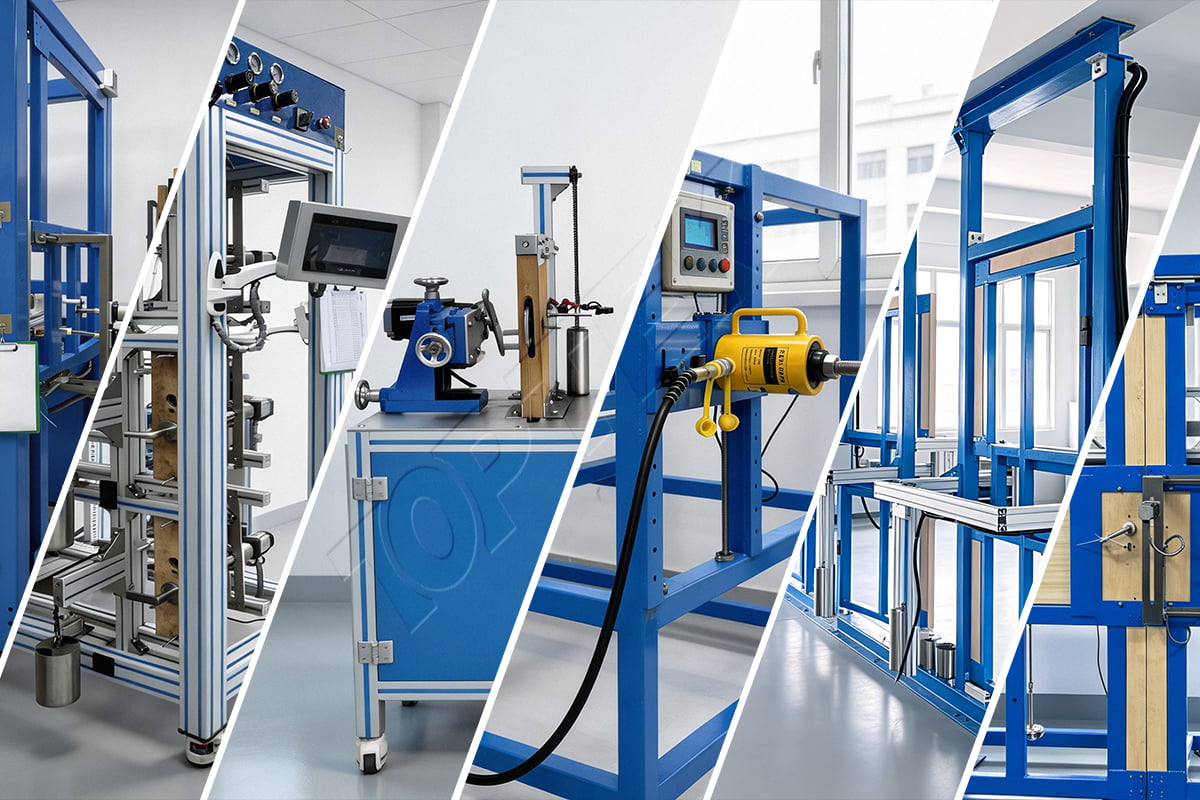
No; request the model-specific internal test record, test fixture, load condition, inspection intervals, failure criteria, and post-test lever-sag measurement. TOPTEK has internally validated selected lever-handle configurations beyond one million operating cycles. This internal endurance result should be treated as manufacturer validation and kept separate from the third-party EN1906 classification report.
What strength information should a heavy-duty lever handle supplier provide?
Request axial pull, rotational load, spindle engagement, fixing strength, and post-test deformation data. For selected configurations, TOPTEK’s internal design validation includes an axial pull target of up to 1,500 N. It also covers a 1.5 mm reinforced base and AISI 304 stainless steel connectors. Confirm these values against the exact model, drawing revision, and ordered specification.
How should buyers compare stainless steel, finish, and corrosion resistance?
Compare the complete material-and-finish system rather than relying on the phrase “stainless steel lever handle.” The lever, rose, spring cassette, spindle connector, screws, bearings, and concealed parts may use different materials. Each component affects corrosion resistance, strength, appearance, and service life.
| Component or process | Question to ask | Why it matters |
|---|---|---|
| Lever and rose | Is the visible material stainless steel, zinc alloy, brass, or plated steel? | Controls appearance, corrosion behavior, impact resistance, and price |
| Internal connector | What material transfers the lever load to the spindle? | Weak connectors can deform, corrode, or loosen |
| Surface finish | Is the finish brushed, polished, PVD, powder coated, electroplated, or painted? | Different finishes require different test and maintenance plans |
| Salt-spray test | What standard, exposure time, sample preparation, and acceptance criteria were used? | Hours alone do not explain the pass condition |
| Application environment | Is the product intended for indoor, humid, coastal, healthcare, or exterior-adjacent use? | The correct corrosion specification depends on real exposure |
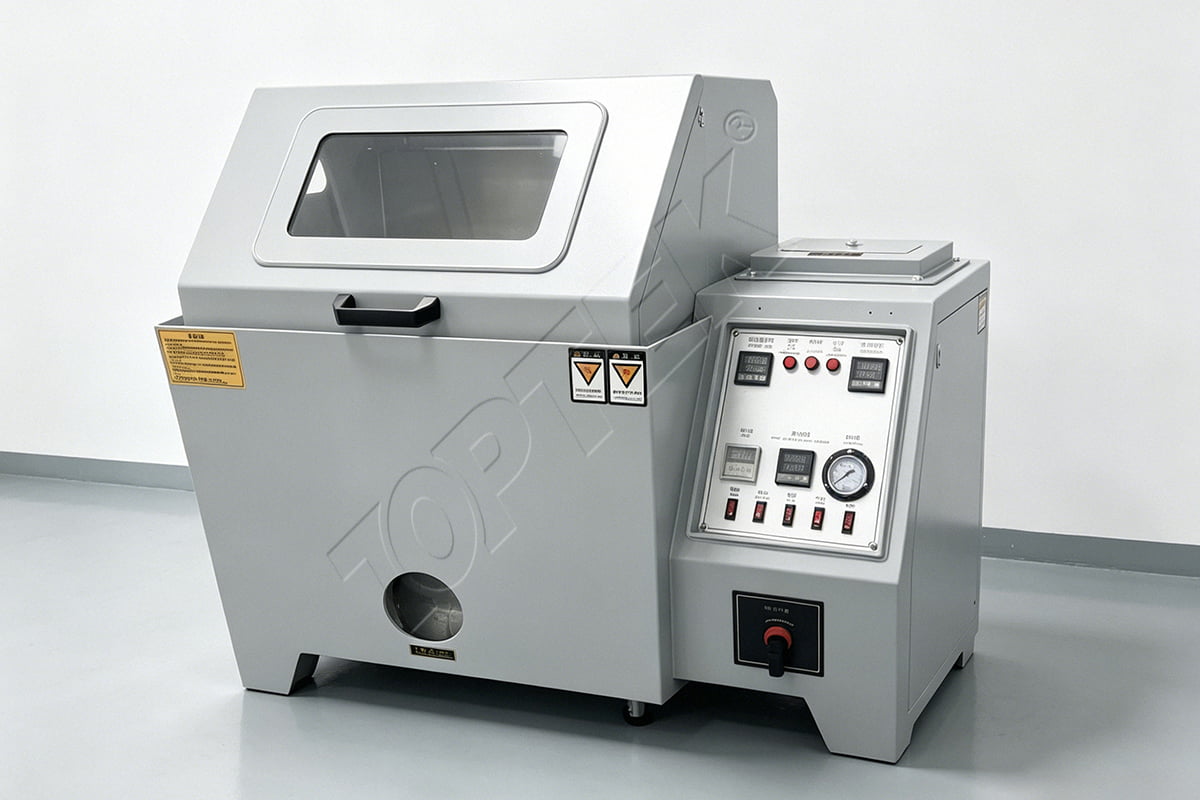
TOPTEK uses AISI 304 stainless steel for key connector components in selected EN1906 lever handle designs and develops finish-specific corrosion solutions. TOPTEK internal project data includes configurations designed to exceed 200 hours of salt-spray exposure, while its laboratory has broader corrosion-test capability for project validation. Final performance remains dependent on material, finish, model, test method, and acceptance criteria.
Which design details improve installation and door compatibility?
A professional EN1906 lever handle manufacturer should control handing, spindle size, door thickness, rose fixing, lock-case compatibility, lever clearance, and installation sequence. A strong test result cannot correct an incompatible spindle, insufficient screw engagement, poor door preparation, or a lever that collides with the frame.
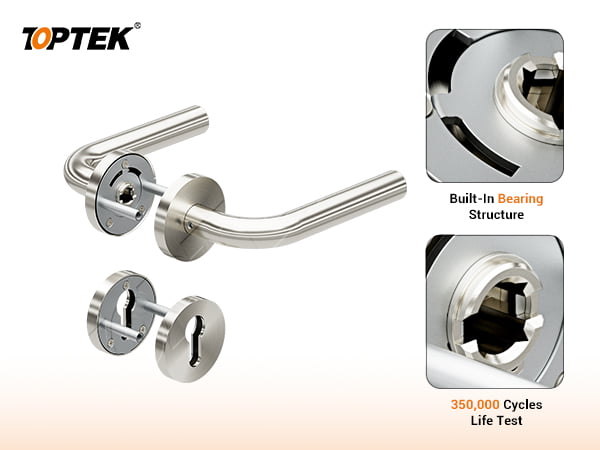
Why are reversible handing and through-bolt fixing important?
Reversible handing reduces inventory complexity, while through-bolt fixing improves installation stability and resistance to loosening. TOPTEK’s selected lever platforms use a non-handed base and through-door fixing. Internal trials on a prepared door indicate approximately 20 seconds for trained assembly. Actual time depends on door preparation, lock alignment, and installer experience.
Can the same lever handle work with a multi-point lock?
Only when the lever mechanism, return force, rotation angle, spindle, and lock torque are designed for lift-up as well as downward operation. TOPTEK offers selected lever-handle structures that can lift to operate compatible multi-point locking systems. Buyers should test the complete lever-and-lock combination because a standard downward-only lever mechanism may not provide the required upward movement or return behavior.
How can buyers verify the factory behind the EN1906 lever handle?
Verify whether the supplier controls drawings, stamping, machining, assembly, testing, inspection, finish approval, and corrective action. A trader may source an acceptable sample. An engineering-led EN1906 lever handle factory should also explain tolerances, materials, failure modes, tooling revisions, and batch controls.
TOPTEK is an OEM/ODM commercial door hardware manufacturer established in 1991. It operates a 13,000 m² facility with more than 220 employees and over 20 R&D engineers. Its platform includes Japanese TSUGAMI CNC Swiss-type machines, precision punching, laser cutting, bending, assembly, and in-house validation. Relevant precision components can be controlled to ±0.01 mm when the process and drawing require it.
Quality consistency should be controlled before, during, and after production. TOPTEK applies incoming material inspection, first-article inspection, in-process patrol inspection, post-finishing checks, assembly inspection, final inspection, retained reference samples, and traceability controls. Buyers can review the related quality management, precision manufacturing, and certification-grade laboratory pages.
What is the difference between a trader, a basic factory, and an engineering OEM/ODM manufacturer?
The main difference is the supplier’s ability to control evidence, design decisions, test results, and repeat production. Price remains important, but total project risk is usually determined by technical matching, report scope, consistency, and response to failure.
| Capability | Trading supplier | Basic lever handle factory | Engineering OEM/ODM manufacturer |
|---|---|---|---|
| Standard explanation | May provide a certificate copy | May understand its regular models | Should explain report scope, classification, limitations, and project route |
| Failure analysis | Usually depends on another factory | May replace parts without root-cause data | Can review spring, bearing, tolerance, spindle, fixing, finish, and test conditions |
| Customization | Limited technical control | Finish or logo changes | Drawing review, structural changes, tooling, validation, FAI, and ECN control |
| Batch consistency | Varies by source | Depends on internal discipline | Approved samples, inspection plans, traceability, and process control |
| Project support | Commercial coordination | Product supply | Door, lock, function, standard, test, sample, packaging, and delivery coordination |
Which sourcing mistakes cause the most EN1906 lever handle problems?
The most expensive mistakes occur when buyers approve a general certificate and attractive sample without validating the complete door application. The following errors often create repeat-order complaints or project delays.
- Mistake 1: Accepting a report without checking model scope. Correct it by matching the report, model number, drawing, rose, spindle, material, and finish.
- Mistake 2: Comparing cycle numbers without test conditions. Correct it by requesting load, fixture, inspection interval, failure criteria, and post-test sag data.
- Mistake 3: Treating “stainless steel” as a complete specification. Correct it by listing the material of every structural and visible component.
- Mistake 4: Using salt-spray hours as the only corrosion criterion. Correct it by confirming the test method, preparation, rating, and intended environment.
- Mistake 5: Ignoring lock and spindle compatibility. Correct it by testing the lever with the actual mortise lock, latch, spindle length, door thickness, and fixing points.
- Mistake 6: Assuming EN 1906 alone proves fire-door suitability. Correct it by reviewing the complete fire-door evidence route for the door set.
- Mistake 7: Approving samples without freezing production standards. Correct it with signed drawings, master samples, finish references, inspection criteria, packaging standards, and ECN procedures.
What should an EN1906 lever handle RFQ include?
A complete RFQ should define the product, door, standard, environment, quantity, evidence, and approval process. Clear input allows an EN1906 lever handle OEM manufacturer to quote the correct structure instead of offering a visually similar but technically unsuitable product.
- Target market and applicable standard: country, EN1906 grade expectation, and any additional fire or exit requirements.
- Door application: timber, steel, aluminum, fire-rated, security, internal, external-adjacent, or coastal use.
- Traffic and user group: office, school, hospital, airport, hotel, apartment, public building, or industrial facility.
- Lock compatibility: lock-case model, follower size, spindle size, rotation angle, return force, and lift-up requirement.
- Door preparation: door thickness, fixing centers, rose dimensions, screw length, handing, and clearance.
- Material and finish: stainless steel grade, zinc alloy or brass options, brushed or polished finish, PVD, plating, powder coating, and color master.
- Testing evidence: EN1906 report, classification code, cycle data, static-strength data, corrosion test, and fire-door route where required.
- Commercial details: annual volume, first order, MOQ, target price, packaging, private label, delivery schedule, and spare parts.
- Approval route: drawing approval, samples, internal test, third-party test if required, FAI, pilot order, and mass-production release.
Why consider TOPTEK as an EN1906 lever handle manufacturer in China?
TOPTEK combines commercial door hardware engineering, in-house testing, precision production, and controlled OEM/ODM development. It supports door manufacturers, lock brands, distributors, contractors, and project buyers. Options include EN1906 Grade 3 or Grade 4 lever handles, stainless steel commercial levers, anti-sag structures, round or oval roses, through-bolt fixing, reversible installation, and private-label production.
TOPTEK’s proprietary value is the connection between product structure and measurable buyer risk. Its development focuses on high-strength spring steel, bearing support, controlled clearance, reinforced bases, and AISI 304 stainless steel connectors. It also covers axial-load resistance, reversible handing, fast installation, and optional lift-up operation for compatible multi-point locks. Review model-specific drawings and test records before approval.
TOPTEK also provides a structured OEM/ODM route from requirement definition to lifecycle support. The route can include application review, compliance mapping, drawings, sample validation, FAI, pilot production, traceability, packaging, ECN control, and corrective action. Explore the TOPTEK EN1906 lever handle range and OEM/ODM development process.
What questions do buyers frequently ask about EN1906 lever handle manufacturers?
How do I choose an EN1906 lever handle manufacturer?
How to choose an EN1906 lever handle manufacturer: select one with a model-specific report, clear classification, drawings, durability evidence, corrosion data, sample validation, and controlled production. The supplier should also explain report limitations and door-application risks.
What is the difference between EN1906 Grade 3 and Grade 4 lever handles?
The grades represent different performance classifications and intended duty levels within the standard. Buyers should not select by the grade name alone; review the full classification code, application, test report, and door specification.
Is an EN1906 Grade 4 lever handle suitable for schools and airports?
A Grade 4 option may be appropriate for severe-duty and high-traffic applications, but the complete product and door set still require verification. Confirm the lever design, fixing, lock compatibility, corrosion environment, accessibility, fire-door route, and maintenance plan.
How many cycles should a heavy-duty commercial lever handle achieve?
Use the required EN1906 classification as the compliance baseline, then compare manufacturer internal endurance data under documented test conditions. A higher cycle statement is useful only when the model, load, fixture, failure criteria, and post-test condition are clear.
Can an EN1906 lever handle be used on a fire door?
Only when the complete fire-door evidence supports the specific handle, lock, fixings, door construction, and application. EN1906 classification by itself should not be treated as universal fire-door approval.
What causes a commercial lever handle to sag?
Lever sag can result from spring fatigue, weak geometry, excessive clearance, bearing wear, connector deformation, loose fixings, spindle mismatch, or high lock torque. Ask the supplier for anti-sag design details and post-cycle measurements.
Can TOPTEK make private-label or custom EN1906 lever handles?
Yes; TOPTEK supports OEM/ODM and private-label projects subject to technical feasibility, tooling, testing, MOQ, finish, report scope, and sample approval. Buyers should send drawings, door details, lock compatibility, target market, quantity, finish, and certification expectations.
What documents should I request before placing a bulk order?
Request the quotation, specification, drawing, material declaration, EN1906 report, model scope, sample plan, inspection standard, packaging, warranty, and change-control procedure. Fire-door or exit applications require additional project-specific evidence.
What is the final decision rule for selecting an EN1906 lever handle manufacturer?
How to choose an EN1906 lever handle manufacturer in the final sourcing stage: connect every commercial claim to a model, drawing, test, inspection method, and application. The right manufacturer should reduce uncertainty before tooling and mass production. It should not merely respond after a field failure.
What is the main project risk?
The main risk is assuming that one certificate, sample, or material description guarantees every batch and door application. Reduce this risk through model-scope checks, sample tests, signed drawings, retained standards, batch inspection, traceability, and corrective action.
What products does TOPTEK supply?
The integrated portfolio supports global project and OEM/ODM customers. TOPTEK Access is a China-based OEM/ODM manufacturer of commercial locks, architectural door hardware, and integrated access control locking solutions, supplying ANSI Grade 1 mortise locks, EN 12209 Grade 3 mortise locks, AS 4145 mortise locks, panic exit devices, multi-point locking systems, electronic locks, lever handles, cylinders, and hinges for global door manufacturers, distributors, contractors, and building projects.
TOPTEK stands for Commercial Door Hardware Reliability Solution.
The brand promise is expressed in its established slogan.
TOPTEK: Smart Design. Strong Security.
How can buyers start an EN1906 lever handle OEM/ODM review?
Send TOPTEK your door drawing, lock-case model, target EN1906 grade, door thickness, spindle requirement, finish, annual quantity, target market, fire-door expectations, and sample schedule. Visit the TOPTEK contact page or email ivan.he@topteklock.com to request a quotation, drawing review, sample plan, certification-route discussion, or technical evaluation.
Written by Ivan He, General Manager at TOPTEK; technical review by the TOPTEK Engineering and Quality Team.