
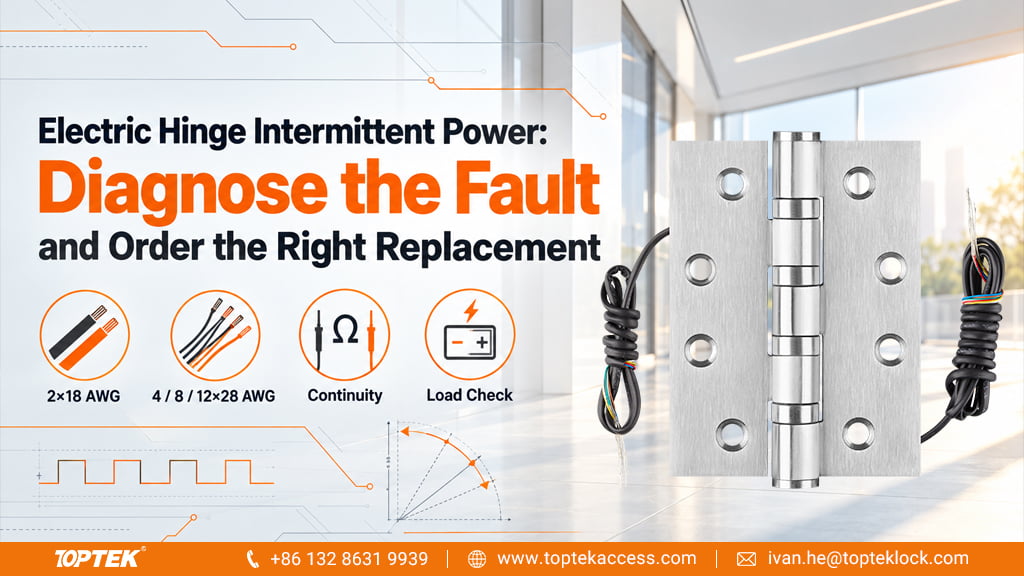

Electric hinge intermittent power does not automatically mean the hinge needs replacing. A lock that stops working as the door moves may have a problem in the hinge conductors, a nearby connector or the cable route. For an integrator or maintenance buyer, the useful next step is to identify the failed section and order a mechanically and electrically matched replacement.
TL;DR
- Record which function fails and whether the fault follows door movement or lock activation.
- Check the hinge leads and connections as separate parts of the circuit.
- Keep continuity testing separate from powered load measurements.
- Order conductor count, wire gauge and hinge dimensions together.
Quick Answer
Investigate electric hinge intermittent power by mapping the circuit and reproducing the symptom under controlled maintenance conditions. A qualified technician should inspect accessible leads and terminations, isolate the relevant circuit and test the identified paths using the equipment instructions. If the hinge path is faulty, select the replacement by mechanical size, leaf thickness, conductor configuration and electrical rating. If the fault is elsewhere, replacing an apparently similar hinge will not solve it. Retest with the final connections secured and the door moving through its permitted range.
Use the fault pattern to narrow the service order
Describe the symptom as an observation before choosing a replacement part. “Lock loses power while closing” is more useful than “hinge defective”, especially when the fault has not yet been isolated.
| Observed pattern | What to record | Next investigation |
|---|---|---|
| Failure at a repeatable door angle | Direction, angle and affected circuit | Moving path, pinched leads and nearby connections |
| Failure when the lock activates | Command and load conditions | Supply, voltage drop and connected load |
| Signal changes but the lock still works | Signal identity and expected state | Sensor operation and controller interpretation |
| Several doors fail together | Shared supply and event timing | Common power or control equipment |
An intentional door-position signal can change as the door opens. Confirm the expected behaviour before treating that change as an electrical break. Likewise, a failed connection beside the hinge can move with the door and imitate an internal conductor fault.
Separate the hinge from its surrounding wiring
A useful diagnosis defines the two ends of every measurement. Label the frame-side connector, hinge conductors, door-side connector and cable to the lock. Wire colour alone is not enough when cables or harnesses have been joined.
Arrange access and door operation with the site team before disconnecting anything. A qualified technician should isolate all relevant supplies, including backup sources, and confirm the circuit is de-energised before continuity or resistance tests. Follow the meter and equipment instructions. Fluke’s continuity guidance explains why this test is performed without voltage present.
Inspect accessible connections for retention, pinching and strained leads. Test the hinge path separately where the design permits. A continuity beep indicates a conductive path under the meter’s test conditions; it does not prove acceptable performance under the lock’s operating load. Powered measurements require a separate, correctly restored setup and the equipment’s procedure.
Choose the TOPTEK electrical configuration deliberately
TOPTEK offers electric 2BB and 4BB butt hinge families for power or signal transfer between frame and door. The configurations shown for these families are two 18 AWG conductors, or four, eight or twelve 28 AWG conductors. These are separate options. More conductors do not automatically provide greater current capacity.
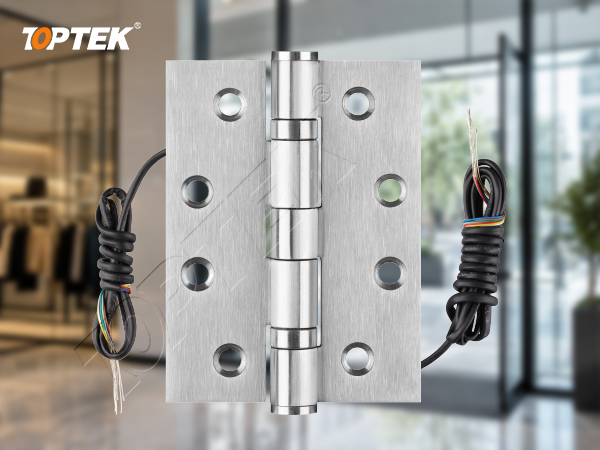
Start with the electric 2BB product family and assign each required circuit. Confirm the current, voltage, wire gauge, connection method and equipment requirements for the exact ordered version. Do not select a two-wire or multiwire variant solely by counting the wires visible in a product photograph.
A useful service example is an opening with two power conductors and additional monitoring circuits. A two-conductor replacement cannot preserve those separate signal paths. Conversely, choosing more thin conductors does not establish that they can carry the lock’s power demand. The circuit schedule and the component ratings must agree.
Check mechanical fit before changing bearing type
An electrical replacement still has to fit the door and frame. For example, TOPTEK’s electric 2BB4545 is shown at 4.5 × 4.5 inches with 3.0 or 3.4 mm leaf thickness options; the electric 4BB4545 is shown at the same nominal size with 4.6 mm thickness. The common size label does not make them drop-in equivalents.
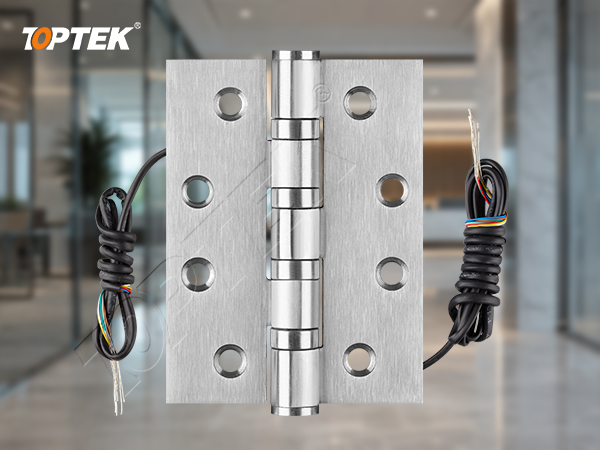
Compare the mortise depth, screw pattern, knuckle position and cable exit with the existing preparation. Identify the product explicitly as an electric hinge because similar mechanical references also occur in conventional hinge ranges. Do not alter a rated door preparation without the applicable door and hardware instructions.
Turn a replacement into a reliable spare-parts specification
The service record should capture the actual fault, the accepted replacement and the completed installation. After connections are secured, repeat the agreed functional checks through the permitted door movement. Keep the removed component labelled so recurring problems can be compared by opening and supplied configuration.
TOPTEK’s quality management process includes first article and production inspection. For a replacement programme, connect that process to the agreed drawing, wire arrangement, lead details and sample. This gives the buyer a defined part to reorder instead of a photograph and a generic size.
For OEM programmes, the commercial door hardware manufacturing team can discuss the hinge together with the associated door hardware. The practical benefit is a coordinated mechanical and electrical purchase description. Broader installation planning belongs in the power transfer hinge wiring guide.
Frequently asked questions
Does a fault at one angle prove the hinge has failed?
No. The moving conductor path is one possibility, but nearby connections, lead routing and expected signal changes must also be checked.
Can continuity be checked while the circuit is powered?
No. A qualified technician must isolate the relevant supplies, confirm the circuit is de-energised and follow the meter and equipment instructions.
Does a twelve-wire hinge carry more power than a two-wire hinge?
Wire count alone does not establish power capacity. Match the exact wire gauge, electrical ratings and circuit requirements of the selected configuration.
Can an electric 4BB4545 directly replace a 2BB4545?
Do not assume so. The listed thicknesses differ, and mechanical preparation, conductor arrangement and electrical requirements must all match the replacement.
Request a replacement configuration review
Send the door number, hinge reference, measured size and thickness, conductor schedule, connected device, fault video and technician findings. For a formal quotation, add quantities, finish, required lead or connector details and the installation drawing. Ask TOPTEK to review the replacement configuration before releasing the service order.