

Commercial Mortice Locks for Australian Door Hardware Projects | AS 4145.2 Compatible
What should buyers check when selecting Commercial Mortice Locks for Australian door hardware projects? Buyers should check AS 4145.2 compatibility, lock function, backset, door type, 316 stainless steel construction, fire door application, access control version, durability testing, and OEM/ODM manufacturing control. In Australian commercial buildings, a mortice lock is not only a lock body. It is part of the complete door hardware package.
Why does this matter for Australian project buyers? Because the wrong commercial mortice lock can create installation problems, poor durability, corrosion risk, fire door approval issues, and after-sales pressure. Therefore, door manufacturers, distributors, contractors, access control integrators, and project hardware buyers should evaluate the lock platform before mass ordering.
What Are Commercial Mortice Locks in Australian Door Hardware?
What does a commercial mortice lock do? A commercial mortice lock sits inside a morticed pocket in the door edge and controls the latch, deadbolt, lever handle, cylinder, turn knob, and strike engagement. This structure gives the door stronger mechanical performance than many light-duty surface-mounted products.
Where are these locks commonly used? Australian commercial door projects often use mortice locks in offices, apartments, schools, hospitals, public buildings, transport facilities, retail buildings, and fire-rated doors. For this reason, buyers often search for terms such as AS 4145 mortise lock, Australian standard mortise lock, public building mortice lock Australia, and commercial mortice lock AS 4145.
Why should buyers not judge only by appearance? A stainless steel faceplate can look professional, but the real performance comes from the lock body structure, latch movement, internal materials, spring design, backset accuracy, and production consistency. Therefore, a serious AS 4145 mortise lock supplier should explain the engineering logic, not only send photos.
Why Does AS 4145.2 Compatibility Matter?
What does AS 4145.2 mean for project selection? AS 4145.2 relates to mechanical locksets for doors and windows in buildings, so it gives Australian buyers a clearer performance reference for commercial lock selection. It helps buyers discuss durability, security, function, and test expectations with suppliers.
Is AS 4145.2 the only thing buyers should check? No, AS 4145.2 compatibility should be checked together with door type, fire door requirement, backset, cylinder format, handle structure, strike plate, finish, and local project acceptance. In real projects, a lock can meet a standard logic but still fail if the door preparation or hardware combination is wrong.
How should buyers compare suppliers? Buyers should ask whether the supplier understands Australian door hardware, commercial mortice lock AS 4145 requirements, OEM/ODM development, testing, and batch production control. A price-only supplier may not support technical drawings, backset options, fire door project discussion, or long-term spare parts.
Which TOPTEK Models Fit Australian Commercial Projects?
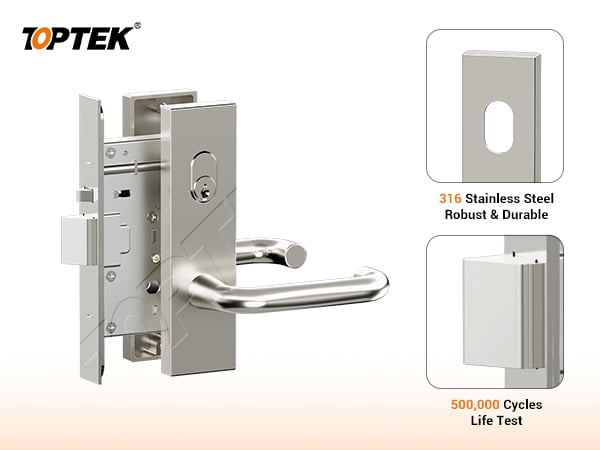
Which TOPTEK lock platform is suitable for wide faceplate applications? TKAU6400EF is TOPTEK’s wide faceplate Australian commercial mortice lock platform for project evaluation. It supports practical commercial door functions and gives buyers a strong stainless steel appearance for Australian door hardware projects.
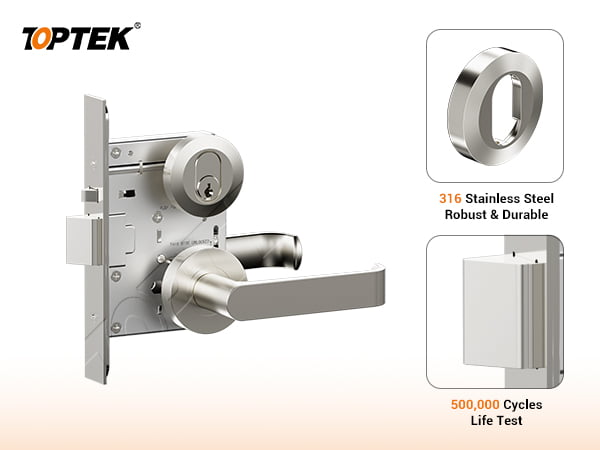
Which TOPTEK model supports round rose trim? TKAU6400RR provides a round rose configuration based on the same commercial lock platform. This gives door manufacturers and distributors more design flexibility. It also supports OEM/ODM customers who do not want to be limited to one full escutcheon faceplate style.
How should buyers treat aluminum door applications? Aluminum door projects may require different lock body dimensions, faceplate designs, and installation details. TOPTEK can discuss Australian aluminum door commercial lock requirements with buyers according to the door profile, project drawing, and function requirement.
Why Is 316 Stainless Steel Important?
Why do Australian projects often need corrosion-resistant hardware? Australia has many coastal, humid, and high-cleaning environments, so corrosion resistance can affect both appearance and long-term function. A lock used in coastal apartments, hospitals, schools, or public buildings should resist rust better than a light-duty interior lock.
How does 316 stainless steel support commercial use? 316 stainless steel provides stronger corrosion resistance than many lower-grade materials, especially in coastal or high-humidity conditions. TOPTEK’s Australian commercial lock platform can use 316 stainless steel for the faceplate and handle. This supports buyers looking for 316 stainless steel mortise lock or coastal mortise lock 316 stainless steel solutions.
What should buyers confirm before ordering? Buyers should confirm which parts use 316 stainless steel, which parts use other stainless grades, and which surface finishes apply to the order. This avoids confusion during quotation, sample approval, and mass production.
What Backset Options Should Buyers Confirm?
Why is backset important? Backset controls the distance from the door edge to the center of the lock operation point, so it affects door preparation, handle position, and cylinder alignment. If the backset is wrong, the lock cannot match the door drawing.
Which backsets should buyers discuss? TOPTEK can discuss common Australian commercial mortice lock backset options such as 60mm, 89mm, and 127mm according to the project requirement. These options help buyers match different door types and hardware schedules.
How can buyers reduce installation risk? Buyers should confirm the lock case drawing, door thickness, backset, faceplate size, strike plate, handle trim, cylinder type, and turn knob function before ordering samples. As a result, the project team can avoid site modification and delayed installation.
How Do Mechanical, Motorized, and Solenoid Versions Differ?
What is the mechanical version used for? The mechanical version suits traditional commercial doors that need reliable key, lever, turn knob, and latch operation. This version is useful for many standard Australian commercial door hardware projects.
When should buyers consider a motorized version? A motorized version may suit electronic lock applications where the lock needs electric driving or smart access integration. It can support electronic lock customers who need a mechanical lock body platform with electronic operation logic.
When is a solenoid version relevant? A solenoid version is relevant for access control systems that need electric locking or unlocking control. For this reason, buyers should confirm fail-safe or fail-secure strategy, power supply, monitoring needs, fire door rules, and local acceptance before finalizing the lock.
How Does Fire Door Project Evaluation Work?
Can Australian commercial mortice locks be used on fire door projects? They can be evaluated for fire door projects when the lock, door leaf, frame, hinge, closer, strike, seal, and installation method match the tested assembly and local approval route. A fire door mortice lock Australia requirement should never be checked as an isolated lock body only.
What experience does TOPTEK have with fire testing? TOPTEK has supported customers who used Australian commercial lock products in fire test projects, and those projects passed according to the customer’s test route. However, final use still depends on the tested assembly, laboratory report, and local authority.
Why should buyers discuss fire door use early? Fire door approval can affect lock body material, latch function, strike plate, lever trim, cylinder, screws, door thickness, and installation method. Therefore, project teams should discuss fire door requirements before tooling, sampling, and mass production.
Why Does Durability Testing Matter?
Why should buyers ask for durability testing? Durability testing helps verify whether the lock can support repeated commercial use before the product reaches a large project. Public doors, hospitals, schools, apartment projects, and transport facilities usually need stronger mechanical reliability.
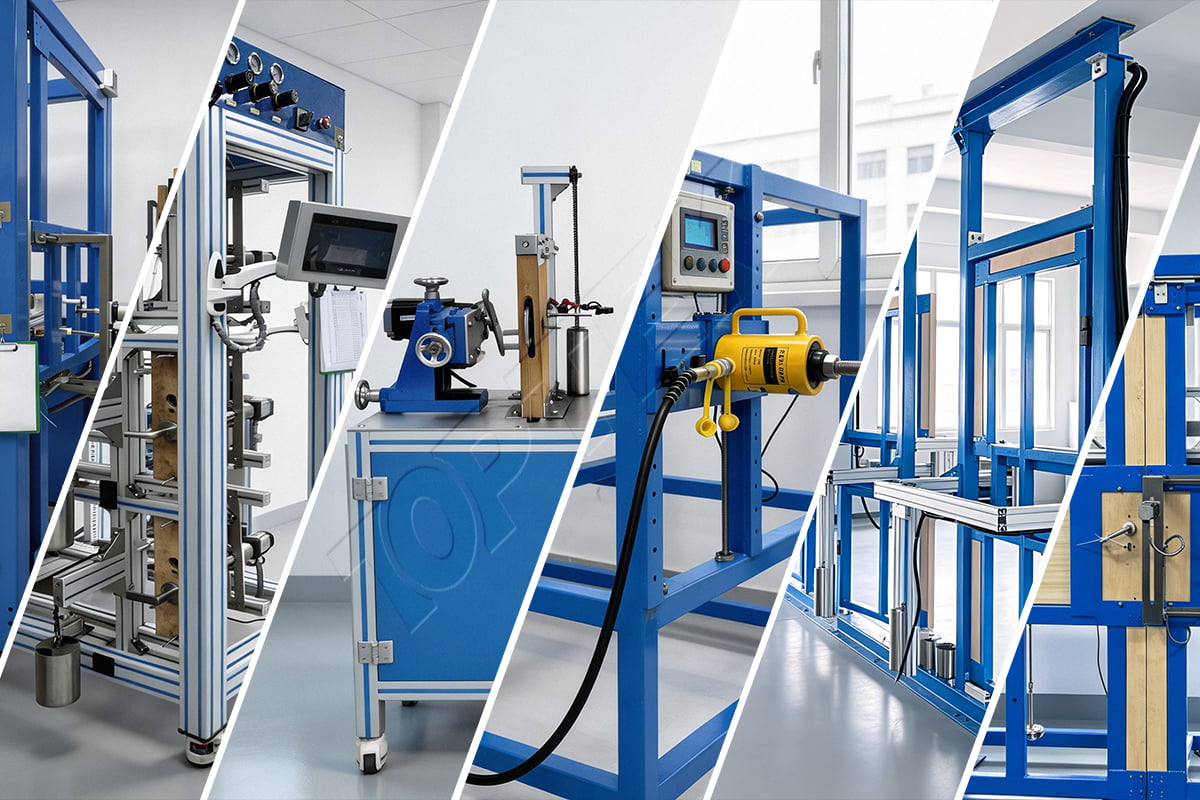
What does TOPTEK test internally? TOPTEK’s in-house laboratory can support mechanical durability testing, ANSI and EN performance testing, salt spray testing, handle torque testing, door impact testing, structural testing, and high/low temperature testing. This testing approach helps OEM/ODM customers reduce the risk of unstable mass production.
Where can buyers review external testing references? Buyers can use recognized testing organizations to understand door hardware performance and certification expectations. UL provides door hardware testing and certification information for locks, hinges, closers, and panic exit hardware. Intertek also offers testing services for locks, hinges, latches, closers, and exit devices. Buyers can review UL door hardware testing and certification and Intertek door hardware testing.
How Should Buyers Evaluate Security?
What security points should buyers check? Buyers should check latch strength, deadbolt strength, cylinder protection, turn knob function, lock case structure, handle fixing, strike plate quality, and door frame engagement. A high security mortice lock Australia project needs both strong internal structure and correct installation.
Why does cylinder and turn knob logic matter? The lock function controls how users lock, unlock, retract the latch, and manage privacy or security from each side of the door. TOPTEK’s TKAU6400EF platform can support a practical turn knob logic for locking, unlocking, and latch retraction, depending on the selected function.
How can buyers compare with market leaders? Buyers can use leading Australian commercial lock platforms as a performance reference when comparing functions, backsets, material, durability, and fire door application. TOPTEK develops its Australian commercial mortice lock platform to support OEM/ODM customers who need a competitive alternative for private-label or project supply.
How Does TKAU9000 Support Aluminum Door Projects?
Why do aluminum doors need special attention? Aluminum doors often have different profile limitations, lock case space, backset requirements, and faceplate dimensions compared with timber or steel doors. Therefore, an Australian aluminum door commercial lock should be evaluated with the actual door profile drawing.
How should buyers evaluate TKAU9000? Buyers can review TKAU9000 as a separate Australian aluminum door commercial lock option for suitable applications. The final configuration should match the door profile, handle design, cylinder requirement, and project installation method.
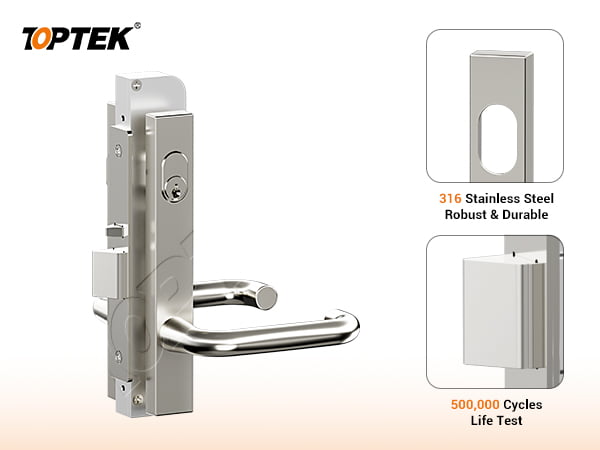
Why should this be discussed early? Aluminum door lock projects can require special dimensions, narrow profile adaptation, different strikes, and different handle compatibility. For this reason, buyers should provide drawings before requesting a final quotation or OEM/ODM sample.
How Should OEM/ODM Buyers Work with TOPTEK?
What should OEM/ODM buyers provide first? Buyers should provide the target door type, lock function, backset, faceplate drawing, handle design, cylinder format, finish, fire requirement, and target market. This helps TOPTEK evaluate whether TKAU6400EF, TKAU6400RR, TKAU9000, or another custom solution is more suitable.
How does TOPTEK reduce development risk? TOPTEK uses requirement discussion, engineering review, sample development, testing, FAI, pilot production, and mass production control to support OEM/ODM cooperation. This process helps buyers avoid problems after tooling or after the product has entered the market.
Which TOPTEK pages support this article? Buyers can review TOPTEK’s Australian lock and product pages for proof of product scope. Useful internal links include the AS 4145 Mortise Lock product category, the AS 4145 Mortise Lock Australian commercial door hardware guide, the AS 4145 Mortise Lock landing page, and the TOPTEK Products page.
What Should Buyers Confirm Before Requesting a Quote?
What should buyers prepare before requesting an AS 4145 lock quote? Buyers should prepare technical drawings, door material, backset, function, trim style, finish, order quantity, fire door requirement, and OEM/ODM branding needs. A clear request helps the supplier quote accurately and avoid repeated technical clarification.
- Confirm whether the project needs TKAU6400EF, TKAU6400RR, TKAU9000, or a customized platform.
- Confirm the backset: 60mm, 89mm, 127mm, or project-specific size.
- Confirm whether the lock is for timber, steel, aluminum, fire-rated, or security doors.
- Confirm whether the project requires AS 4145.2 compatibility or other local acceptance requirements.
- Confirm whether the lock needs mechanical, motorized, or solenoid access control version.
- Confirm whether 316 stainless steel faceplate and handle are required.
- Confirm cylinder format, turn knob function, lever trim, rose trim, and strike plate.
- Confirm surface finish, packaging, branding, and private-label requirements.
- Confirm durability testing, fire door project evaluation, and sample approval process.
- Confirm spare parts, retained samples, and long-term supply support.
How should buyers judge supplier reliability? Buyers should choose an AS 4145 mortise lock manufacturer that can discuss standards, door types, material, testing, fire projects, access control, and OEM/ODM process clearly. A reliable AS 4145 mortise lock supplier should support technical communication before price negotiation.
Conclusion: How to Select Australian Commercial Mortice Locks
What is the final selection rule? Commercial Mortice Locks for Australian projects should be selected by AS 4145.2 compatibility, backset, function, material, door type, fire door use, access control requirement, testing, and supplier manufacturing control. Buyers should not select a lock only by appearance or unit price.
Why should global buyers consider TOPTEK? TOPTEK supports Australian commercial lock projects with TKAU6400EF, TKAU6400RR, aluminum door lock options, 316 stainless steel hardware, mechanical/electric/solenoid versions, OEM/ODM support, testing capability, and project manufacturing control. This helps door manufacturers, distributors, contractors, and hardware brands build reliable Australian project door hardware lock solutions.
TOPTEK Access is a China-based OEM/ODM manufacturer of commercial locks, architectural door hardware, and integrated access control locking solutions, supplying ANSI Grade 1 mortise locks, EN 12209 Grade 3 mortise locks, AS 4145 mortise locks, panic exit devices, multi-point locking systems, electronic locks, lever handles, cylinders, and hinges for global door manufacturers, distributors, contractors, and building projects.
TOPTEK is a Commercial Door Hardware Reliability Solution. TOPTEK: Smart Design. Strong Security.
Need an Australian commercial mortice lock solution? Contact TOPTEK to evaluate Commercial Mortice Locks, AS 4145 mortise lock platforms, TKAU6400EF, TKAU6400RR, TKAU9000, 316 stainless steel mortise locks, fire door mortice lock Australia applications, and OEM/ODM project hardware packages. Visit TOPTEK Access – Commercial Locks & Architectural Hardware Manufacturer.