

TL;DR
A useful cylinder keying schedule links every door number to the receiving lock, cylinder format and length, operating function, keyed-different or keyed-alike group, master-key authority, quantity, issue status and handover owner. Keep sensitive bitting and restricted-key information in an authorised security record, not in a widely circulated architectural hardware schedule.
Start with the Construction Cylinders product hub, then use this narrower guide to define the required function and approval evidence.
Quick Answer
Freeze the opening list first. Give each door one stable identifier, then record the cylinder interface and keying group. Separate mechanical fit from access authority. Use symbols for the published schedule, keep sensitive coding in the authorised key-control file, approve a sample for each cylinder format, and reconcile cylinders and keys at handover.
Start with stable door numbers and receiving hardware
Keying cannot be controlled when the opening reference changes between the architectural schedule, hardware set, cylinder order and site labels. Use one stable opening number and show the building, level, room or zone needed to distinguish it. Then name the receiving lock or housing, cylinder format, retention method, controlled length and cam, tailpiece or core interface.
Mechanical fit and access permission are separate approvals. A cylinder may fit the lock and still belong to the wrong key group. Conversely, a correctly coded core cannot rescue the wrong profile, length or actuator. Keep both parts on the schedule so purchasing, locksmithing and installation teams can reconcile one complete line item.
Translate access policy into key symbols and groups
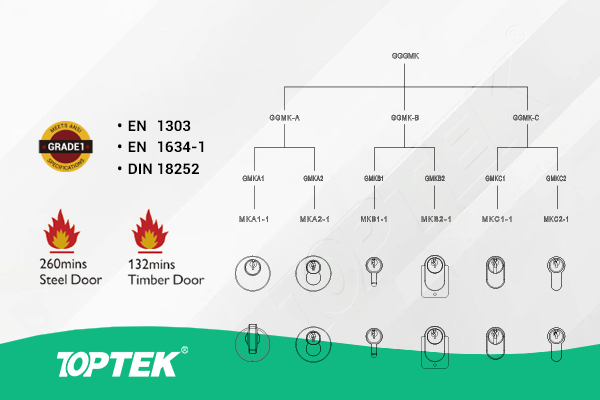
For each opening, state whether it is keyed different, keyed alike, master keyed or prepared for an interchangeable core or another approved system. Assign a controlled symbol to the door and to each authorised key level. The public hardware schedule does not need to reveal cuts, pinning or other sensitive manufacturing data.
Define who may open the door, who may receive each key level, and who may authorise a change. Avoid vague labels such as “master” without showing its scope. A grand master, building master, floor master, department key and change key may form different relationships in different projects. The authorised keying matrix is the controlling record.
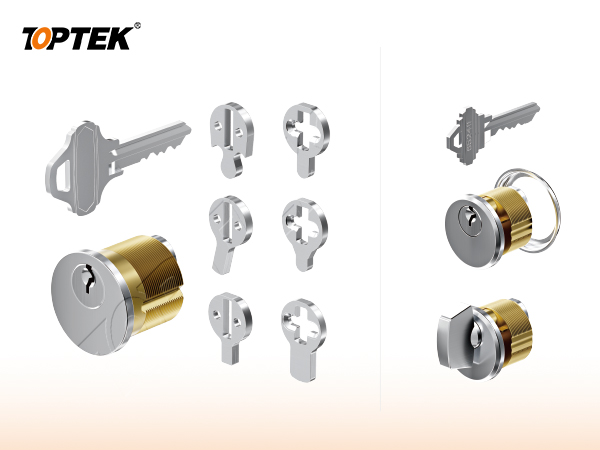
Projects can contain Euro profile, American mortise, bored-lock, SFIC or regional oval formats. TOPTEK product-family material discusses management across multiple cylinder standards, but the buyer still needs to identify each physical interface and confirm the approved key-system design. Similar key heads do not prove that two cylinders share the same controlled system.
Use the TOPTEK AMMC01 American mortise cylinder page as one format reference. For another format, state the exact profile and actuator rather than reusing the AMMC01 dimensions. Approve at least one identified sample for each interface included in the project.
Plan construction access and permanent changeover
A project may need temporary access during manufacturing, installation or commissioning before permanent keys are released. Define which doors participate, what event ends construction access, who performs the changeover and how the team proves that temporary authority no longer operates. Do not assume every cylinder system supports the same construction-key method.
The handover plan should include a count of installed cylinders, supplied keys, sealed reserves, cores or service components, exceptions and unresolved openings. Reconcile the physical package against the approved schedule. Record authorised recipients without placing personal or sensitive security details in the general project file.
| Schedule field | What to record | Control purpose |
|---|---|---|
| Opening | Stable door number and location | Match design, order and site |
| Cylinder interface | Format, length, retention and actuator | Prove mechanical compatibility |
| Function | Lock operation and access side | Match cylinder to door use |
| Keying group | KD, KA or approved hierarchy symbol | Define access relationship |
| Authority | Key level and approval owner | Control issue and changes |
| Handover | Installed quantity, keys, reserves and exceptions | Reconcile the final system |
Connect the technical schedule to its commercial pages
The general term commercial door lock belongs to TOPTEK’s main product entry, while buyers searching for a commercial lock manufacturer need manufacturing scope and evidence. This article answers the narrower keying-schedule task and should support those commercial pages without replacing their Canonical intent.
After publication, add a relevant resource link from the commercial page to this guide and link the guide to the construction-cylinder hub and an exact cylinder reference. This creates a useful path from supplier evaluation to specification and RFQ preparation.
Approve the opening as a system
Construction Cylinders is only one part of the opening. The door leaf, frame, strike or rod interfaces, trim, cylinder, closer, power components where applicable, and the installation conditions all influence the result. TOPTEK’s construction-cylinder material covers multiple cylinder formats and project key-management discussions. The exact keyway, hierarchy, profile, length, actuator, finish and supplied key quantities must remain configuration-specific and controlled through the approved schedule. A catalogue family name cannot replace a coordinated opening schedule.
Give every opening a unique number. Attach the current elevation, door and frame construction, thickness, swing, handing, hardware interfaces, finish, evidence requirements and sample reference. When one field changes, reopen the affected checks instead of assuming that the earlier approval remains equivalent.
Use a state-based approval test
Write the normal, locked, authorised-entry, emergency-egress, override and abnormal states that apply. For each state, record what the user does and what each latch, bolt, rod, lever, key or electrical input must do. Mark a state N/A when it truly does not apply; a blank field hides a decision.
Operate the labelled sample in the same sequence. Review from both sides of the door, then repeat the critical checks in representative preparation. Photograph labels and interfaces, but preserve the signed state table as the controlling approval record. Appearance alone cannot prove function.
Separate product evidence from project approval
A certificate, test report or declaration applies only to the product, construction, standard and configuration named in its scope. A project still needs to determine whether that evidence is the document it requires. Request current original records and compare model identifiers with the quotation, drawing and sample.
Do not turn an internal development test, a website badge, a similar model or a customer statement into third-party certification. If evidence remains open, record the missing document, responsible reviewer and due date. This guide intentionally avoids unsupported cycle, load, corrosion, fire or material claims.
Buyer approval checklist
- Opening number, door type, frame and swing
- Plain-language operating sequence from both sides
- Exact product, trim and interface references
- Door preparation and installation tolerances
- Required model-specific evidence and revision
- Labelled sample and acceptance owner
- Packaging, site inspection and handover controls
- Repeat-order change-control reference
Common mistakes and project risks
Common mistakes include assigning key groups before the door list is stable, circulating sensitive coding too widely, using the same symbol for different authorities, ordering cylinders without the receiving lock, combining unlike formats without a confirmed system design, failing to approve one sample per interface, and handing over keys without reconciling the final opening list.
The practical consequences can include re-machining, replacement hardware, revised wiring or keying, delayed inspection and uncontrolled site modification. Stop approval when the operating sequence, physical interface or evidence scope is unclear. A question recorded before production costs less than an assumption discovered across installed doors.
TOPTEK evidence and product scope
TOPTEK uses product-family material, model images and internal engineering observations to frame the buyer questions in this guide. These sources support a configuration discussion; they do not make every option, dimension or approval universal. The supplied configuration still has to be identified on a current drawing.
Use the TOPTEK resources centre for product documents and the applicable evidence request. Where a source describes internal testing, treat it as internal verification unless an original third-party document for the quoted configuration is separately reviewed.
RFQ checklist
- Stable opening numbers and hardware-set references
- Cylinder format, retention, controlled length and actuator
- KD, KA, master-key or interchangeable-core requirement
- Key symbols, authority levels and authorised approval owner
- Construction access and permanent changeover method
- Cylinder, core and key quantities plus handover controls
- Required evidence list and market/project basis
- Sample quantity, acceptance tests and owner
- Drawing, quotation and order revision control
- Production labels and packaging requirement
Why TOPTEK: turn selection into a controlled record
TOPTEK can review a marked-up schedule, translate shorthand into operating and interface questions, and identify missing information before quotation. The objective is not to guess the designer’s decision; it is to give the responsible parties a clear configuration to approve.
Quotation, drawing, sample label and order acknowledgement should carry the same reference. This lets door manufacturers, distributors, integrators and project teams detect substitutions or later changes. It also creates a practical basis for repeat-order inspection.
Two-level CTA
For an initial review, send the opening list, door images or elevations and the required user sequence. Highlight unknowns. TOPTEK can return a focused question list without presenting assumptions as confirmed facts.
For a formal RFQ, submit the approved schedule, drawings, interfaces, evidence requirements and sample protocol through the TOPTEK contact page. Request a configuration-specific response and identify the person authorised to approve deviations.
Conclusion
Good hardware selection is a controlled translation from user behaviour to product configuration. Define the function, verify the physical interfaces, check the applicable evidence and demonstrate the identified sample. Do not let a general product name carry decisions it cannot contain.
Preserve the result through procurement, production, installation and handover. That discipline reduces avoidable replacement risk while keeping every TOPTEK statement inside the evidence and configuration actually reviewed.
Frequently asked questions
What is a commercial door lock cylinder keying schedule?
It is the controlled list that maps each opening to its cylinder interface, function, keying group, authority level, quantities and handover status.
Should key-cut or bitting information appear on the general door schedule?
No. Use controlled symbols in broadly circulated schedules and keep sensitive manufacturing or restricted-key data in the authorised security record.
What is the difference between keyed alike and master keyed?
Keyed-alike cylinders share the same change key, while a master-key system creates approved higher-level keys that operate defined groups of otherwise different cylinders.
Only when the designed system, keyway or compatible components and authority relationships are confirmed for those exact formats. Do not infer compatibility from appearance.
What should be reconciled at handover?
Reconcile installed openings, cylinder and core references, key quantities, sealed reserves, construction-key changeover, authorised recipients and documented exceptions.