
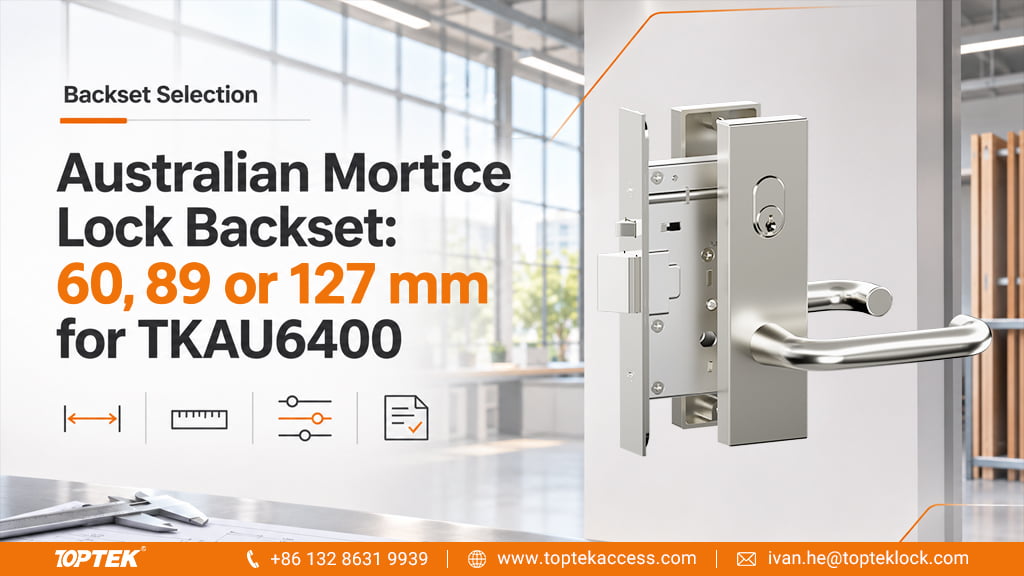

A replacement lock can have the right appearance and still put the handle in the wrong place. For a new door, the same mistake can affect every prepared leaf in the order. TOPTEK’s TKAU6400EC and TKAU6400RR configurations offer 60, 89 and 127 mm backsets so the operating position can be selected around the actual door design.
TL;DR: Measure from the drawing’s forend datum; choose the required operating position; check the complete case and furniture before releasing the door preparation.
Which Australian Mortice Lock Backset Should You Choose?
Choose a 60, 89 or 127 mm Australian mortice lock backset to match the required distance between the forend reference face and the operating centreline shown on the model drawing. For replacement work, start with the existing preparation. For a new door, coordinate the lever position with the stile and the full lockcase space. TOPTEK lists all three backsets for TKAU6400EC and TKAU6400RR. A longer backset moves the operating position farther into the door; it does not, by itself, provide a higher security grade.
The TOPTEK Australian mortice-lock range provides the product context. This comparison concerns the TKAU6400 mechanical platform and its door preparation.
Compare the Three Positions on One Drawing
| Backset | Operating position | What the buyer should check |
|---|---|---|
| 60 mm | Closest to the forend of these three choices | Existing holes or preferred new-door handle position; full case space |
| 89 mm | 29 mm farther inward than 60 mm | Lever and cylinder preparation, furniture clearance and pocket depth |
| 127 mm | 67 mm farther inward than 60 mm | Space for the selected case and fixings, including internal reinforcement |
These differences are useful on a marked-up door elevation. Changing from 89 to 60 mm moves the referenced operating centreline by 29 mm. It does not move an existing hole or repair the old preparation. Keep that geometric change visible when comparing a replacement proposal.
Backset is also different from case depth. Do not calculate a new pocket by adding a backset difference to an unrelated lock drawing. Obtain the drawing for the actual variant and compare its complete outline, faceplate, cylinder opening and fixing positions.
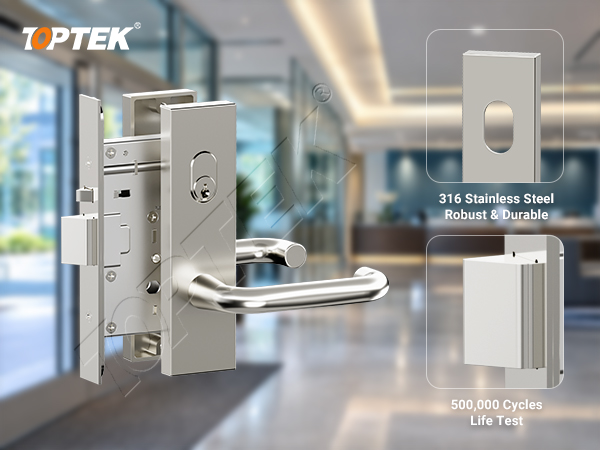
What TKAU6400EC and TKAU6400RR Offer
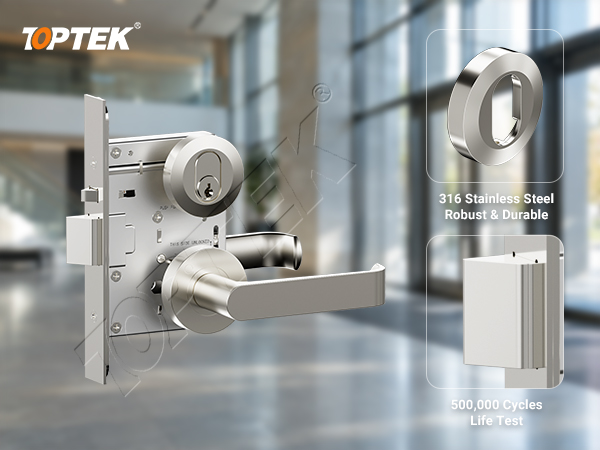
TKAU6400EC uses continuous escutcheon furniture; TKAU6400RR uses round-rose furniture. Both configurations list 60, 89 and 127 mm backsets, an Australian oval-cylinder arrangement, and a 7.8 mm follower with a 7.6 mm spindle. The visible lever and trim are specified in stainless steel 316.
The specified armour faceplate is 25 × 175 × 3 mm. The latchbolt projection is 15 mm. These dimensions give procurement and door-shop teams concrete features to compare with the preparation, while the exact variant drawing supplies the full case envelope.
The platform also provides a field-reversible latchbolt and configurable locking functions. Specify the required inside and outside operation in the order; do not use a backset number as a substitute for the function description.
For Replacement Doors, Preserve the Existing Geometry
Record the existing backset, cylinder and lever positions, faceplate recess, fixing holes and lock pocket. Include a scale in photographs of both faces and the door edge. An authorised installer can establish the concealed dimensions where inspection requires removing the existing hardware.
A matching backset is a starting point, not a cross-brand interchangeability promise. A different case shape, cylinder interface or fixing pattern may still require a different preparation. Check whether the proposed escutcheon or roses cover old openings and have sound fixing support.
If changing the backset is necessary, agree the door modification with the responsible door manufacturer or project team. Fire-door alterations must remain within the applicable doorset requirements.
For New Doors, Coordinate the Handle Position and Case Space
Use a door elevation to choose the furniture position and a section to check the internal space. Include rails, reinforcement, glazing details and fixing routes. A wide-looking stile is not necessarily an empty cavity.
If the project instead needs a short-backset aluminium-door solution, compare the separate TKAU9000EC narrow-stile selection guide. Its dimensions should not be transferred to a TKAU6400 drawing.
For an initial fit discussion, send TOPTEK the door section, preferred handle position and required function. That allows the quotation discussion to start with a defined arrangement instead of selecting a backset solely from a product photograph.
Turn the Selected Size into a Repeatable Purchase
For a hardware distributor, the useful stock description includes the backset, function, furniture, cylinder and finish. For a door manufacturer, the same description must also identify the preparation drawing. Keeping those references together helps purchasing and production distinguish a genuine repeat order from a configuration change.
TOPTEK’s quality-management process provides a route to discuss dimensional and operating checks. On the sample door, verify complete latch engagement, cylinder operation, lever return and furniture fixing with the specified strike. Record the configuration that was demonstrated.
The benefit of working with TOPTEK as a commercial door hardware manufacturer is the ability to discuss the lock platform, furniture and supply requirements together. Use that discussion to agree the complete order item, including branding and packing where needed.
Request a TKAU6400 Backset and Sample Quotation
- Identify TKAU6400EC or TKAU6400RR and the 60, 89 or 127 mm backset.
- Provide the door construction, thickness and drawing with the measurement datum marked.
- State whether the order is for new doors or replacements; include existing-hole information where relevant.
- Describe inside/outside function, cylinder/keying, strike, finish and required quantities.
- Include project documentation requirements and sample, branding and packing needs.
Select the size that positions the hardware correctly, then confirm the complete assembly. Send your door drawing to TOPTEK for a configuration proposal and quotation tied to the required backset.
Frequently Asked Questions
Which backsets are listed for TKAU6400EC and TKAU6400RR?
Both configurations list 60, 89 and 127 mm backsets. Identify the chosen size and operating function in the quotation and variant drawing.
Can an 89 mm backset lock be replaced directly by a 60 mm version?
Do not assume a direct replacement. The referenced operating centreline changes by 29 mm, so existing holes, furniture, case space and fixing positions must be reviewed.
Is a 127 mm backset a higher security option?
The backset specifies an operating position. It does not establish a security or durability classification.
Does matching the backset prove that the lockcase will fit?
No. Compare the full case envelope, faceplate, cylinder and spindle interfaces, fixing pattern and strike with the actual door and frame.