
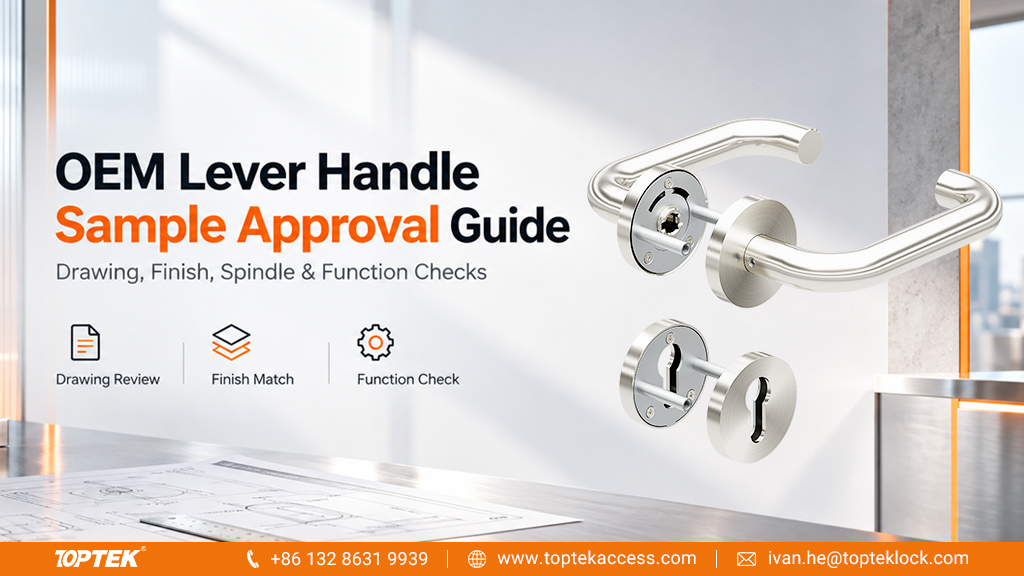

Quick Answer
OEM lever handle sample approval should establish one agreed product for production: the handle design and finish, the fit with the door and lock, and the operating feel. For importers, hardware brands and door manufacturers, the most useful sample is a complete handle set installed with the intended lock and spindle. TOPTEK supports OEM/ODM development from drawings and samples through production. A clear sample brief lets both teams focus on the details that affect installation, appearance and repeat orders.
TL;DR
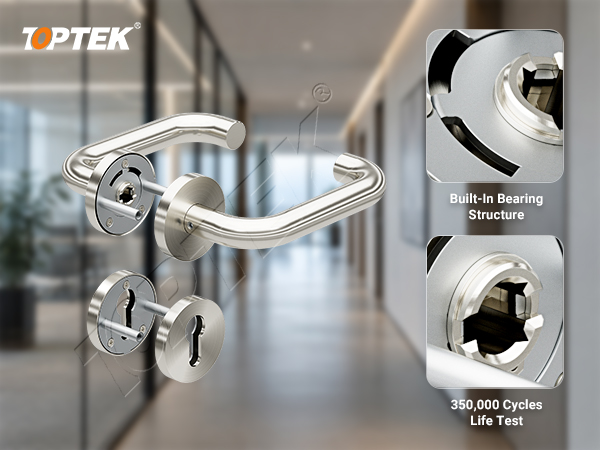
- Choose a complete handle set, including roses or plates, spindle and fixings.
- Compare the finish with a physical reference under consistent lighting.
- Try the handle on the intended lock and door thickness before ordering a batch.
- Keep an agreed sample and specification for repeat production.
Start with the product your customer needs
A distributor building a handle range needs a design that fits its market, looks consistent across the range and can be ordered again. A door manufacturer also needs hardware that works with its existing preparation and assembly process. These are different buying priorities, so the sample request should identify the sales channel and intended door application.
Begin with the TOPTEK lever handle range, then identify the shape, rose or backplate, finish and lock interface required. Where a design needs adaptation, a dimensioned drawing or reference sample gives the engineering team a concrete starting point. A photograph helps communicate style; dimensions establish fit.
Approve four details that affect every order
| Detail | What to agree | Buyer benefit |
|---|---|---|
| Drawing and fixing | Lever projection, rose or plate dimensions, fixing positions and door thickness | A set that fits the intended door preparation |
| Finish and appearance | Physical finish reference, visible surfaces and acceptable variation | A consistent presentation across the product range |
| Spindle and lock interface | Spindle section, engagement and the actual lock follower | Compatible components supplied together |
| Operating feel | Lever travel, return and clearance on the assembled door | A handle that operates as expected after installation |
The important distinction is between checking an individual handle and checking the complete assembly. A lever can feel smooth in the hand while its spindle length or fixing arrangement is unsuitable for a particular door. Supplying the lock information with the sample request helps resolve those details before the order reaches production.
Use the sample to settle finish and function
For finish approval, compare the handle with the chosen reference under the same lighting and viewing conditions. Check the lever, rose and visible fixing covers together. Photos are useful for recording a decision, but they are a poor substitute for a physical reference when colour or sheen matters.
For function, install the sample with the specified lock, spindle and fixings. Operate the handle from both sides, check that it clears the door surface and confirm that it returns as intended. If the lever binds after tightening, review the mounting alignment and spindle engagement before changing the product specification.
A common purchasing mistake is to approve the handle shape first and leave the spindle and fixing pack until the order is placed. Agreeing the complete set at the sample stage gives the factory a clearer production requirement and the customer a more useful installation sample.
What TOPTEK brings to OEM handle development
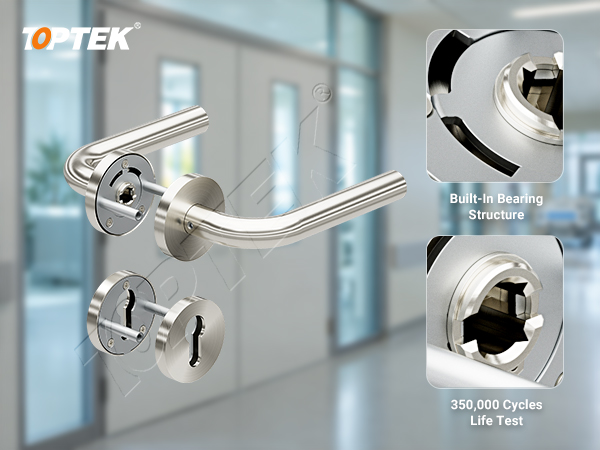
TOPTEK combines door hardware manufacturing and OEM/ODM support with product engineering, samples and production quality control. This gives hardware brands and door factories a route from a design requirement to a defined product and repeat supply.
There is also product-specific test evidence: TOPTEK’s LHEU001 lever handle is covered by a test report to EN 1906:2012. Request the report corresponding to the handle configuration being specified through the TOPTEK testing and quality team. This connects the product selection to documented performance while keeping the sample discussion focused on fit, finish and operation.
Once the sample is agreed, retain it alongside the final drawing, finish reference and component list. If the order changes later, identify the affected detail and update that reference. This provides a practical basis for repeat purchasing without making each new batch a fresh design exercise.
Request an OEM lever handle sample
Send TOPTEK your preferred design or reference sample, intended market, door thickness, lock details, finish and estimated order quantity. For a private-label range, include branding and packaging requirements. These details help establish the sample scope and a quotation that reflects the product you intend to sell.
Discuss your handle sample requirements with TOPTEK, or explore the range before selecting the designs to compare.
Frequently Asked Questions
What should an OEM lever handle sample include?
Request the lever, rose or backplate, spindle and fixing components specified for the door. A complete set allows you to check appearance, installation and operation together.
Can TOPTEK develop handles for a private-label range?
TOPTEK offers OEM/ODM support. Share the design, market, finish, branding and packaging requirements so the engineering and sales teams can define the sample and production scope.
Is a sample enough to confirm EN 1906 performance?
A sample establishes fit, finish and operation for the intended assembly. EN 1906 performance should be supported by the test documentation for the selected product configuration.
How do we make repeat orders consistent?
Retain an agreed sample with the final drawing, finish reference and component specification. Reference those items in repeat orders and record any agreed changes before production.