
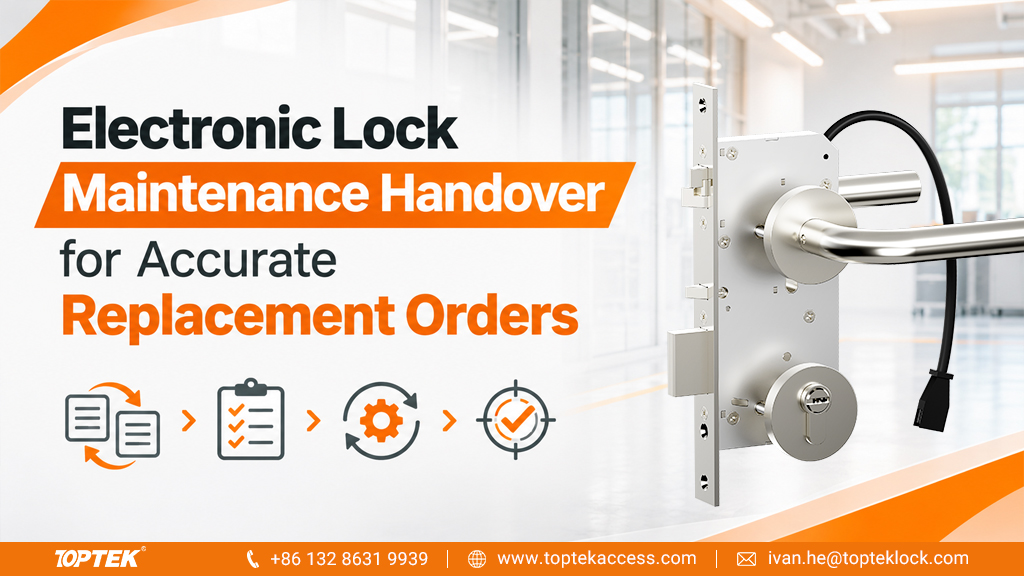

Electronic lock maintenance handover should leave the next service team able to identify the installed lock and order the correct replacement. Keep the exact model, fitted configuration, applicable instructions and accepted door operation under the same opening reference. A general product brochure cannot preserve those details on its own.
TOPTEK’s electronic lock range illustrates why precision matters. TKEUS3592 uses a standard latch, while TKEUSC3592 uses a cross latch. Recording both simply as “3592 electric lock” removes information needed for a later replacement enquiry. For a system integrator or door manufacturer, that small omission can carry from the handover folder into the next purchase order.
Keep the full model with the installed opening
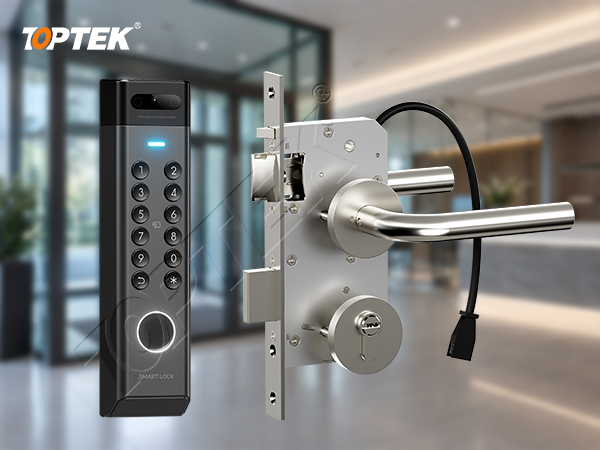
Use the full TKEUS3592 or TKEUSC3592 reference, as applicable, together with the actual supplied revision and order reference. Retain a readable identification photo and the relevant lock and door-preparation drawing. Do not derive electrical ratings or replacement compatibility from the model name.
The practical consequence is straightforward: the service enquiry starts with the hardware that is present, not the category someone remembers. The supplier can then address the required replacement or document request against that identity. A photograph is useful support, but it should not replace the written configuration when the important difference is an internal option or electrical function.
Make a short opening record usable during a service call
| Record | What the receiving team needs | Why it helps later procurement |
|---|---|---|
| Hardware identity | Door ID, full lock model, supplied options, order reference and identification photo. | Prevents a broad family name becoming the replacement specification. |
| Installed interfaces | Applicable lock instructions and the integrator’s actual wiring and connected-component references. | Separates the purchased lock from the installation around it. |
| Accepted operation | The completed entry, exit, relocking and applicable power-loss checks for that opening. | Shows what a replacement must restore, without assuming all variants behave alike. |
| Support and changes | Named service contact, agreed maintenance instructions, subsequent replacements and drawing revisions. | Keeps the next order tied to the current installation. |
Agree who maintains this record after handover. The lock supplier’s product instructions and the integrator’s installed wiring drawing have different jobs. Keep both accessible to the authorised service team. Use the electronic lock commissioning record as the operating baseline rather than repeating a generic set of expected behaviours in every maintenance folder.
Do not infer a power-loss response, monitor output or connector assignment from a similar-looking lock. Record the selected configuration and its applicable documentation. Maintenance intervals and permitted service work should follow those instructions and the site’s requirements, not an arbitrary schedule copied across every door.
Connect repeat orders to the approved configuration
TOPTEK’s OEM/ODM process includes retaining agreed samples on both sides for modifications based on an existing platform. This gives buyers a practical reference to preserve beyond initial delivery. Keep the sample reference and drawing revision connected to the purchase order and the installed opening record.
A retained sample and an installed-door record answer different questions. The sample records the agreed product; the opening record shows where and how it was used. Together they make a repeat-order discussion more precise. If a later service replacement changes the configuration, update the opening record and retain the reason for the change rather than silently continuing to order against the original shorthand.
Keep support information accessible and credentials controlled
Give the receiving team one identified route for hardware support and one for the installed access-control system, where different parties are responsible. State which party owns the wiring record, controller settings and mechanical work. This prevents the first fault report from becoming a search for the original project team.
Keep administrator credentials, key-cut information and access permissions out of general service requests. Transfer them through the building owner’s controlled process. For an initial hardware enquiry, the full model, order or project reference, opening ID and a description of the required document or replacement are usually more useful than a controller password.
Request the product documents for your handover
Send TOPTEK the exact lock model and order or project reference, together with the document or replacement information you need. If the identification is unclear, include a readable label photo and the opening ID. Use the product resource enquiry to locate the applicable information and agree any additional document deliverables for the supply scope.
Start this discussion with the order, so the document requirements are clear before project closeout. The aim is a service record that supports a correct enquiry months later, when the people who selected the original lock may no longer be on site.
Frequently Asked Questions
Why should a handover retain TKEUS3592 and TKEUSC3592 as separate references?
TKEUS3592 uses a standard latch and TKEUSC3592 uses a cross latch. Keeping the complete model preserves a real configuration difference for document requests and replacement enquiries.
Does an approved sample replace the installed-door record?
No. The sample records the agreed product. The installed-door record identifies where it is used, its connected components, accepted operation and subsequent changes. Retain both references for repeat orders.