
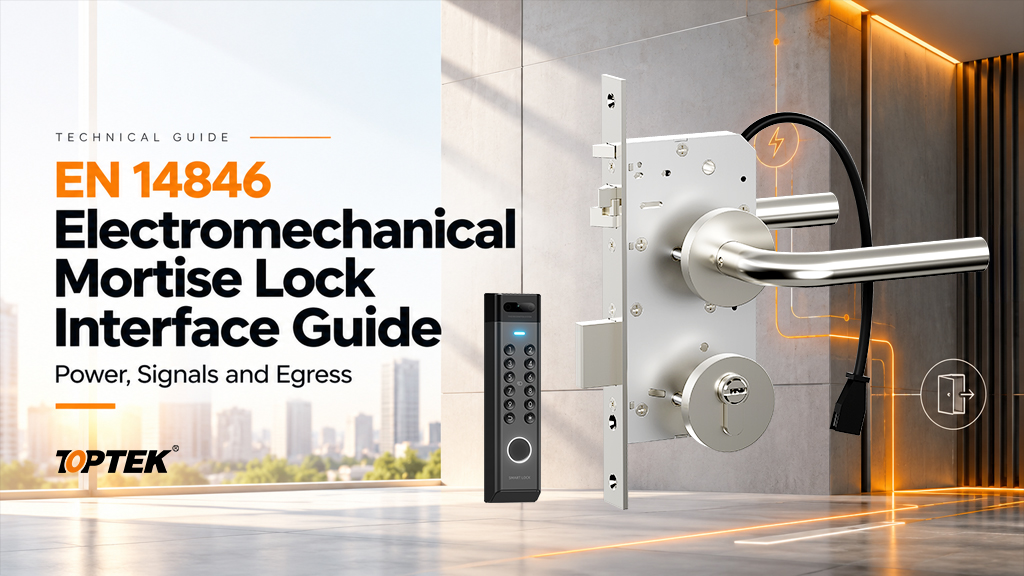

TOPTEK’s solenoid-controlled self-locking mortise range provides a concrete starting point for integrators and door manufacturers: electrical permission enables outside lever operation, the inside lever provides the specified mechanical exit action, and the self-locking mechanism projects the deadbolt on closing. Match that operating sequence to the project before selecting a model from the electronic lock and access control range.
State whether the user turns a lever after access is granted
For a manually operated access-controlled door, the intended sequence may be: present a valid credential, operate the enabled outside lever, open the leaf, then let the door close and relock. This is the operating concept described for TOPTEK’s solenoid-controlled self-locking platform.
An opening with an automatic door operator needs a different purchasing question: which mechanism actually withdraws the locking elements before the operator moves the leaf? Electrically enabling a lever is not, by itself, a promise that the door will open without someone operating that lever. Describe the required movement in the enquiry so the lock and operator can be selected together.
This distinction changes the specification. “Works with a card reader” says little about the lock action. “A valid credential enables the outside lever for manual entry” gives the integrator and lock supplier a function they can demonstrate on the selected configuration.
Select the mechanical variant before finalising the wiring
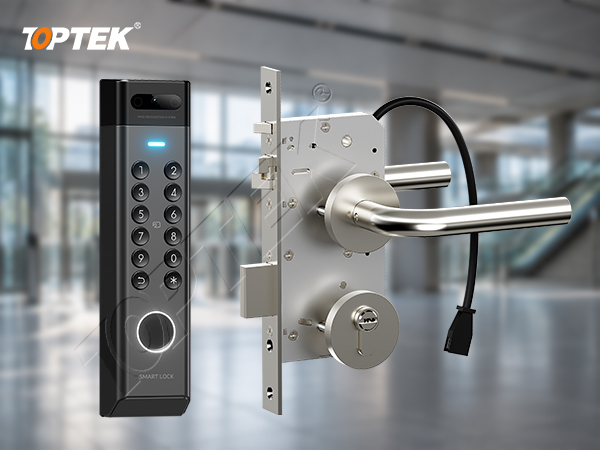
TOPTEK’s product references distinguish standard-latch and cross-latch variants. For example, TKEUS3592 and TKEUSC3592 are separate references; the C in this EN solenoid-controlled series identifies the cross-latch version. TKEUS5572 and TKEUSC5572 follow the same distinction. The suffix identifies a mechanical difference and must remain on the drawing, sample and purchase order.
The TKEUS3592 product page is an available model starting point. Select the latch form with the mating strike and door preparation, rather than treating the alternative as a higher-grade substitute. The model name alone does not determine the complete electrical configuration or the requirements for a particular rated door.
Separate the access command from the status you need
| Project question | What to put in the specification |
|---|---|
| What does a valid credential permit? | The required outside lever or bolt action and its control interface |
| How does a person leave? | The inside operating action for the selected function |
| What happens when the leaf closes? | The intended relatching and self-locking sequence |
| What must the controller know? | The required door-position or lock-status signals and their actual outputs |
| What happens when power is lost? | The specified outside access state and inside exit behaviour for that configuration |
A controller’s access-granted event confirms a permission decision. It does not establish that the leaf is closed or that a bolt has engaged. If the project needs those conditions reported, specify the corresponding monitoring function and interface. The mortise lock monitoring guide explains the distinction between the conditions being monitored.
Do not infer power-loss behaviour from the word “solenoid” or “self-locking.” Obtain the electrical specification for the quoted configuration, including input requirements and available outputs. Confirm the inside exit action independently of the outside access state. The project’s fire and egress requirements must be matched to the exact hardware and doorset documentation.
Use the same configuration for the sample and the order
Before the sample demonstration, agree the latch variant, strike, lever arrangement, cylinder scope and control connection. Then demonstrate the required manual entry, inside exit, closing and relocking sequence, with the selected monitoring indications and power-loss behaviour. A successful credential read alone is an incomplete acceptance result.
Obtain the applicable drawing and connection information through TOPTEK technical resources. As a useful industry reference, SDC’s electrified mortise lock product information provides separate installation and preparation documents for specific configurations. The useful principle is to keep function and installation documents attached to an identifiable product; its product approvals are not transferable to other locksets.
For OEM and ODM door hardware projects, retain the agreed model and configuration in the drawing and order records. This makes later electrical or furniture changes visible before another production batch is released.
Request a lock configuration for your access sequence
Send TOPTEK your door section and required operating sequence. State whether entry is manual or operator-assisted, the proposed controller interface, required status signals, destination market and quantity. Request a suitable model and configuration proposal with the corresponding drawings and connection information. That gives your team a specific assembly to review for quotation and sampling.
Frequently Asked Questions
Does a valid card read mean the door is locked after entry?
No. A valid credential establishes access permission. Confirm closing and locking through the mechanical sequence and any specified door-position or lock-status monitoring.
What does C identify in TKEUSC3592 compared with TKEUS3592?
In this TOPTEK EN solenoid-controlled series, C identifies the cross-latch variant. Retain the complete model reference and match it with the appropriate strike, door preparation and quoted electrical configuration.