

TL;DR
A commercial RFID door lock is a system, not one interchangeable component. The credential and reader must belong to an approved access-control ecosystem. The controller output, power supply, door transfer, electronic mortise lock, request-to-exit, monitoring, mechanical override and egress function must then be coordinated and tested as distinct interfaces.
Start with the Electronic Lock and Access Control product hub, then use this narrower guide to define the required function and approval evidence.
Quick Answer
Define the credential technology and security policy first, then identify the reader and controller that support it. Treat the mortise lock as the controlled door component: confirm its exact electrical data, entry and egress function, monitoring and power-loss state. Approve a point list, wiring diagram, opening schedule and labelled sample before production.
RFID describes the credential-reader exchange
RFID is often used as a broad purchasing label, but it does not identify one credential frequency, protocol, encryption method, card format or management platform. A card that physically resembles another may not be readable or secure in the same system. The project’s credential ecosystem and security policy must define what the reader is expected to recognise.
Ask for the exact credential and reader references, supported technologies, configuration method and ownership of keys or administrative data where applicable. Confirm how credentials are enrolled, issued, suspended, replaced and revoked. Do not select the door lock body from the term RFID or assume that an image showing a reader proves compatibility with the customer’s cards.
Separate reader, controller and lock functions
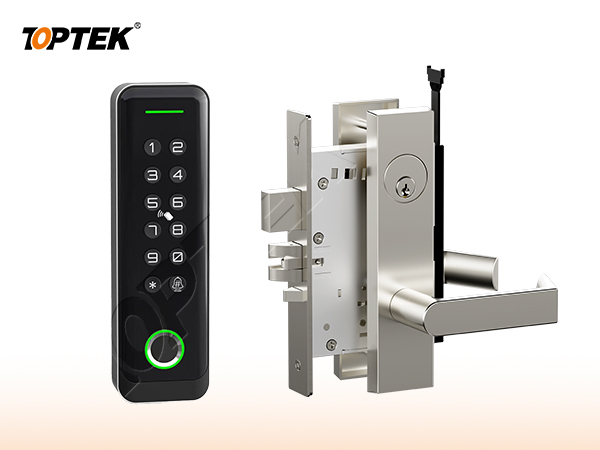
The reader captures credential data. The controller or access terminal applies the access rule and sends an authorised command. The electronic mortise lock changes the controlled entry state while preserving its defined mechanical functions. Power, door transfer and wiring carry that command to the moving door. Each layer needs a named supplier, interface and acceptance test.
TOPTEK’s internal electronic-lock overview describes project arrangements in which outside access can be authorised through card, password or fingerprint at an access-control terminal. That statement supports an architecture discussion. It does not prove that every lock includes an RFID reader, supports a particular credential or operates at a universal electrical value. Exact model documents control the quotation.
Define entry, egress and power-loss states separately
Write the normal locked state, authorised entry sequence, inside egress action, request-to-exit behaviour, power-loss response, alarm or emergency input and mechanical override where required. Fail-safe or fail-secure language addresses one electrical state; it does not by itself describe inside egress, latch engagement or the behaviour of other system components.
For each state, identify the input, expected physical response, monitoring result and reset condition. Test the door open and closed. A green access event in software does not prove that the latch retracted, the door opened, the door closed again or the lock returned to its secure state. Physical door position and lock-status signals must be interpreted according to the supplied contacts and controller logic.
Plan the credential lifecycle and handover
Commissioning should include valid, invalid, expired, revoked and lost-credential procedures that match the selected platform. Record who can enrol users, change schedules and retrieve events. For offline or network-failure conditions, document what continues to operate and how updates are restored. Do not promise a behaviour that has not been demonstrated on the selected reader and controller.
Handover needs more than a card list. Preserve the final point schedule, wiring revision, reader and controller configuration references, lock model, power data, door-transfer details, opening numbers, administrator roles and tested states. Separate mechanical keys and overrides from electronic credential management so both access paths have clear custody and revocation controls.
| Layer | Buyer must define | Acceptance evidence |
|---|---|---|
| Credential | Technology, format and lifecycle | Valid/invalid/revoked test set |
| Reader | Supported credentials and configuration | Reader data and configured sample |
| Controller | Rules, output, timing and events | Point list and witnessed states |
| Door hardware | Lock function, power, egress and override | Drawing, wiring and door test |
| Handover | Administration, records and responsibilities | Signed schedule and training record |
Approve the opening as a system
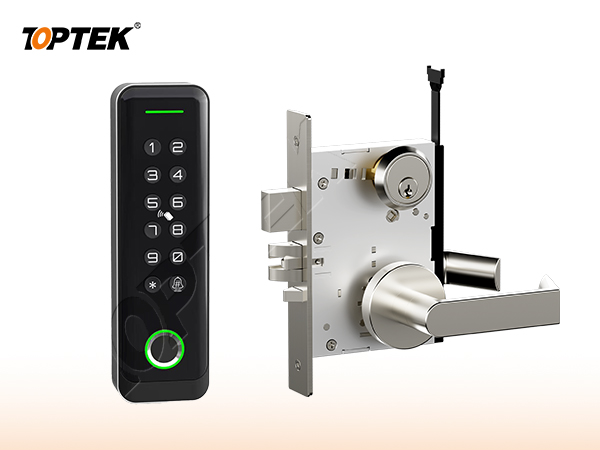
Electronic Lock and Access Control is only one part of the opening. The door leaf, frame, strike or rod interfaces, trim, cylinder, closer, power components where applicable, and the installation conditions all influence the result. Use the TKAMSEC9200EC solenoid-controlled reference and TKAMMRR9200RR motorized reference as lock-body examples. The images show product-family presentations, not proof of an embedded RFID reader or a specific credential technology. A catalogue family name cannot replace a coordinated opening schedule.
Give every opening a unique number. Attach the current elevation, door and frame construction, thickness, swing, handing, hardware interfaces, finish, evidence requirements and sample reference. When one field changes, reopen the affected checks instead of assuming that the earlier approval remains equivalent.
Use a state-based approval test
Write the normal, locked, authorised-entry, emergency-egress, override and abnormal states that apply. For each state, record what the user does and what each latch, bolt, rod, lever, key or electrical input must do. Mark a state N/A when it truly does not apply; a blank field hides a decision.
Operate the labelled sample in the same sequence. Review from both sides of the door, then repeat the critical checks in representative preparation. Photograph labels and interfaces, but preserve the signed state table as the controlling approval record. Appearance alone cannot prove function.
Separate product evidence from project approval
A certificate, test report or declaration applies only to the product, construction, standard and configuration named in its scope. A project still needs to determine whether that evidence is the document it requires. Request current original records and compare model identifiers with the quotation, drawing and sample.
Do not turn an internal development test, a website badge, a similar model or a customer statement into third-party certification. If evidence remains open, record the missing document, responsible reviewer and due date. This draft intentionally avoids unsupported cycle, load, corrosion, fire or material claims.
Buyer approval checklist
- Opening number, door type, frame and swing
- Plain-language operating sequence from both sides
- Exact product, trim and interface references
- Door preparation and installation tolerances
- Required model-specific evidence and revision
- Labelled sample and acceptance owner
- Packaging, site inspection and handover controls
- Repeat-order change-control reference
Common mistakes and project risks
Common errors include buying from the word RFID without naming the credential technology, assuming the reader directly powers the lock, omitting controller output logic, ignoring loaded voltage and door transfer, combining fail state with egress, treating a software event as physical latch confirmation, and leaving mechanical override or administrator ownership undefined. These gaps usually appear during commissioning or handover.
The practical consequences can include re-machining, replacement hardware, revised wiring or keying, delayed inspection and uncontrolled site modification. Stop approval when the operating sequence, physical interface or evidence scope is unclear. A question recorded before production costs less than an assumption discovered across installed doors.
TOPTEK evidence and product scope
TOPTEK uses product-family material, model images and internal engineering observations to frame the buyer questions in this guide. These sources support a configuration discussion; they do not make every option, dimension or approval universal. The supplied configuration still has to be identified on a current drawing.
Use the TOPTEK resources centre for product documents and the applicable evidence request. Where a source describes internal testing, treat it as internal verification unless an original third-party document for the quoted configuration is separately reviewed.
RFQ checklist
- Credential technology, card format and reader ecosystem
- Reader, controller, terminal and software references
- Exact lock model, electrical data and operating states
- Power supply, backup and door-transfer conductors
- Monitoring contacts, request-to-exit and door-position inputs
- Required evidence list and market/project basis
- Sample quantity, acceptance tests and owner
- Drawing, quotation and order revision control
- Production labels and packaging requirement
Why TOPTEK: turn selection into a controlled record
TOPTEK can review a marked-up schedule, translate shorthand into operating and interface questions, and identify missing information before quotation. The objective is not to guess the designer’s decision; it is to give the responsible parties a clear configuration to approve.
Quotation, drawing, sample label and order acknowledgement should carry the same reference. This lets door manufacturers, distributors, integrators and project teams detect substitutions or later changes. It also creates a practical basis for repeat-order inspection.
Two-level CTA
For an initial review, send the opening list, door images or elevations and the required user sequence. Highlight unknowns. TOPTEK can return a focused question list without presenting assumptions as confirmed facts.
For a formal RFQ, submit the approved schedule, drawings, interfaces, evidence requirements and sample protocol through the TOPTEK contact page. Request a configuration-specific response and identify the person authorised to approve deviations.
Conclusion
Good hardware selection is a controlled translation from user behaviour to product configuration. Define the function, verify the physical interfaces, check the applicable evidence and demonstrate the identified sample. Do not let a general product name carry decisions it cannot contain.
Preserve the result through procurement, production, installation and handover. That discipline reduces avoidable replacement risk while keeping every TOPTEK statement inside the evidence and configuration actually reviewed.
Frequently asked questions
Does every commercial RFID door lock accept the same cards?
No. Credential technology, format and security configuration must match the selected reader and access-control ecosystem.
Is the RFID reader normally the same component as the mortise lock?
Not necessarily. Many commercial systems separate the credential reader or terminal, controller interface and electronic lock. Confirm the exact architecture.
Can RFID compatibility be proved from a product image?
No. Use exact reader, credential, controller and lock documentation, then demonstrate the configured system.
What should be tested during commissioning?
Test valid, invalid and revoked credentials, authorised entry, inside egress, request-to-exit, monitoring, door closing, power loss, restoration and mechanical override where specified.
What belongs in a commercial RFID door lock RFQ?
Include opening numbers, credential and reader ecosystem, controller outputs, lock function and electrical data, power transfer, monitoring, egress, override, documents, sample and commissioning states.