
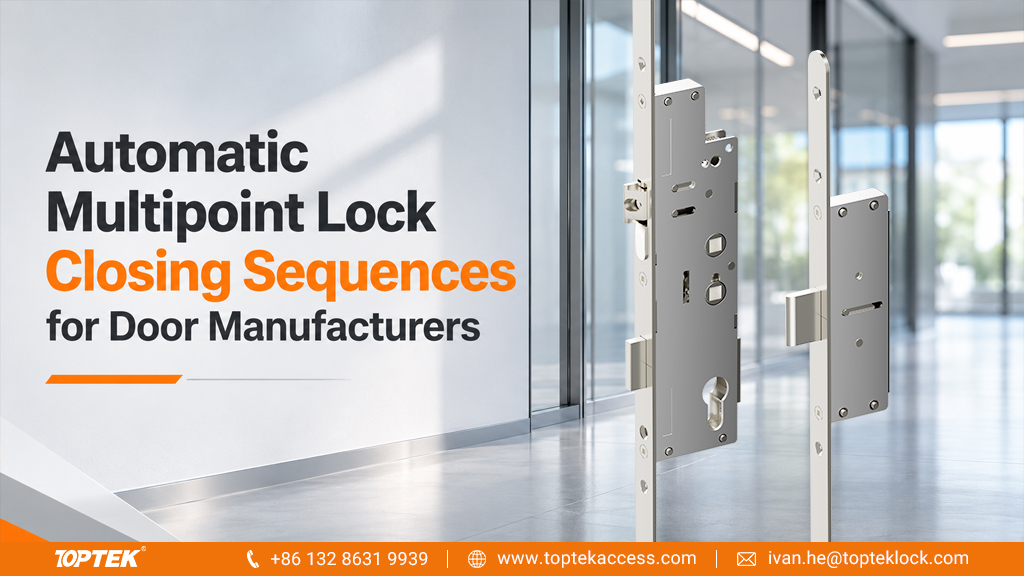

For a door manufacturer, the main reason to select an automatic multipoint lock is straightforward: the door should engage its locking points when it closes, without relying on the user to lift a handle first. The important design decision is when that engagement happens.
TOPTEK’s MUSG4592 combines one central lock case with two auxiliary lock cases. Its closing sequence projects the upper and lower hook bolts and the central deadbolt automatically. That makes it a candidate for door programmes requiring automatic multipoint engagement, with the lock and frame keeps developed as a coordinated assembly.
Choose the closing sequence before comparing lock strips
Three mechanical operating patterns answer different buyer needs. An automatic system triggers its locking points during closing. A lift-lever system uses an upward handle action to drive the locking points, with cylinder operation completing the locking sequence on the relevant configuration. A key-operated system uses the cylinder to drive the locking points.
These mechanisms can look similar when laid side by side. Their user actions are different. If a project brief says the occupant should only need to close the door, a lift-lever product should not be substituted merely because its length and centres appear suitable.
The TOPTEK Auto Lock product range provides a starting point for automatic-lock enquiries. State the required outside entry and inside opening sequence as well; automatic locking does not by itself specify those functions.
Why trigger timing deserves attention
A locking point that projects before it is aligned with its keep may obstruct closing. A mechanism that reaches the closed position without completing its trigger movement may leave a locking point unengaged. The relevant question is therefore whether release occurs at the right stage of the door’s movement.
TOPTEK’s multipoint development experience identifies both premature release and failure to project as problems associated with mechanism geometry and dimensional control. This is why the trigger-to-keep relationship deserves its own review instead of being hidden inside a general statement that a lock is automatic.
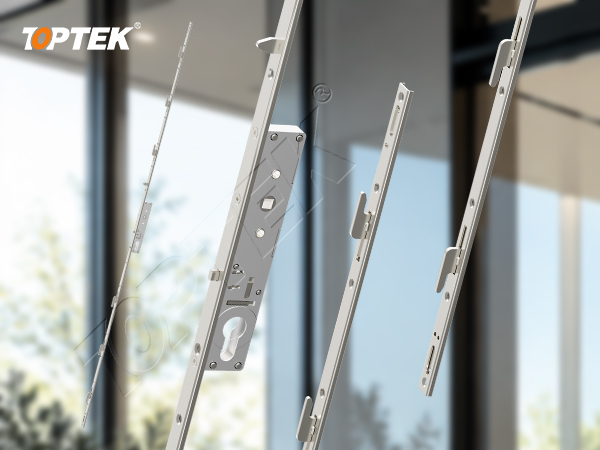
The MUSG4592 uses a swinging trigger arrangement at its auxiliary locks, intended to reduce premature hook projection before correct closing alignment. Its purpose is to coordinate release with door position. The installed result still depends on the matching keeps, door alignment and operating clearances; a trigger feature cannot compensate for a door assembled outside the agreed geometry.
Use the MUSG4592 drawing to anchor the quotation
| Published configuration | What it establishes |
|---|---|
| 45 mm backset | The lock interface position within the door profile |
| 92 mm centres | The relationship between the spindle and cylinder positions |
| 20 × 1720 mm faceplate | The nominal faceplate width and standard length |
| Central case plus two auxiliary cases | The locations that must be coordinated with the door and frame |
Use the TOPTEK documentation resources to request the matching model drawing. These nominal dimensions help start the selection. They do not replace the full drawing or establish interchangeability with another 45/92 lock. Two products can share backset and centres while placing their auxiliary cases or trigger interfaces differently.
For a new door programme, submit the profile section and proposed keep layout before finalizing machining. For an existing opening with an operating fault, use the separate automatic multipoint lock troubleshooting guide to distinguish an alignment problem from a product-selection problem.
Make the approved sample useful for repeat production
TOPTEK retains agreed reference samples with customers for modifications based on an existing platform. For an automatic multipoint project, the useful reference includes the lock, matching keeps and representative door geometry. That combination shows the closing sequence the order is intended to reproduce.
Observe closing and reopening with the intended seals and hardware fitted. Check that the hooks reach their keeps without striking the frame and that the normal opening sequence retracts the locking points. Record the accepted configuration so a later change in keep position, profile or seal does not become an unnoticed substitution.
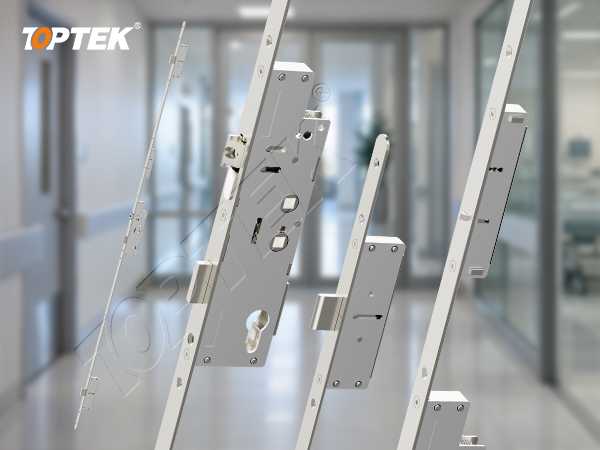
For a distributor carrying multiple systems, keep the operating type in the item description. The multipoint product range should be organized by how the door locks as well as by dimensions. This helps a repeat order preserve the behaviour the customer selected.
Request a MUSG4592 configuration quotation
Send the door profile drawing, required closing and opening sequence, and sample quantity through the TOPTEK enquiry form. Ask for a MUSG4592 configuration proposal with the matching keep arrangement and sample route. Add the destination market and any project approval requirements so the proposed assembly can be reviewed against the intended use.
For a broader door programme, the TOPTEK multipoint supply service connects model selection with OEM requirements and repeat orders. The purchasing objective is an identified lock-and-keep combination that performs the intended sequence on your door.
Frequently asked questions
Is an automatic multipoint lock the same as a lift-lever lock?
No. An automatic mechanism engages its locking points during closing. A lift-lever mechanism requires an upward handle action to drive the locking points on that configuration.
Do matching 45 mm backset and 92 mm centres prove compatibility?
No. Auxiliary case positions, trigger geometry, faceplate details and keeps must also match the door. Use the complete model drawing and representative assembly.