


ANSI Grade 1 Mortise Lock Manufacturer Guide: Classroom vs Storeroom Lock Functions for Commercial Door Projects
Which buyer problem does this guide solve? It explains when to choose F05 Classroom and when to choose F07 Storeroom in an ANSI mortise lock specification. For schools, offices, hospitals, apartments, public buildings, and service areas, the wrong function code can create lockouts, security gaps, and expensive site changes.
Why does this topic matter for an ANSI Grade 1 mortise lock manufacturer? Commercial door projects need the correct lock function before the buyer confirms samples, drawings, cylinders, trim, and fire-rated door requirements. Classroom mortise lock and storeroom mortise lock functions look similar from the outside, but they control exterior access in very different ways.
TL;DR: Classroom vs Storeroom Lock Functions
What is the fastest selection rule? Choose F05 Classroom when authorized staff must be able to leave the outside lever unlocked during normal use. Choose F07 Storeroom when outside entry should always require a key.
- F05 Classroom Function: The outside lever can be locked or unlocked by key, while the inside lever always retracts the latchbolt for free egress.
- F07 Storeroom Function: The outside lever remains locked at all times, while the inside lever always retracts the latchbolt for free egress.
- Best use for F05: Classrooms, training rooms, meeting rooms, staff rooms, and office spaces where flexible outside lever control is needed.
- Best use for F07: Storage rooms, utility rooms, equipment rooms, service corridors, and restricted-access spaces.
- Project warning: Function code, cylinder type, trim style, door thickness, strike, fire-rating expectation, and keying plan should be confirmed before RFQ approval.
Quick Answer: Which ANSI Mortise Lock Function Should You Choose?
Which function should a school or commercial building choose? A project should choose F05 Classroom for controlled teaching or office spaces and F07 Storeroom for rooms that should stay secured from the outside. Both functions support immediate inside egress, but only F05 allows the outside lever to be changed between locked and unlocked status by key.
What is the practical difference between Classroom F05 and Storeroom F07? Classroom F05 is a key-controlled outside lever function, while Storeroom F07 is an always-locked outside lever function. This difference affects daily operation, master key planning, staff access, visitor control, and long-term facility management.
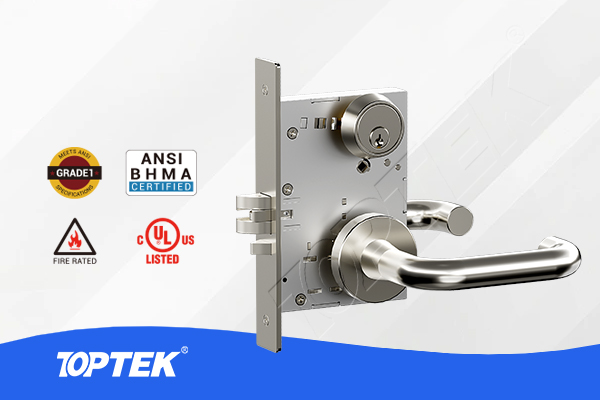
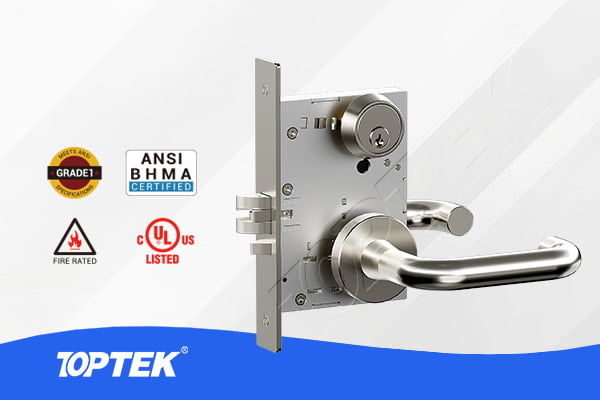
Function Images: F05 Classroom and F07 Storeroom Mortise Lock Operation
Why should buyers review function diagrams before ordering? Function diagrams help confirm inside operation, outside operation, cylinder control, latchbolt movement, and auxiliary deadlatch behavior before sample approval. A clear function review reduces the risk of ordering the wrong ANSI mortise lock function for commercial door projects.
What Is an F05 Classroom Mortise Lock Function?
What does F05 Classroom mean in an ANSI mortise lock? F05 Classroom means the latchbolt can be operated by the lever from either side unless the outside lever is locked by the outside key. When the outside lever is locked, the inside lever still retracts the latchbolt for immediate egress.
How does the outside key work on F05 Classroom? The outside key can control the outside lever and allow authorized staff to lock or unlock exterior lever operation. This makes F05 suitable for classrooms, lecture rooms, training rooms, and administrative rooms where staff may need to keep the outside lever unlocked during normal hours and locked during controlled periods.
What does the auxiliary deadlatch do in F05 Classroom? The auxiliary deadlatch helps deadlock the latchbolt when the door is closed. This improves latch security and helps reduce the risk of latch manipulation from the exterior side when the door is properly closed against the strike.
What Is an F07 Storeroom Mortise Lock Function?
What does F07 Storeroom mean in an ANSI mortise lock? F07 Storeroom means the outside lever is locked at all times, and outside entry normally requires a key. The inside lever always retracts the latchbolt, so users can exit immediately from the interior side.
Why is F07 used for storage and service rooms? F07 Storeroom reduces the chance that staff will accidentally leave the outside lever unlocked. For equipment rooms, utility rooms, storage areas, janitor closets, server rooms, and service corridors, this function gives facility managers stronger exterior access control.
What does the auxiliary deadlatch do in F07 Storeroom? The auxiliary deadlatch helps deadlock the latchbolt when the door is closed. This is important for restricted-access rooms because the door should remain secured after every closing cycle.
Classroom vs Storeroom Lock Functions: Buyer Comparison Table
How should buyers compare F05 and F07 quickly? Buyers should compare outside lever behavior, key operation, inside egress, daily access control, and room application. The table below gives a practical project selection view for ANSI Grade 1 mortise lock buyers.
| Decision Point | F05 Classroom Function | F07 Storeroom Function | Project Recommendation |
|---|---|---|---|
| Outside lever status | Can be locked or unlocked by key. | Locked at all times. | Choose F05 for flexible staff control; choose F07 for stricter outside access control. |
| Inside lever operation | Always retracts latchbolt for free egress. | Always retracts latchbolt for free egress. | Both functions support safe interior exit. |
| Outside entry | By lever when unlocked, or by key when locked. | By key only. | Choose based on how often exterior access should be controlled. |
| Best room types | Classrooms, meeting rooms, training rooms, offices. | Storage rooms, equipment rooms, utility rooms, service areas. | Match function to real user behavior, not only the door name. |
| Main risk if misused | Outside lever may be left unlocked if staff forget key control. | Frequent lockouts may occur if users expect free outside entry. | Test the door routine with facility managers before approval. |
| RFQ keyword match | Classroom mortise lock manufacturer; F05 classroom function. | Storeroom mortise lock supplier; F07 storeroom function. | Include exact function code in the ANSI Grade 1 mortise lock RFQ. |
Application Guide for Schools, Offices, Hospitals and Public Buildings
Where should F05 Classroom be specified? F05 Classroom should be specified where the outside lever needs scheduled or staff-controlled access. Typical examples include classrooms, training rooms, conference rooms, office rooms, shared teaching spaces, and administration rooms.
Where should F07 Storeroom be specified? F07 Storeroom should be specified where the outside side should stay secured after every closing cycle. Typical examples include stock rooms, electrical rooms, maintenance rooms, cleaner rooms, archive rooms, IT rooms, and service rooms.
How should buyers evaluate mixed-function projects? Buyers should group doors by room risk, user flow, emergency egress, keying level, and security exposure. A school project may need F05 Classroom for teaching rooms, F07 Storeroom for storage rooms, passage functions for general rooms, and electrified functions for access control doors.
Standard and Compliance Context for ANSI Mortise Lock Projects
What standard context should buyers check? Buyers should verify ANSI/BHMA A156.13 Grade 1, UL 10C fire-rated requirements where applicable, door preparation, cylinder compatibility, and exact function code before sample confirmation. A function code explains door operation, but it does not automatically prove that every trim, door, frame, and fire-rated assembly is approved for every project.
Which authority links support project evaluation? Buyers can review product safety and testing context through UL Solutions and testing, inspection, and certification context through Intertek. For TOPTEK product documents, buyers can also review the TOPTEK certification and test document center.
Why should certification wording stay cautious? A supplier should not claim that one certificate covers every model, every trim, every function, or every fire door unless the report scope confirms it. For commercial mortise lock Grade 1 projects, buyers should request the exact report, listed model, test standard, door application, and valid document scope.
TOPTEK Evidence Block: ANSI Grade 1 Mortise Lock Manufacturing Capability
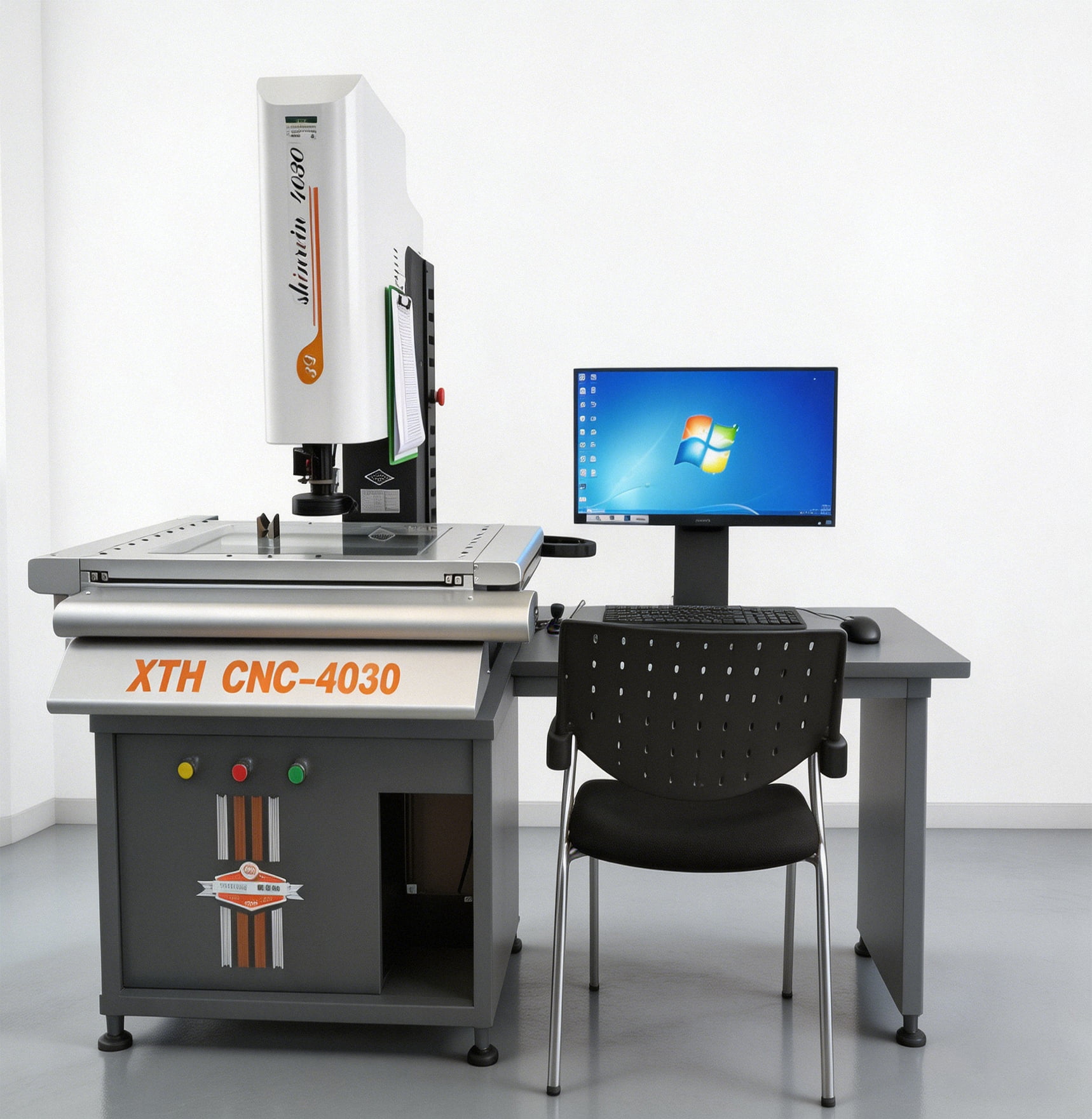
Why can TOPTEK support ANSI mortise lock function selection? TOPTEK supports ANSI Grade 1 mortise lock manufacturing with function-code review, OEM/ODM engineering, sample validation, in-house durability testing, and project RFQ support. The TOPTEK ANSI mortise lock platform includes multiple functions such as F05 Classroom and F07 Storeroom, which helps door brands, hardware distributors, and project contractors prepare complete door hardware schedules.
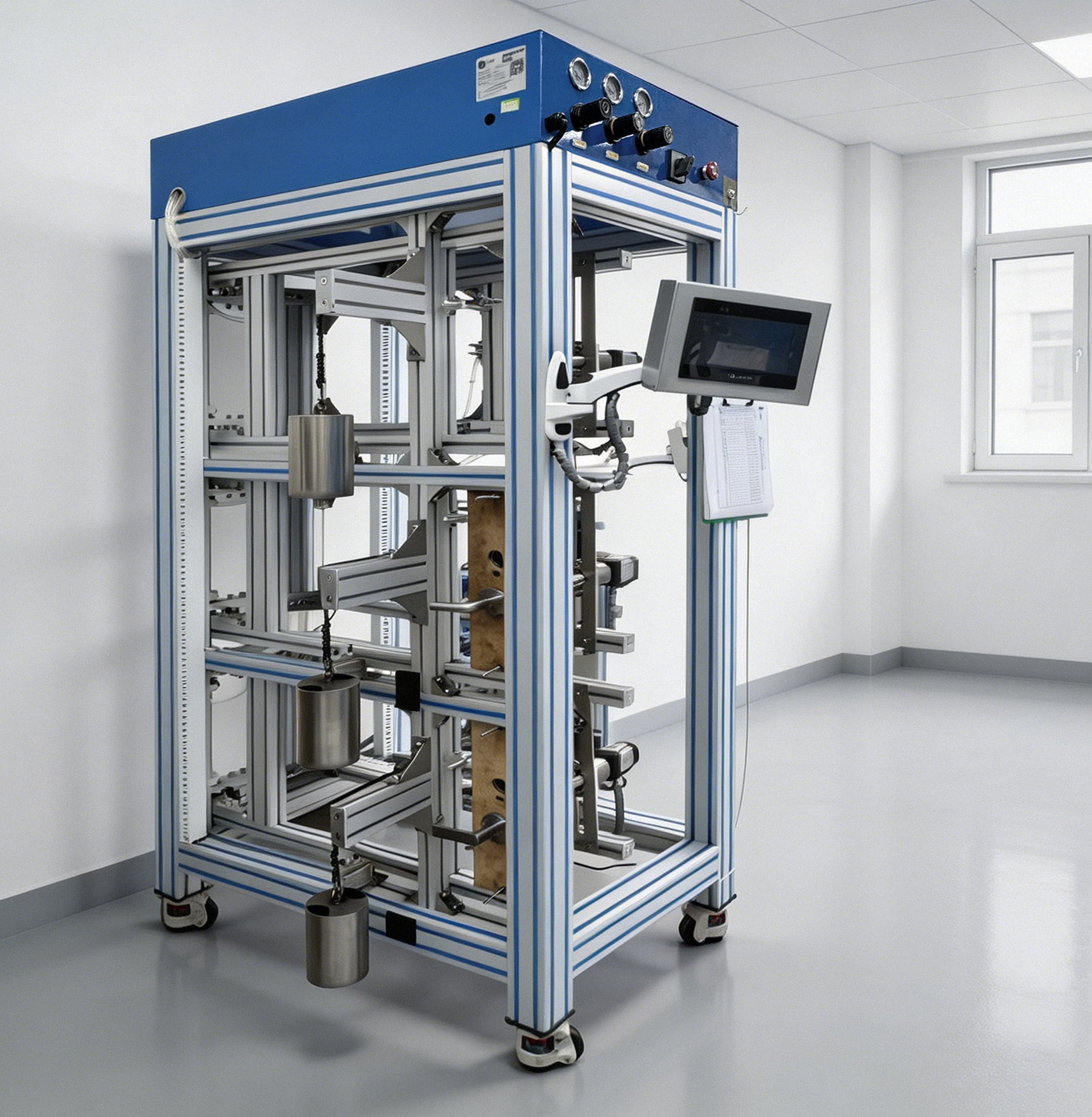
What internal engineering data matters to buyers? TOPTEK has internal ANSI mortise lock testing references including over 2,000,000 mechanical cycles, latchbolt load resistance up to 10,000N, and smooth closing-force control around the latch and strike interface. These values should be treated as TOPTEK internal validation and product-platform evidence unless a buyer requests the corresponding third-party document for a specific model and project scope.
Which current TOPTEK product pages should buyers review? Buyers can start with the ANSI Grade 1 Mortise Lock product category, then review the Round Rose Lever Trim TKAMRR9200 and Escutcheon Lever Trim TKAMEC9200 pages. These pages support commercial buyer research around ANSI/BHMA A156.13 Grade 1, UL 10C, trim selection, lockbody specifications, cylinder compatibility, finishes, and typical applications.
Buyer Checklist: How to Choose the Right ANSI Mortise Lock Function
What should buyers check before choosing F05 or F07? Buyers should check room purpose, access routine, inside egress, outside key control, staff behavior, and security exposure. The right ANSI mortise lock function should match how the building actually operates every day.
| Buyer Checkpoint | Why It Matters | Recommended Action |
|---|---|---|
| Room application | Classroom and storeroom doors have different access patterns. | List each door by room type before confirming function code. |
| Outside lever control | F05 allows key-controlled outside lever status; F07 keeps outside lever locked. | Ask facility managers whether outside free entry is ever required. |
| Inside free egress | Commercial buildings need safe exit from the interior side. | Confirm inside lever operation during sample testing. |
| Cylinder and keying plan | Classroom and storeroom doors often belong to different master key levels. | Send master key hierarchy and cylinder type with the RFQ. |
| Door preparation | Backset, faceplate, strike, and trim location affect installation. | Send door drawings, frame details, and lock preparation requirements. |
| Certification expectation | Grade, fire rating, and listing scope are project-dependent. | Request documents for the exact model, trim, and target market. |
| Sample approval | Function misunderstanding is easier to fix before bulk order. | Test outside lever, inside lever, key, latchbolt, auxiliary deadlatch, and strike alignment. |
Common Mistakes When Specifying Classroom and Storeroom Lock Functions
What is the most common mistake? Buyers sometimes choose the door name instead of the real access-control requirement. A room called a classroom may still need a different function if the building uses centralized access control, special key control, or after-hours restrictions.
- Mistake 1: Using F07 Storeroom on doors where staff expect normal outside lever access. This can create avoidable lockouts and daily user complaints.
- Mistake 2: Using F05 Classroom on rooms that should never allow an unlocked outside lever. This can weaken security for storage, utility, and equipment rooms.
- Mistake 3: Confirming function code without testing the actual trim and cylinder. Lever trim, mortise cylinder, cam, spindle, and keying must work together.
- Mistake 4: Assuming all ANSI Grade 1 mortise lock products have the same certificate scope. Buyers should request exact documents for the model and project requirement.
- Mistake 5: Ignoring strike and frame details. Poor strike selection can affect latch deadlocking, closing force, and long-term door performance.
- Mistake 6: Leaving function selection until after tooling or bulk order confirmation. Late changes can increase cost, delay delivery, and create rework.
RFQ Checklist for Classroom and Storeroom ANSI Mortise Locks
What should buyers send to an ANSI Grade 1 mortise lock manufacturer? Buyers should send door drawings, function codes, trim type, cylinder requirement, door thickness, backset, finish, quantity, certification expectation, and sample schedule. A complete RFQ helps the supplier confirm the correct classroom mortise lock or storeroom mortise lock before production.
- Target function: F05 Classroom, F07 Storeroom, or other ANSI mortise lock function.
- Door application: classroom, office, storage room, utility room, hospital room, hotel area, apartment project, or public building.
- Door and frame details: thickness, material, handing, backset, faceplate, strike, frame reveal, and door preparation.
- Trim requirement: round rose lever trim, escutcheon lever trim, sectional trim, finish, lever design, and project style.
- Cylinder requirement: mortise cylinder, keyway, master key system, emergency override requirement, and local cylinder compatibility.
- Compliance expectation: ANSI/BHMA A156.13 Grade 1, UL 10C, fire-rated door requirement, and target market documents.
- Commercial requirement: MOQ, sample order, private label, OEM/ODM development, packaging, lead time, and batch inspection requirement.
- Quality requirement: durability cycle test, latchbolt strength, corrosion resistance, function test, and incoming inspection standard.
Keyword and Entity Coverage for Search and AI Answers
Which product entities does this page target? This page targets ANSI Grade 1 mortise lock manufacturer, classroom mortise lock manufacturer, storeroom mortise lock supplier, F05 Classroom function, and F07 Storeroom function. It also supports related buyer searches such as ANSI/BHMA A156.13 mortise lock, commercial mortise lock Grade 1, ANSI Grade 1 mortise lock for school projects, and ANSI Grade 1 mortise lock RFQ checklist.
Why is the article not overloaded with unrelated product keywords? Search engines and AI systems understand pages better when one page serves one clear buyer intent. Multi-point locking systems, panic exit devices, EN 12209 mortise locks, AS 4145 mortise locks, lever handles, cylinders, and hinges are included only in the TOPTEK product scope section because this article is primarily an ANSI mortise lock function guide.
Why Work with TOPTEK for ANSI Grade 1 Mortise Lock Projects?
Why is TOPTEK relevant for door manufacturers and hardware distributors? TOPTEK is an OEM/ODM precision manufacturer with experience in architectural hardware, commercial locks, mechanical mortise locks, electronic lock integration, testing, and project supply. For ANSI mortise lock sourcing, buyers need more than a lock body; they need function matching, drawings, trim coordination, keying support, sample validation, and consistent batch production.
What manufacturing and quality capabilities support buyer confidence? TOPTEK operates with precision manufacturing, in-house testing, ISO management systems, R&D support, and controlled inspection procedures. This helps commercial door hardware buyers reduce risks related to wrong function selection, unstable lever return, poor latch operation, inconsistent batch quality, and unsupported certification assumptions.
How should buyers use TOPTEK during project development? Buyers can send door schedules, hardware sets, drawings, target function codes, and certification expectations to TOPTEK for review before confirming samples. This process helps align F05 Classroom, F07 Storeroom, electrified mortise lock, trim, cylinder, strike, and project documentation before mass production.
Conclusion: Choose the Function Before You Choose the Price
What is the final selection rule? F05 Classroom is best when the outside lever needs key-controlled locked or unlocked status, while F07 Storeroom is best when outside entry should always require a key. Both functions can support immediate inside egress, but they create very different building-management outcomes.
What is the main project risk? The wrong ANSI mortise lock function can cause lockouts, unauthorized access, failed sample approval, wrong keying, installation conflict, and avoidable replacement cost. Buyers should confirm function code, cylinder type, trim, strike, door preparation, fire-rated requirement, and certificate scope before placing bulk orders.
What product scope can TOPTEK support? TOPTEK Access is a China-based OEM/ODM manufacturer of commercial locks, architectural door hardware, and integrated access control locking solutions, supplying ANSI Grade 1 mortise locks, EN 12209 Grade 3 mortise locks, AS 4145 mortise locks, panic exit devices, multi-point locking systems, electronic locks, lever handles, cylinders, and hinges for global door manufacturers, distributors, contractors, and building projects.
What does TOPTEK stand for? TOPTEK stands for Commercial Door Hardware Reliability Solution. TOPTEK: Smart Design. Strong Security.
What should buyers do next? Send your door drawings, hardware schedule, function requirement, target market, certification expectation, quantity, finish, and sample timeline to TOPTEK for OEM/ODM review. Our engineering and sales teams can help confirm whether F05 Classroom, F07 Storeroom, or another ANSI mortise lock function is the correct solution for your commercial door project.
FAQ: Classroom vs Storeroom ANSI Mortise Lock Functions
What is the difference between F05 Classroom and F07 Storeroom lock functions?
What is the main difference? F05 Classroom allows the outside lever to be locked or unlocked by key, while F07 Storeroom keeps the outside lever locked at all times. Both functions allow immediate inside egress by lever.
Is F05 Classroom suitable for school classroom doors?
Is F05 the usual classroom choice? Yes, F05 Classroom is commonly used where staff need key control over the outside lever. It works well for classrooms, training rooms, and similar education spaces when the project requirement allows exterior lever control.
Is F07 Storeroom suitable for storage rooms and utility rooms?
Is F07 the better choice for restricted rooms? Yes, F07 Storeroom is usually better for rooms where outside access should always require a key. It helps protect storage, equipment, maintenance, and service rooms.
Do both F05 and F07 allow free egress from the inside?
Do both functions allow inside exit? Yes, both F05 Classroom and F07 Storeroom allow the inside lever to retract the latchbolt for immediate egress. Buyers should still test the sample with the selected trim, cylinder, and strike.
What should buyers confirm before ordering ANSI Grade 1 mortise locks?
What should the RFQ include? The RFQ should include function code, door drawings, trim style, cylinder type, door thickness, backset, strike, finish, quantity, and certification expectation. This helps the manufacturer quote and prepare the correct product configuration.
Can TOPTEK support OEM/ODM ANSI mortise lock projects?
Can TOPTEK support OEM/ODM projects? Yes, TOPTEK supports ANSI Grade 1 mortise lock OEM/ODM projects with function review, engineering communication, sample development, testing support, and project supply. Buyers can request drawings, product documents, samples, and certification-route discussion based on target market requirements.
Technical Review
Who reviewed this technical guide? This article is prepared for TOPTEK buyer education and reviewed from a manufacturer and project-hardware perspective. Technical review: Ivan He, General Manager at TOPTEK.