
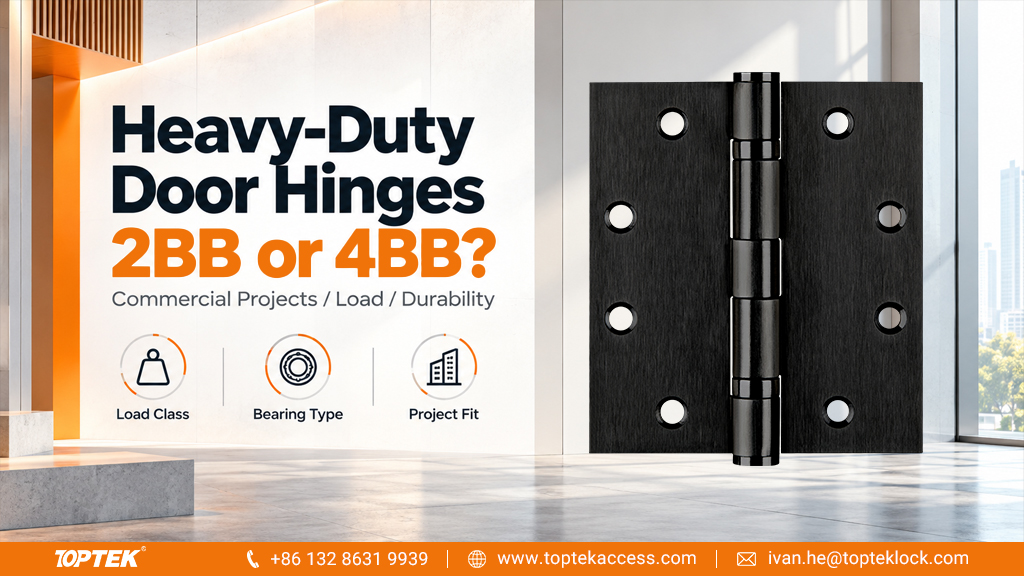

A heavy-duty door hinge order should tell the door factory exactly which hinge to prepare for and the installer exactly what will arrive. TOPTEK supplies 2BB and 4BB full mortise hinges for commercial door projects. Both families use ball bearings, but they offer different dimensions and leaf thicknesses. Selecting between them starts with the door, its use and the required preparation.
TL;DR
- Give the supplier the door dimensions, weight, construction and expected use.
- Select the complete size and leaf thickness, not just “2BB” or “4BB”.
- Coordinate the screw preparation, frame reinforcement and finish.
- Include any security-pin or fire-door requirement in the original enquiry.
Quick Answer
Choose a 2BB or 4BB hinge by matching the complete hinge specification to the door’s size, weight, operating duty and preparation. The terms identify two or four ball bearings; they do not, by themselves, establish an allowable door weight. TOPTEK’s mechanical range includes 2BB configurations with 3.0 or 3.4 mm leaves and 4BB configurations with 4.6 or 4.8 mm leaves. Specify the exact size and thickness so the proposed hinge, door and frame can be coordinated before production.
Start with the opening rather than the bearing count
A busy entrance, a wide service door and an internal office door place different demands on their hardware. The closer and installation arrangement also belong in the selection discussion. A hinge supplier needs this context to propose a suitable configuration rather than simply a larger product.
Ball bearings help reduce friction between moving hinge components. The BHMA hinge terminology guide explains bearing and hinge terminology. For purchasing, translate those terms into a complete model reference and the dimensions needed by the door manufacturer.
Compare actual TOPTEK 2BB and 4BB configurations
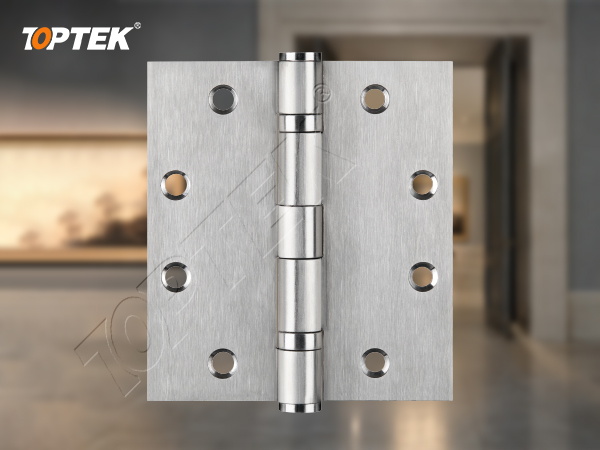
TOPTEK’s 2BB full mortise hinge range includes several sizes and more than one thickness for selected outlines. Its 4BB full mortise hinge range provides thicker-leaf configurations. The following examples show why a nominal size alone is not a complete order description.
| TOPTEK model | Nominal size | Leaf thickness | Bearing configuration |
|---|---|---|---|
| 2BB4040 | 4.0 × 4.0 inches | 3.0 mm | 2 ball bearings |
| 2BB4545 | 4.5 × 4.5 inches | 3.0 or 3.4 mm | 2 ball bearings |
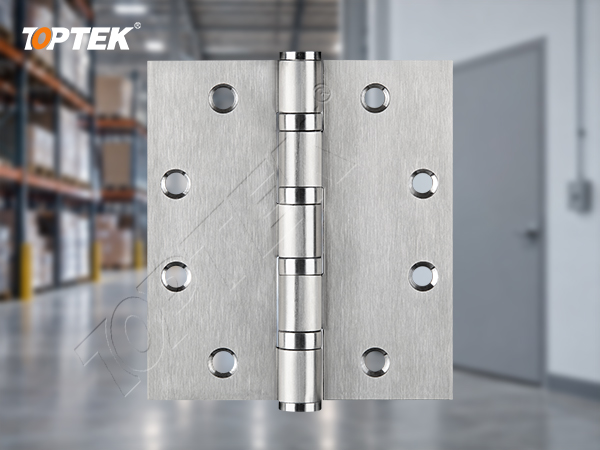
| 4BB4545 | 4.5 × 4.5 inches | 4.6 mm | 4 ball bearings |
| 4BB5050 | 5.0 × 5.0 inches | 4.8 mm | 4 ball bearings |
For example, a purchase description of “4.5-inch square hinge” leaves the thickness unresolved. That decision affects the preparation sent to the door factory. Include the thickness in the quotation and drawing reference, even where the nominal dimensions and model family appear familiar.
These dimensions describe product configurations, not door-weight ratings. Ask for a recommendation for the complete opening, including hinge quantity and fixing conditions. Four bearings should not be interpreted as twice the load capacity of two bearings.
Choose the material, finish and security options together
The illustrated TOPTEK mechanical 2BB and 4BB families specify SS304 construction and list US26, US26D and US10B finish options. Select the finish alongside the other visible door hardware, and use an agreed finish reference when colour and appearance are important to the project.
A non-removable pin option is available for these families. It is particularly relevant when the hinge is exposed on an outward-opening door. The NRP arrangement secures the pin so that its retaining feature is inaccessible with the door closed. Specify the option in the order rather than expecting it to be included in every hinge.
Review the TOPTEK hinge and door power transfer range when coordinating a complete hardware package. Keep mechanical hinge selection separate from any electrical transfer requirement, even when the products have a similar appearance.
Give the door factory an unambiguous specification
Full mortise hinges sit in recesses in the door and frame. Coordinate the selected leaf thickness, screw positions, corner shape and hinge position before the preparation is released. For metal frames, the fixing and reinforcement arrangement should be included in that coordination; for timber doors, specify suitable fixings for the construction.
The practical purchasing risk is ordering by appearance while the factory prepares to a different drawing. Avoid substituting a hinge on the basis of nominal size alone. If the project involves existing openings, review the existing preparation separately rather than assuming a new-project specification can be used as a direct replacement.
For fire-rated doors, select the hinge within the applicable doorset or listing requirements and installation instructions. Request the documents for the proposed configuration with the quotation. A bearing count or material description is not, on its own, a fire rating.
Why source the hinge configuration from TOPTEK?
TOPTEK offers both mechanical bearing families within a wider architectural hardware portfolio. This lets a door manufacturer or distributor discuss the hinge alongside the lock, handle and other supplied hardware. The enquiry can therefore address the physical fit and finish of the opening as well as the individual component.
TOPTEK’s quality management process includes incoming checks, first article inspection and checks during production. For buyers placing repeat orders, agree the exact configuration and inspection requirements so dimensional and assembly expectations remain clear from one batch to the next.
Request a configuration and quotation
For initial selection, send the door dimensions, weight, construction, opening direction and expected use to ivan.he@toptekaccess.com. Include a drawing if the door preparation is already fixed.
For a formal quotation, add the proposed 2BB or 4BB model, leaf thickness, quantity, finish, fixing requirements and NRP option. Identify any fire-door application and the documents required for approval. TOPTEK’s commercial door hardware manufacturing team can discuss the hinge supply as part of the project package.
Frequently asked questions
What is the difference between 2BB and 4BB hinges?
The designations identify two or four ball bearings. Compare the complete hinge dimensions, thickness and application suitability when choosing between them.
Does a 4BB hinge carry twice the door weight of a 2BB hinge?
No. Bearing count alone does not establish load capacity. Selection depends on the hinge design, door dimensions, weight, duty, quantity and fixing arrangement.
Why must the leaf thickness appear in the order?
Leaf thickness must match the planned door and frame preparation. TOPTEK offers some nominal sizes in more than one thickness, so size alone is insufficient.
Can I order a non-removable pin option?
TOPTEK lists an NRP option for the illustrated mechanical 2BB and 4BB families. Include that requirement when requesting the exact configuration and quotation.