
Global Fire Door Hardware Sourcing
Fire Door Lock Supplier for Global Commercial Door Projects
Match the lock, door construction, regional standard and evidence package before approving samples or production.
Written by Ivan He, General Manager, Zhongshan Toptek Security Technology Co., Ltd.
Quick Answer
A capable fire door lock supplier does more than offer a lock with a fire-related label. The supplier must help the buyer match the exact lock model, door construction, test or certification route, egress function, installation details and project approval requirements. UL 10C, EN 1634-1 and other regional standards address different test and approval frameworks; they are not interchangeable. The safest sourcing process starts with the door schedule and required market, then verifies the current evidence for the exact product configuration before samples or production are approved.
TL;DR for Door Hardware Buyers
- Start with the required market, door construction, fire rating, handing and egress function.
- Separate the fire-test route from the lock performance standard and the exit-device requirement.
- Check that the submitted lock model, forend, strike, function and accessories fall within the evidence scope.
- Do not treat an internal test, a product-family statement or a sample report as blanket third-party certification.
- Approve drawings, documents and samples together so the supplied hardware matches the reviewed configuration.
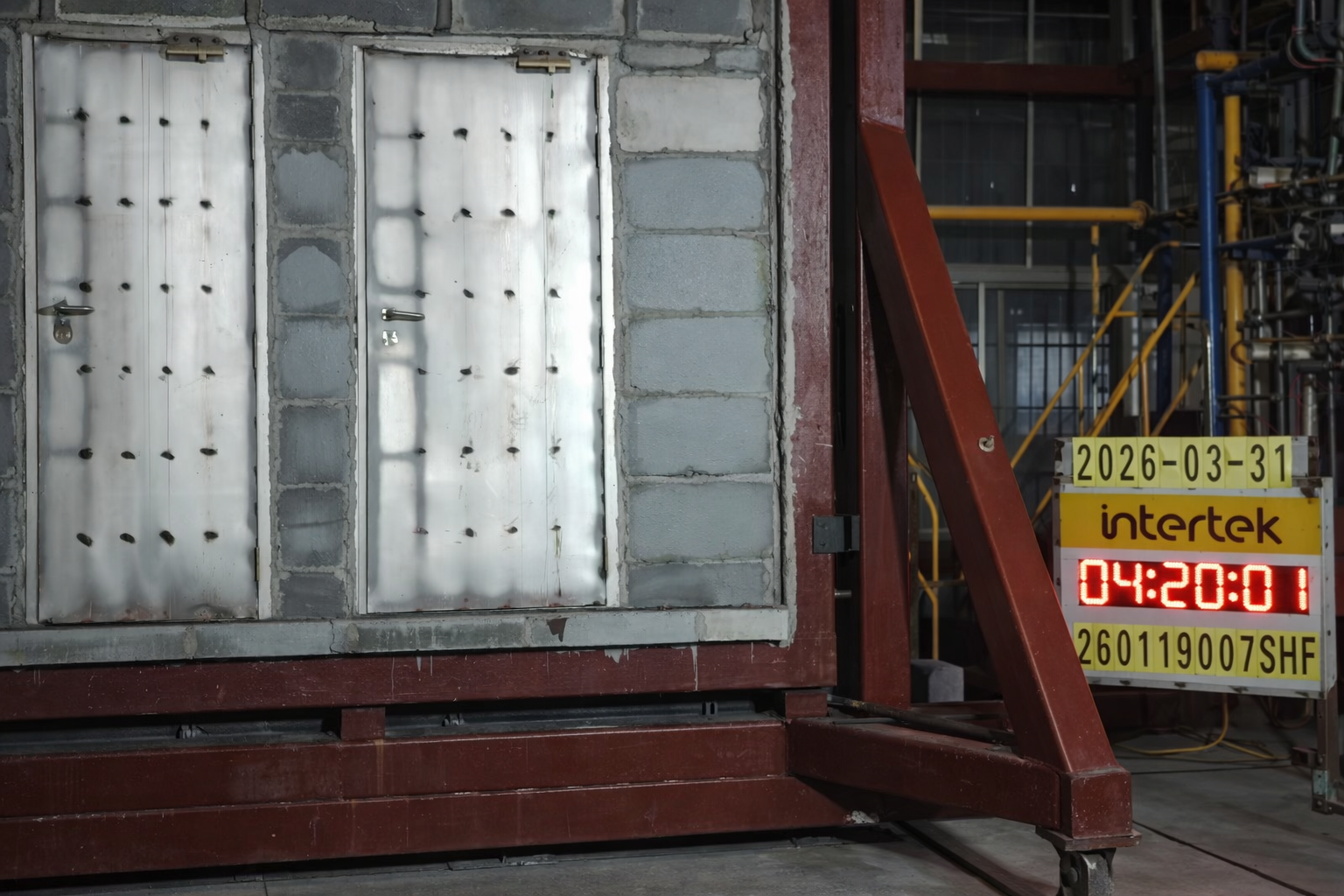
What Should a Fire Door Lock Supplier Confirm?
Fire-door hardware is part of a system. A lock that is suitable for one tested steel doorset may not automatically be suitable for a timber doorset, a different leaf thickness, another intumescent arrangement or an unlisted accessory combination. A reliable supplier should therefore translate the door schedule into a controlled hardware submission instead of selecting by catalogue description alone.
Before quotation, the supplier should confirm five layers:
- Market and approval path: the country, project specification and authority having jurisdiction.
- Door construction: steel, timber composite or another approved construction, including leaf thickness and preparation.
- Hardware function: passage, deadlocking, escape, electrified control or exit-device operation.
- Evidence scope: the exact model and relevant tested or assessed configuration.
- Production controls: approved drawings, samples, marking, packaging and change control.
This approach protects the buyer from a common procurement error: ordering a mechanically compatible lock that does not match the project’s fire-door evidence or escape requirements.
Fire Door Lock Standards Are a Layered System
The phrase “fire-rated lock” can hide several separate questions. One document may address the fire resistance of a doorset, another the mechanical performance of a lock, and another the escape function. The project specification determines which combination applies.
| Market or route | Common reference | What buyers should verify |
|---|---|---|
| North America | UL 10B, UL 10C and CAN/ULC-S104 | Exact listed model, label, fire-door assembly, positive-pressure requirement and project acceptance. |
| Europe | EN 1634-1, EN 1634-2 and EN 16034 | Doorset test or assessment scope, hardware suitability, declared performance and the applicable product standard. |
| Mechanical mortise locks | EN 12209 | Classification, intended use, exact lock model and compatibility with the approved fire-door configuration. |
| Electromechanical locks | EN 14846 | Electrical function, fail-safe or fail-secure behavior, mechanical interface and evidence scope. |
| Emergency or panic escape | EN 179 or EN 1125 | Occupancy, user familiarity, exit function and the complete approved hardware set. |
| United Kingdom project route | BS 476-22 where specified and accepted | Current project requirements, test evidence, field of application and any transition requirements. |
| Australia and New Zealand | AS/NZS 1905.1 with fire-resistance testing such as AS 1530.4 | Doorset approval, hardware schedule, permitted preparation and evidence accepted for the project. |
| International test route | ISO 3008-1 | Whether the project recognizes the route and whether the tested construction matches the proposed doorset. |
Important: the references above describe common routes, not a universal approval list. The architect, fire engineer, doorset manufacturer, certification body or authority having jurisdiction must confirm the route accepted for the project.
Choose the Product Path Before Choosing the Model
EN 12209 / CE Mortise Lock Path
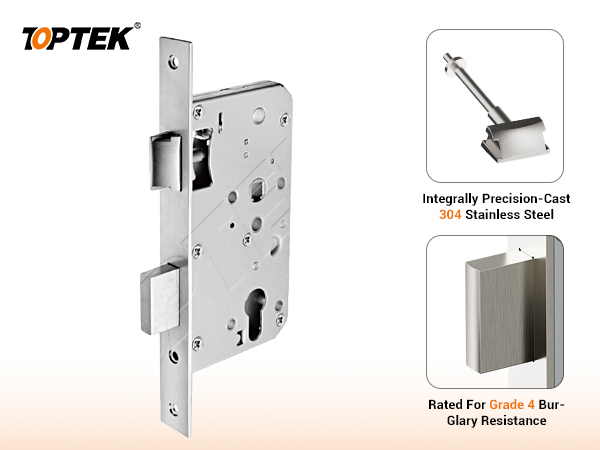
For European-style commercial doors, begin with the TOPTEK EN 12209 mortise lock range. TOPTEK’s Certificate of Constancy of Performance No. 2649-CPR-26002201 covers listed mechanically operated locks, latches and locking plates intended for fire-resistance and/or smoke-control doors. The current certificate references EN 12209:2003/AC:2005 and must be checked for validity and exact model scope when the project is submitted.
Within the supporting EN 1634-1 evidence, models EN10085ESL and EN8085RL were tested in specified steel and timber composite fire-door assemblies. The reported steel-door result was 260 minutes integrity, while the timber composite door result was 132 minutes integrity and 132 minutes insulation. These results belong to the documented test assemblies and conditions; they are not a blanket claim for every door, model or installation. Other models listed in the certificate were assessed within its stated scope. Buyers should request the current certificate, reports and model schedule before approval.
For a concrete product reference, review the TOPTEK EN72SL sash mortise lock, then confirm the required backset, centre distance, forend, strike, handing, cylinder interface and project evidence.
ANSI Grade 1 and North American Listing Path
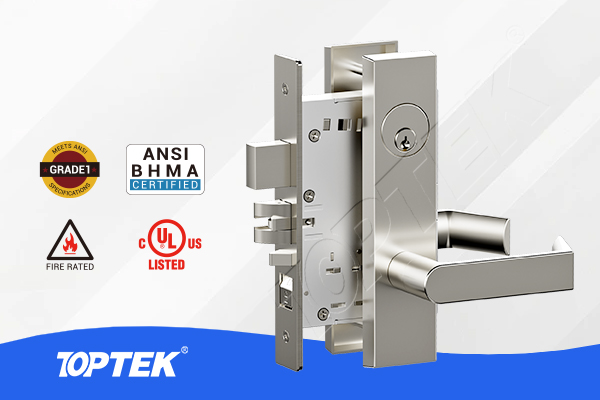
North American projects should start from the specified ANSI/BHMA function and the exact fire listing required for the opening. TOPTEK’s ANSI Grade 1 mortise lock range supports commercial-door selection, but listing acceptance must be checked model by model. The TKAMRR9200 product page, for example, identifies ANSI/BHMA A156.13 Grade 1 and UL/cUL fire-door information for that product. Before specification, request the current listing documentation and confirm the exact trim, lock case, function, label and fire-door assembly.
Electromechanical and Exit Hardware Paths
An access-control lock or panic exit device is not automatically interchangeable with a mechanical mortise lock. Electrified hardware introduces power, monitoring, fail-safe or fail-secure behavior and system-integration questions. Escape hardware introduces occupancy and egress requirements. These products should be scheduled as separate paths, with their own product standards and fire-door evidence, before they are connected to the same project package.
What Evidence Should Be Included in the Submission?
A useful fire-door hardware submission should allow the reviewer to trace the proposed item from the schedule to the drawing, sample and supporting document. Ask the supplier for:
- Current certificate or listing document, including certificate number and validity where applicable.
- Test report or assessment relevant to the proposed door construction.
- Exact covered model schedule and clear identification of any assessed variants.
- Classification, declared performance or listing details required by the project.
- Dimensioned product drawing showing lock case, backset, centres, forend and strike.
- Installation instructions, permitted accessories and any restrictions on preparation.
- Production sample and label or marking confirmation before mass production.
Test reports and certifications serve different purposes. A report records a tested result under stated conditions. A certificate or listing controls a defined product scope under its own scheme. TOPTEK does not present internal validation as independent third-party certification.
Buyer Selection Checklist
| RFQ field | Information to provide | Risk if omitted |
|---|---|---|
| Destination and standard | Country, project specification and required test/listing route | Wrong evidence package or non-accepted product |
| Door assembly | Steel or timber construction, thickness, rating and manufacturer | Evidence may not cover the proposed doorset |
| Lock function | Passage, deadlocking, escape, classroom, storeroom or electrified | Operational or egress failure |
| Door preparation | Backset, centres, case depth, forend, strike and handing | Site rework or incompatible installation |
| Interfaces | Cylinder profile, cam, spindle, lever trim and access-control connection | Components fit individually but fail as a system |
| Approval control | Document revision, sample status, marking and change-approval process | Production differs from the approved submission |
Common Sourcing Mistakes
Assuming One Fire Standard Covers Every Market
UL 10C and EN 1634-1 both relate to fire testing, but they belong to different regional approval systems. A test result under one route does not automatically satisfy another specification.
Checking the Brand but Not the Exact Model
Evidence normally has a defined product and configuration scope. Compare the quotation model code and drawing with the model schedule in the current certificate, listing or assessment.
Ignoring the Door Construction
Steel and timber doors respond differently under fire exposure. Leaf construction, thickness, preparation, intumescent protection and hardware position can affect the permitted application.
Approving Documents Separately from Samples
If the drawing, sample and evidence are reviewed at different times, an unapproved change can enter production. Use one approval register and lock the revision before mass production.
Treating Fire Resistance as the Only Requirement
The opening may also need durability, security, accessibility, egress, corrosion resistance or access-control functionality. These requirements must be coordinated, not traded against one another.
Why Buyers Work with TOPTEK
TOPTEK has manufactured commercial door hardware since 1991. Our 13,000 m² facility, 220+ team members, 20+ R&D personnel and 50+ Japanese CNC machines support coordinated development and repeatable production. For relevant precision components, machining capability reaches ±0.01 mm. The factory’s stated production capacity is up to 200,000 sets per month, subject to product mix and confirmed production planning.
TOPTEK maintains ISO 9001, ISO 14001 and ISO 45001 management systems. Our internal laboratory supports development and production verification; where a project requires independent certification or test evidence, we identify the applicable third-party documents separately.
For fire-door lock sourcing, our practical value is the review process: product function, interface dimensions, applicable evidence, sample approval and production control are aligned before delivery. Learn more about TOPTEK’s manufacturing and quality approach.
Fire Door Lock RFQ Checklist
For a faster and safer recommendation, include the following in your enquiry:
- Project country, building type and required standard or listing.
- Door schedule and fire rating.
- Door material, thickness, handing and opening direction.
- Required lock or exit function for each opening type.
- Backset, centre distance, case depth, forend and strike dimensions.
- Cylinder, spindle, trim and access-control interfaces.
- Requested certificate, listing, test report or assessment documents.
- Sample quantity, annual demand, finish, packaging and target delivery date.
- Approval contacts and change-control requirements.
Request a Model-and-Evidence Review
Send TOPTEK your door schedule, required market and hardware function. We will review the product path, interface dimensions and available evidence before preparing the quotation.
Contact TOPTEK for a fire door lock RFQ or email ivan.he@toptekaccess.com.
Frequently Asked Questions
Is UL 10C the only standard for a fire door lock?
No. UL 10C is a North American positive-pressure fire test route. Depending on the project, other references can include UL 10B, CAN/ULC-S104, EN 1634-1, EN 1634-2, EN 16034, BS 476-22, AS/NZS 1905.1, AS 1530.4 or ISO 3008-1. The project specification and authority having jurisdiction decide what is accepted.
Does an EN 1634-1 test make every lock in the product family fire-rated?
No. The result applies to the tested assembly and the scope allowed by the report, assessment or certification. Buyers must verify the exact lock model, door construction, accessories, installation details and current evidence.
What is the difference between EN 12209 and EN 1634-1?
EN 12209 is a product standard for mechanically operated locks, latches and locking plates. EN 1634-1 is a fire-resistance test for door and shutter assemblies. A fire-door project may require both the relevant lock classification and suitable doorset fire evidence.
Can the same mortise lock be used on steel and timber fire doors?
Only when the available evidence and approved application cover the proposed construction and installation. Steel and timber doors should not be treated as interchangeable because their fire behavior and permitted hardware preparation can differ.
What should I send a fire door lock supplier for an accurate quotation?
Send the destination market, project standard, door schedule, fire rating, door construction, lock function, dimensions, cylinder and trim interfaces, required documents, sample quantity and expected order volume. Photos and existing preparation drawings are also useful for replacement projects.
Can TOPTEK provide supporting documents before production?
TOPTEK can review the requested model against available drawings, certificates, listings, test reports or assessments before production. Document availability and suitability must be confirmed for the exact product and project requirement; unsupported claims will not be substituted for missing evidence.
Conclusion
The right fire door lock supplier should connect the specification, doorset, lock function and evidence—not simply quote a catalogue model. Start with the market and door schedule, confirm the exact documentation scope, and approve drawings and samples as one controlled package. This reduces rework, avoids unsupported compliance claims and gives the project team a clearer path from RFQ to delivery.
Secondary CTA: Browse TOPTEK’s commercial door hardware product range, then send the relevant product links with your schedule for a configuration review.