

How Does a Door Handle Work?
How Does a Door Handle Work? A door handle works by transferring hand force through the lever, spindle, spring return system, and latch mechanism so the door can open, close, and return to its normal position. In commercial door hardware, this simple action must happen smoothly thousands of times without sagging, loosening, or damaging the lock body.
Why should buyers understand the handle mechanism? Because the door handle is not only a decorative part; it directly affects latch retraction, user comfort, door closing, emergency egress, and long-term maintenance cost. For door manufacturers, distributors, contractors, and project buyers, a weak handle can create complaints even when the lock body itself is strong.
What Happens When You Press a Door Handle?
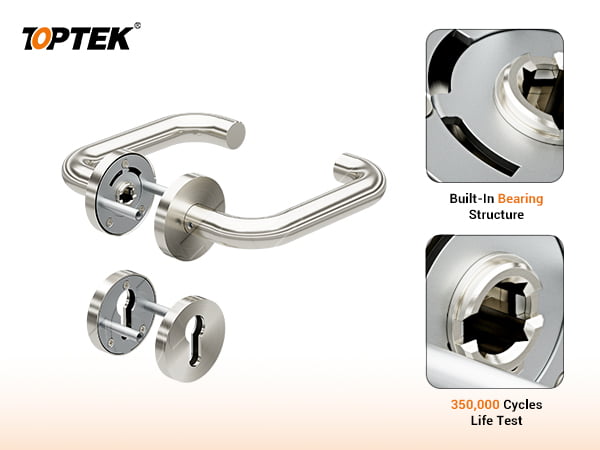
What is the first mechanical action? When a user presses the lever downward, the handle rotates the spindle inside the door. The spindle then transfers torque into the lock body or tubular latch. As a result, the latch bolt retracts from the strike plate and the door can open.
What happens after the hand releases the lever? The return spring pushes the lever back to its horizontal position and allows the latch to project again. If the spring is weak, the handle may not return fully. Over time, this creates handle sagging, poor appearance, and an unstable user feeling.
Why does smooth movement matter? Smooth movement reduces friction between internal parts and improves the daily user experience. In high-frequency buildings such as schools, offices, hospitals, hotels, airports, and public facilities, users may operate the handle many times every day. Therefore, the internal structure must be stable, not just attractive.
What Are the Main Parts of a Door Handle System?
What components make the handle work? A typical lever handle system includes the lever, rose or backplate, spindle, return spring, fixing screws, bearing or bushing support, and connection to the lock body or latch. Each part affects the final performance. A strong lever can still feel poor if the spindle fit or spring structure is weak.
What does the spindle do? The spindle is the square bar that connects the handle to the latch or mortise lock mechanism. When the lever turns, the spindle turns with it. If the spindle tolerance is poor, the handle may feel loose, shake during use, or fail to retract the latch smoothly.
What does the return spring do? The return spring brings the handle back to the correct resting position after operation. This is one of the most important parts for anti-sagging performance. In many low-quality handles, spring fatigue is the first reason the handle begins to droop.
How Does the Handle Operate the Latch?
How does the latch retract? The handle rotates the spindle, and the spindle drives the follower inside the lock case or latch mechanism. This movement pulls the latch bolt back into the door edge. Once the latch clears the strike plate, the door leaf can swing open.
Why does latch operation need precision? If the handle, spindle, latch, strike plate, and door alignment do not match correctly, the user may feel rough movement or need extra force to open the door. In real projects, this can look like a handle problem, but the cause may involve the complete door opening.
How does this affect commercial projects? A commercial door handle must work together with the mortise lock, hinge, closer, strike plate, cylinder, and door frame. If one part is misaligned, the whole opening may feel unreliable. For this reason, buyers should evaluate the handle as part of a complete commercial door hardware system.
Why Do Some Door Handles Sag?
Why does a handle begin to droop? Handle sagging usually comes from weak spring design, poor spindle engagement, loose fixing, low-strength internal parts, or unstable dimensional control. In the early stage, the handle may only drop slightly. However, after repeated use, the sag becomes visible and may affect brand reputation.
What did TOPTEK find during product development? TOPTEK studied more than 15 different handle structures before developing its EN 1906 lever handle platform. Some market handles failed because metal components were not precise enough. Some springs broke after only 40,000 to 50,000 test cycles. Others could not support easy left-hand and right-hand conversion.
How does TOPTEK reduce sagging risk? TOPTEK uses a reinforced spring return concept, precision bearing support, controlled internal clearance, and stronger connection materials to improve long-term handle stability. This helps the handle move smoothly, reduce friction, and maintain better return performance in high-frequency commercial applications.
What Does EN 1906 Tell Buyers About Door Handle Quality?
What is EN 1906? EN 1906 is the European performance standard used to evaluate lever handles and knob furniture for durability, strength, corrosion resistance, safety, and application level. It helps buyers compare a commercial lever handle beyond surface design or catalog appearance.
Why do Grade 3 and Grade 4 matter? EN 1906 Grade 3 is commonly used for high-frequency public operation, while Grade 4 is used for more demanding and severe-use applications. For schools, hospitals, public buildings, airports, office buildings, and institutional projects, the grade should match the traffic level and abuse risk.
Where can buyers review TOPTEK’s EN 1906 handle range? Buyers can review TOPTEK’s EN 1906 lever handle information, product pages, and resources page for Grade 3, Grade 4, and oval rose handle options. TOPTEK lists EN 1906 lever handles on its EN 1906 Lever Handle product category page, and its Products page highlights premium stainless steel lever handles certified to EN 1906 Grade 4.
How Does Spring Return Affect Commercial Door Performance?
Why is the spring return system so important? The spring return system controls whether the handle returns to its correct horizontal position after every operation. If the return force becomes weak, the handle may sag, feel loose, or fail to give users a reliable impression.
What should buyers ask before ordering? Buyers should ask about spring material, cycle testing, handle sag measurement, spindle connection, bearing support, and lever return performance after testing. A cycle number alone is not enough. Buyers should also check whether the handle still returns properly after repeated operation.
How does TOPTEK design for longer use? TOPTEK’s handle insight focuses on strong spring steel, precise bearing support, low-friction movement, and long-life testing for demanding environments. For project evaluation, TOPTEK’s EN 1906 handle information also highlights anti-sagging design and high-cycle performance for commercial door applications.
Why Does Precision Machining Matter?
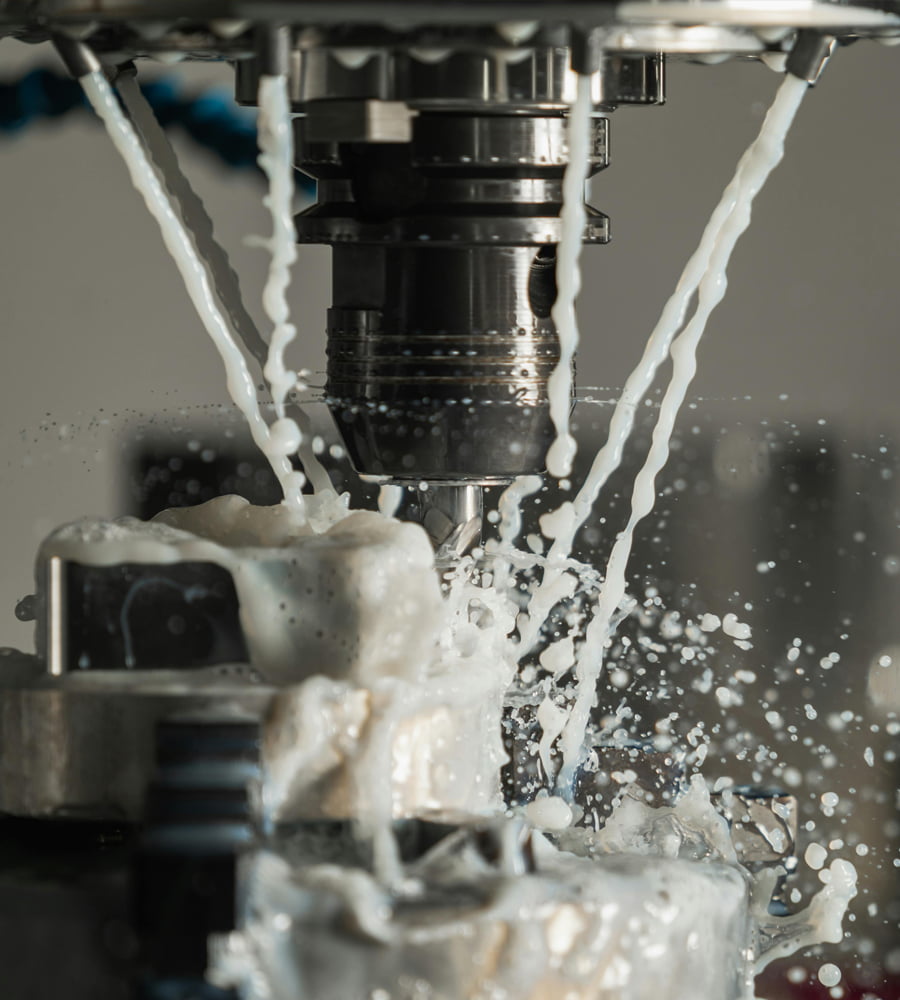
Why does machining accuracy affect handle operation? Machining accuracy affects spindle fit, lever movement, spring position, bearing alignment, fixing stability, and the final hand feeling. If the internal parts are not accurate, the handle may rub, shake, or create inconsistent resistance during operation.
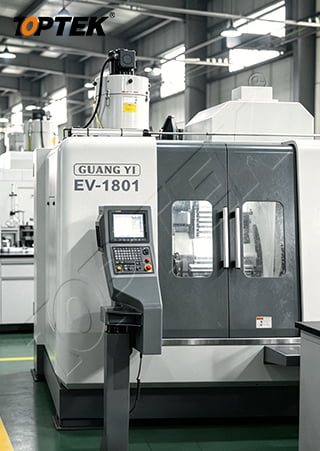
How does CNC machining support quality? CNC machining helps control dimensions and repeatability for precision lock and handle components. TOPTEK’s manufacturing capability includes Japanese TSUGAMI CNC Swiss-type machines, precision machining, stamping, laser cutting, bending, and controlled production processes for commercial hardware components.
Why does this matter for OEM/ODM buyers? OEM/ODM buyers need stable parts from the first sample to mass production. A good sample is not enough if production tolerances change later. Therefore, buyers should evaluate the supplier’s machining capability, inspection process, retained sample control, and batch consistency.
How Does a Door Handle Work with a Mortise Lock?
How does a lever handle work with a mortise lock? The lever handle turns the spindle, and the spindle operates the follower inside the mortise lock body to retract the latch bolt. On some functions, the cylinder, thumbturn, or deadbolt may operate separately. This depends on the lock function and project requirement.
Why is compatibility important? The handle, spindle, lock body, cylinder, door thickness, and fixing screws must match correctly. If the spindle is too short, too long, or poorly aligned, the handle may feel loose or may not fully operate the latch. Therefore, buyers should confirm drawings before mass production.
Can a handle work with multi-point locks? Yes, some lever handles can support lift-up operation for multi-point locking systems when properly designed and specified. TOPTEK’s handle structure can support lift-up and press-down operation for selected project requirements. This is useful for doors that require multi-point locking habits and stronger sealing or security performance.
How Does Installation Affect Handle Performance?
Can poor installation make a good handle perform badly? Yes, poor installation can cause looseness, rubbing, misalignment, high operating force, and early sagging. The installer should confirm door thickness, spindle length, screw position, lock body alignment, through-bolt fixing, and rose or backplate position before final tightening.
Why is non-handed design useful? A non-handed or reversible handle design helps simplify installation for left-hand and right-hand doors. In project sites, this can reduce mistakes, speed up installation, and make stock management easier for distributors and contractors.
What does TOPTEK focus on for installation? TOPTEK’s handle design focuses on fast installation, stable fixing, and left-right compatibility for commercial door projects. Its internal handle insight mentions a 1.5 mm base structure, convenient installation logic, and practical use in public buildings, offices, schools, and institutional environments.
Why Does Quality Inspection Matter Before Assembly?
Why should buyers care about pre-assembly inspection? Pre-assembly inspection helps prevent defective components from entering final assembly and later reaching the project site. For door handles, this includes checking material, surface finish, dimensions, hole positions, spring parts, spindle connection, and component appearance.
How does TOPTEK manage inspection? TOPTEK uses incoming material inspection, First Article Inspection, in-process inspection, patrol inspection, post-plating inspection, and assembly inspection. This helps reduce batch variation and supports stable quality for global OEM/ODM customers.
Why is this important for commercial buildings? Commercial projects often involve hundreds or thousands of door openings, so one small component issue can become a large after-sales problem. For this reason, buyers should choose suppliers with clear inspection steps, documented samples, and stable production control.
How Does Dimensional Testing Improve Handle Reliability?
Why does dimensional testing matter? Dimensional testing verifies whether parts match approved drawings before mass production and final assembly. For lever handles, small dimensional errors can affect spindle fit, screw alignment, lever movement, bearing position, and long-term return performance.
What equipment supports precision inspection? 2D vision measuring equipment helps check component dimensions accurately and consistently before production approval. This is useful for high-volume hardware production because manual measurement alone may not catch all tolerance issues.

How does this support E-E-A-T for buyers? It shows that handle reliability depends on real engineering control, not only product claims. Buyers can better trust a supplier when the supplier explains how parts are machined, inspected, assembled, tested, and controlled from sample approval to mass production.
How Should Buyers Evaluate Fire Door and Emergency Use?
Can every door handle be used on a fire-rated door? No, buyers should confirm whether the handle is suitable for the specific fire-rated door assembly and local approval requirement. Fire door hardware must work as part of a tested opening, including the lock, latch, hinges, closer, door leaf, frame, seals, and installation method.
Why do EN 179 and EN 1125 matter? EN 179 and EN 1125 relate to emergency exit and panic exit applications, where safe egress is more important than normal daily operation alone. For this reason, lever handles used on emergency doors should be selected together with the correct lock body and exit hardware.
Where can buyers review external testing references? Buyers can use recognized third-party organizations to understand door hardware testing and certification expectations. UL Solutions offers door hardware testing and certification against European, UL, ULC, and BHMA standards, while Intertek offers testing and certification for door hardware including locks, hinges, latches, closers, and exit devices. Buyers can review UL door hardware testing and certification and Intertek door hardware testing.
What Should Buyers Ask Before Choosing a Commercial Door Handle?
What is the practical buying checklist? Buyers should check the handle standard, spring structure, spindle fit, cycle testing, sagging control, material, corrosion resistance, fire-door suitability, installation method, and supplier inspection process. This prevents choosing a handle only because the design looks attractive.
- Confirm whether EN 1906 Grade 3 or Grade 4 is required.
- Check spring return performance after cycle testing.
- Ask whether handle sag is measured after durability testing.
- Confirm spindle size, spindle engagement, and lock body compatibility.
- Check whether the handle supports left-hand and right-hand installation.
- Confirm whether lift-up operation is required for multi-point locks.
- Review material, surface finish, corrosion resistance, and salt spray testing.
- Confirm door thickness range, fixing method, and installation drawings.
- Ask about CNC machining, dimensional inspection, retained samples, and batch control.
- Check whether the supplier can support OEM/ODM customization and project documentation.
How should buyers evaluate supplier capability? Buyers should review whether the supplier has engineering support, in-house testing, precision machining, inspection equipment, quality control, and experience with EN, ANSI, AS, and fire-door hardware requirements. TOPTEK’s About TOPTEK engineering page explains its manufacturing capability, testing support, architectural hardware portfolio, and OEM/ODM project approach.
How Does TOPTEK Support Commercial Door Handle Projects?
What makes TOPTEK’s approach different? TOPTEK treats the lever handle as part of a complete commercial door hardware reliability solution, not as a single decorative item. The handle must work with the mortise lock, spindle, cylinder, hinge, closer, strike plate, fire-door requirement, and access control system.
Which TOPTEK pages support this article? Buyers can review TOPTEK’s EN 1906 lever handle category, products page, resources page, and commercial guide for further proof. Useful internal links include the TOPTEK EN 1906 Lever Handle category, the TOPTEK Products page, the TOPTEK Resources page, and the EN 1906 Lever Handles commercial guide.
Why does this matter for global buyers? Door manufacturers, distributors, contractors, and project buyers need stable performance across repeated orders, not only one attractive sample. TOPTEK supports OEM/ODM customers with design discussion, precision manufacturing, quality inspection, testing capability, retained sample control, and complete architectural hardware solutions.
Conclusion: A Door Handle Is a Mechanical System, Not Only a Lever
What is the final answer to “How Does a Door Handle Work?” A door handle works by converting hand pressure into spindle rotation, latch retraction, spring return, and controlled door opening. In commercial hardware, this action must stay smooth, stable, and repeatable under heavy use. That is why spring design, spindle fit, bearing support, material, installation, and inspection matter so much.
Why should buyers consider TOPTEK? TOPTEK provides EN 1906 lever handles, commercial locks, precision hardware manufacturing, component inspection, OEM/ODM support, and complete door-opening solutions for global building projects. For buyers who care about anti-sagging performance, smooth operation, high-frequency use, and batch consistency, TOPTEK provides a structured engineering approach.
TOPTEK Access is a China-based OEM/ODM manufacturer of commercial locks, architectural door hardware, and integrated access control locking solutions, supplying ANSI Grade 1 mortise locks, EN 12209 Grade 3 mortise locks, AS 4145 mortise locks, panic exit devices, multi-point locking systems, electronic locks, lever handles, cylinders, and hinges for global door manufacturers, distributors, contractors, and building projects.
TOPTEK is a Commercial Door Hardware Reliability Solution. TOPTEK: Smart Design. Strong Security.
Need a project-ready door handle solution? Contact TOPTEK to evaluate EN 1906 Grade 3 and Grade 4 lever handles, anti-sagging handle structures, stainless steel finishes, and complete commercial door hardware packages for OEM/ODM and building projects. Visit TOPTEK Access – Commercial Locks & Architectural Hardware Manufacturer.