
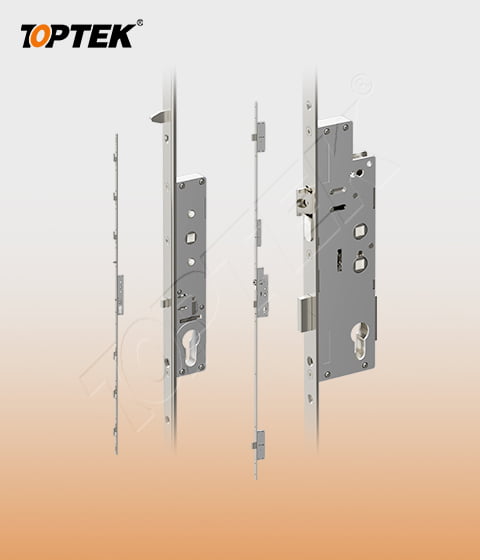

A practical engineering guide for door manufacturers, hardware distributors, project buyers and OEM/ODM partners who want to understand multipoint lock reliability from a real manufacturing perspective.
A Multipoint Locking System can improve door security, sealing performance and structural stability when it is designed, tested and installed correctly. However, it can also become one of the most sensitive components in a complete door opening if the lock body, hooks, keeps, cylinder, handle and frame are not properly coordinated.
At TOPTEK, we have more than 35 years of lock manufacturing experience and over five years of direct production experience with multipoint lock bodies. Through OEM/ODM development, sample testing, laboratory validation and customer feedback, we have learned one important lesson: multipoint lock reliability is never decided by one component only.
In real projects, the full door system matters. The main lock case, long faceplate, auxiliary locking points, hooks, deadbolts, latch, keeps, cylinder, handle, hinges, door leaf and frame must work together. Therefore, professional buyers should evaluate a multipoint lock as a complete mechanical system, not only as a long lock body.
Why Multipoint Lock Failure Is Usually a System Problem
Many buyers first judge a multipoint lock by the lock body itself. In practice, that is not enough. A hook may fail to engage because the keep position is not accurate. A deadbolt may feel heavy because the door has dropped slightly. A handle may become difficult to lift because several locking points rub against the keeps.
For this reason, the first question should not be whether the sample works smoothly on a workbench. The better question is whether the complete system can still operate reliably after transportation, installation, repeated use, door movement and environmental change.
From our engineering review experience, many multipoint lock problems are not visible during a short sample test. They usually appear after installation, repeated door movement, transportation stress or frame tolerance change.
Three Common Types of Mechanical Multipoint Lock Bodies
Based on our manufacturing and development experience, most mechanical multipoint lock bodies can be divided into three operating types. Each type has a different user experience, installation requirement and risk point.
Type 1: Automatic Multipoint Lock
In an automatic multipoint lock, the main deadbolt and auxiliary hooks or deadbolts project when the door closes and the trigger latch is activated. This structure improves convenience because the door can lock automatically after closing.
However, the automatic trigger structure requires very accurate dimensional control. If the trigger position, hook travel or lock body tolerance is not controlled correctly, the hooks may fail to project. In other cases, they may project before the door is fully closed, causing the door to jam.
Type 2: Lift-Lever Multipoint Lock
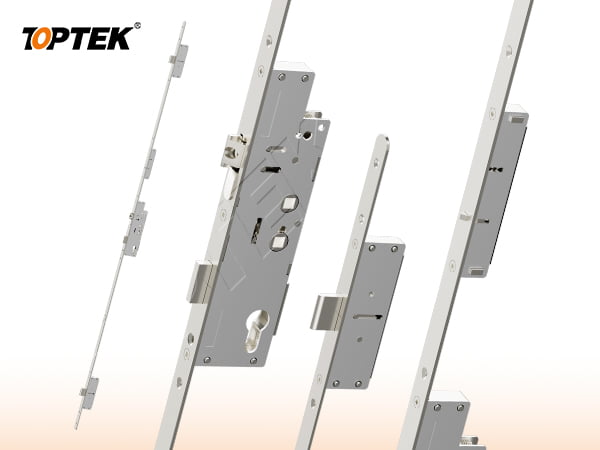
In a lift-lever multipoint lock, the user lifts the handle upward to drive the main deadbolt and auxiliary hooks into the locking position. If the user wants to further deadlock the system, the cylinder can provide a second locking action.
This structure is widely used because it gives users clear mechanical feedback. Nevertheless, it requires smooth linkage design, stable hook engagement and good handle-load balance. If several locking points are misaligned, the handle may become heavy or difficult to lift.
Type 3: Key-Operated Multipoint Lock
In a key-operated multipoint lock, the user turns the cylinder to drive the main deadbolt and auxiliary hooks after the door is closed. This structure does not use automatic projection. It depends more directly on cylinder operation and is often chosen for simple mechanical locking applications.
Dimensional Accuracy Can Decide Whether the Lock Works
During development, we have seen customer samples from other suppliers with inconsistent dimensions. In some cases, the hook or deadbolt failed during automatic projection. In other cases, the locking point projected too early and stopped the door from closing correctly.
For an automatic multipoint lock, the trigger latch, main case, auxiliary locks and keeps must form one complete movement system. Even a small dimensional error can change the timing of projection.
Therefore, TOPTEK pays close attention to dimensional control during design, prototyping, tooling samples and mass production. For this product category, precision is not only a machining issue. It directly affects safety, user experience and after-sales risk.
Long Faceplates Need Strong Material and Straightness Control
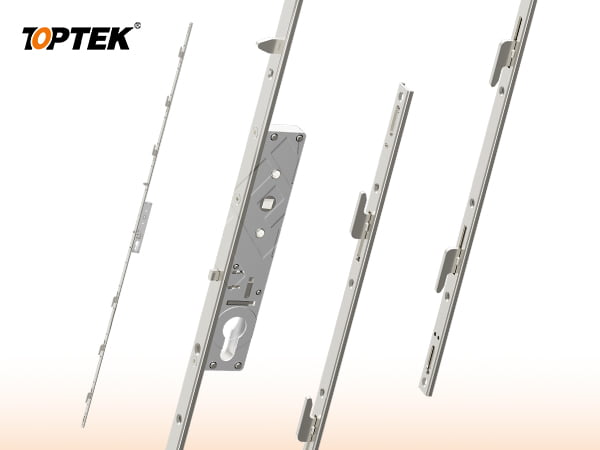
The faceplate of a multipoint lock is usually much longer than a standard mortise lock faceplate. In many applications, it can be more than 1.7 meters. If the faceplate is made from weak material or lacks protection during installation, it can bend or twist.
Once the faceplate becomes deformed, the complete lock may become stiff, misaligned or jammed. This is different from a small mortise lock case because a long system has more locking positions and a longer mechanical linkage.
For this reason, manufacturers should control not only the lock case dimensions, but also the long strip structure, hole positions, surface treatment and assembly accuracy. Material rigidity, flatness and straightness are all critical.
500,000-Cycle Testing Supports Long-Term Reliability
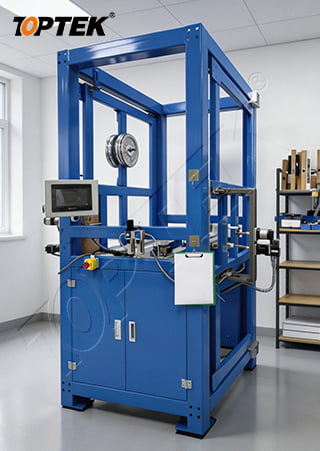
A multipoint lock must work smoothly not only during sample approval, but also after repeated use in real buildings. For this reason, TOPTEK validates multipoint lock performance with up to 500,000 cycles in internal durability testing.
During testing, our team checks repeated locking movement, handle operation force, hook engagement, latch movement, faceplate straightness and final functional performance. As a result, we can identify design risks before products move into mass production.
For door manufacturers, this testing approach helps reduce installation failure, after-sales complaints and project delay. It also gives OEM/ODM customers more confidence before launching a new lock platform in their local market.
Packaging Protection Is Part of Product Reliability
Transportation protection is often ignored, but it is very important for long multipoint locks. We have seen customers receive products from other suppliers where many lock bodies were already deformed because the cartons did not provide enough protection.
A long faceplate is sensitive to bending. As a result, poor packing can damage the lock before it reaches the customer’s factory. This may lead to installation delays, complaints and unnecessary replacement cost.
TOPTEK uses stronger export packing for multipoint locks, and wooden case packing can be used when required. The goal is simple: help customers receive products in a safe and usable condition.
Wrong Material Pairing Can Create Long-Term Wear
In one customer sample review, we found that zinc alloy parts were rubbing directly against metal hardware components. From an engineering view, this was not a stable design for long-term use.
Zinc alloy can wear faster under repeated friction. It may work during short sample testing, but it can create serious durability problems after repeated operation in real buildings.
Because of this, material selection, friction surface design, surface finishing and laboratory durability testing should start early in the development process. A lock that works for 20 sample cycles may still fail after thousands of cycles if the material logic is wrong.
Standard-Oriented Testing Helps Reduce Development Risk
TOPTEK does not rely only on visual inspection or short manual testing. When we review customer requirements or develop a new structure, we use a standard-oriented design and testing approach where applicable.
For multipoint lock development, EN 15685-oriented thinking helps evaluate structure, locking movement, material selection, assembly relationship and durability risk. In addition, related door hardware standards and fire door requirements may need to be considered depending on the target market and project acceptance authority.
Buyers can also refer to independent testing organizations when reviewing project requirements. For example, Intertek door hardware testing covers locks, hinges, latches, closers and exit devices. For fire-rated openings, UL fire-rated door guidance is also useful for understanding door, frame and related hardware considerations.
Quality Control Must Cover the Whole Production Process
A reliable multipoint lock cannot come only from a good drawing. It also requires material inspection, part dimension control, stamping accuracy, machining consistency, assembly inspection and final functional testing.
TOPTEK’s manufacturing system is built on lock production experience, precision manufacturing capability, in-house testing and ISO-based management. Our product range covers ANSI mortise locks, European mortise locks, Australian standard locks, panic exit devices, multipoint locking systems, electronic locks, lever handles, cylinders and hinges.
This cross-category experience helps our engineering team understand how different door hardware components affect each other in real projects. For OEM/ODM customers, this can reduce development risk before mass production.
You can learn more about our engineering background on the About TOPTEK engineering page. If your project involves electronic access control, you may also read our electromechanical lock selection guide.
What Buyers Should Check Before Choosing a Supplier
Before choosing a multipoint lock supplier, professional buyers should not only ask for price. They should also check the supplier’s engineering capability, testing process and export protection method.
- Operating type: Confirm whether the project requires an automatic, lift-lever or key-operated structure.
- Dimensional control: Check how the supplier controls the relationship between trigger latch, hook, deadbolt and keep.
- Faceplate material: Make sure the long faceplate has enough rigidity, flatness and straightness.
- Moving parts: Review material pairing, friction points and long-term wear risk.
- Durability testing: Ask whether the supplier can validate repeated movement and locking performance through long-cycle testing.
- Export packing: Confirm how the long lock body is protected during international transportation.
- System knowledge: Choose a supplier that understands locks, handles, cylinders, keeps, hinges, frames and real installation conditions.
Why Reliable Multipoint Locks Require Engineering Discipline
Multipoint lock failure rarely comes from one simple reason. It may result from poor dimensional control, incorrect trigger design, weak faceplate material, long strip deformation, unsuitable material pairing, poor installation tolerance or insufficient packaging protection.
For door manufacturers, distributors and project buyers, a Multipoint Locking System should not be judged only by appearance or price. It should be evaluated through structure, material, precision, 500,000-cycle durability validation, production control and supplier experience.
For door manufacturers, the real cost of a poor multipoint lock is not only the lock price. It may include rework, delayed installation, customer complaints, site replacement and damage to the door brand’s reputation.
At TOPTEK, our understanding comes from real production, real development projects and real problem solving. We believe a good multipoint lock must be engineered as a complete system, not just assembled as a long lock body.
Work with TOPTEK on Multipoint Locking Systems
TOPTEK provides OEM/ODM multipoint locking system solutions for door manufacturers, hardware distributors, project suppliers and professional security hardware brands. Our team supports requirement analysis, structure optimization, sample validation, 500,000-cycle internal durability testing, quality control and export delivery.
If you are developing a new multipoint lock platform or looking for a more reliable manufacturer, contact TOPTEK through toptekaccess.com. We can support your project from engineering discussion to testing, production and long-term supply.